
Petor Georgallou appears to be wearing two pairs of glasses. Layered on top of one another and affixed with bright yellow adhesive tape, his explanation for this idiosyncratic balance of form and function is interrupted when he leaps up to open a window after his dog passes wind.
Perhaps a little eccentric, certainly charismatic, and an entertaining raconteur; we’d first bumped into each other at the inaugural GiRodeo hosted by The Service Course in Girona. Petor had just wrapped up another Bespoked*—the handmade bicycle show he co-owns with friend Josh Bullock—before driving down overnight from London in a slightly rough-round-the-edges Mercedes S-Class.
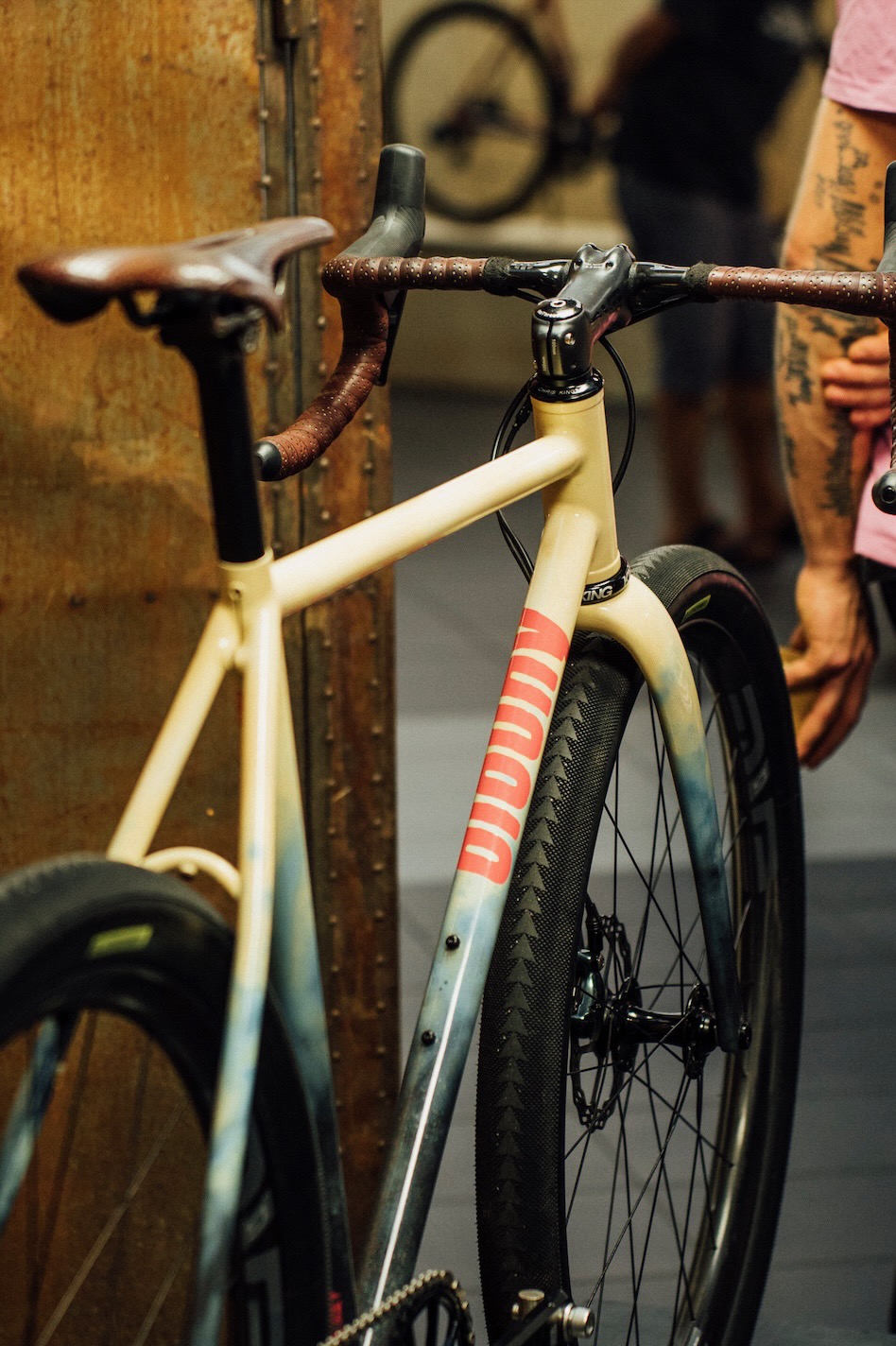
*The 2023 Bespoked held at Dresden International Airport pictured throughout.
“I can’t overstate the toll the show takes on your body. Especially the year we did it at Lee Valley Velodrome in East London which is a curious example of architecture in that I question whether it’s fit for purpose. The track functions adequately—you can ride around it—but whoever designed the rest of the building shouldn’t be allowed near a pen. And then I immediately jumped into a 90s luxury car—at one point probably worth more than my house—and headed south.”


Click image to enlarge
Attending the long weekend of gravel related events wearing his Radavist hat—Petor is a regular and well-respected contributor—he not only photographed the bikes being shown by a veritable Who’s Who of European fabricators, but joined the Sunday Social ride astride an Argonaut GR3 the US-based bike company had brought over for Petor to do a long-term review.
“Maybe the best riding bike that I’ve ever experienced. Which is funny as I was quite set against reviewing it because I just didn’t think it would be my cup of tea. But it was the exact opposite actually and a very pleasant surprise.”
Numbering the bikes he’s previously owned at any one time in the hundreds, Petor now has this whittled down to a more manageable twenty: split between the living space and loft in his house, the warehouse where all the show staging for Bespoked is stored, and his parents’ garage. Both political refugees from Cyprus, they changed his name to Petor when he started school to make it easier for the teachers to pronounce.
“University—which I loved—followed school. I enrolled on an art foundation at Kingston and then stayed on for a fine art degree. And looking back, I can’t imagine a better learning environment. Amazing tutors and a lot of actual tutoring time.”

Click image to enlarge
Graduating in 2008 during a financial crisis, jobs in the art world were far and few between so Petor spent a year working at an auction house photographing items for the sales catalogues.
“Strangely very, very boring yet also very, very intense. I had to unpack three hundred or more really fragile items, set up a makeshift studio, photograph them and then repack them in numbered order. And all this in two days. By myself. And then on auction day, I was the guy who holds-stuff-up-at-the-front. Maybe I managed the first three or four items with a certain panache but after that, you just want it to end.”
Fired after dropping a commemorative Guinness toucan,* a spell at the London Bike Kitchen supporting people working on their own bikes proved a test of Petor’s temperament.
*To England-based readers of a certain age, this will make complete sense.
“It’s funny because my current job is quite socially orientated but I’m not really a people person. And the difference, I suppose, is that with Bespoked I can be super selective with whom I interact. Whereas at the Bike Kitchen, there was this expectation that you get along with whoever walks in off the street, irrespective of how much their personality clashes with your own. Not in any way a slight on the Bike Kitchen, but it can take a lot of trial and error to work out what you’re good at and what you’re not so good at. In my case, forty years to figure out where I am in the world.”


Click image to enlarge
This process of figuring out also applied to his relationship to riding; Petor describing how he didn’t feel terribly happy after leaving school and his response was to spend more time out on his bike.
“I suppose the bike acted as a substitute for what I felt was missing. And then when I started my MA at the Royal College of Art, I was still living with my parents in Surrey and couldn’t afford the train into London each day. So I would ride from Kingston to Battersea to do a full day of study, and then onto Hackney Wick to start work before riding back home again. Pretty much 50 miles a day, give or take.”
Despite studying at such a prestigious institution, it was the frame building course he attended at the now defunct Bicycle Academy that changed everything; Petor finding a vacant workshop in West London and setting up in business under the moniker Dear Susan.
“The cycling industry at that time seemed either very macho or rather too earnest. And not wanting to take myself too seriously, I wanted a name that was a little bit naff and didn’t have anything to do with anything. So I sat down and thought up a bunch of names and Dear Susan was bottom of the list. So I went with that.”


Click image to enlarge
Perhaps not a time-honoured approach to frame fabrication but one that applied equally to Petor’s choice of workshop vehicle.
“I bought a Volvo 740 hearse from an undertaker. The best car I’ve ever owned and my car spirit animal. He was quite an eccentric character with a full-size Wurlitzer church organ in his living room which had the volume on a limiter otherwise it would shatter the window glass. He made me sit down and listen to a rendition of I do like to be beside the seaside which was still so loud I had my fingers in my ears and everything in the house was shaking. And then when we were doing the deal, he made me promise to never fill the vehicle up with fuel at a petrol station because it was disrespectful. Apparently you have to go to the petrol station with a large container and fill that up instead. But when I picked up the hearse from Bristol it had less than a quarter of a tank to get me back to London. And it’s disrespectful to who? And how? But once I’d got beyond the etiquette of filling-up, I discovered it could carry five people and seven bikes. You could even camp in it. After all, it’s made for lying down in.”
Initially seeing his framebuilding as a further iteration of his fine art practice, Petor now understands that instead of tricking people into buying a piece of art—when all they wanted was a bicycle—he was the one that got tricked.
“It was rare that a bike I showed was a customer project. They tended to be just bikes. But Dear Susan was visible in frame building because the stuff I built was quite show-worthy. I never spent hours filing my welds to make them perfect—that just didn’t matter to me and I was never that good a builder—but it was a creative outlet that I enjoyed.”

Click image to enlarge
“I suppose I’ve always felt there’s an element of gatekeeping in the term frame builder. That you need to be steeped in bicycling lore and be a chain-smoking, old man living up a French mountain who rode in the team car at the Tour back in the 70s. Putting that aside, what I do find exciting is the sheer variety of super talented fabricators, building what they like and what you can’t find elsewhere.”
Although exhibiting his Dear Susan builds at the handmade bike show Bespoked, Petor never harboured dreams of one day taking over the reins. But when founders Phil and Tess Taylor announced they were calling it a day, he nevertheless decided to step in and buy the business.
“Phil and Tess did a great job in creating a scene where there previously wasn’t one. But it functioned a little like a car boot sale. You paid your money to get a stand and that was it. They worked on it two days a week throughout the year—which, when I bought the show, I doubted was really necessary—but now I work five days a week and the team continues to grow.”
“What that actually means, is I spend all my time sitting in front of a computer screen, corresponding by email. Constantly. It’s relentless. But you need to work with press and media outlets to publicise the shows, organise the venue in terms of the space our exhibitors need, and then chase each of them an average of 38 times to settle their account.”


Click image to enlarge
Setting out to research what makes a show run well—and understanding how the landscape has changed since Bespoked first launched back in 2011—Petor picked up on comments from builders after they attended another show where the organisers provided all the staging which meant there wasn’t a requirement to set up or pack down. In response, Bespoked designed and fabricated its own staging which now sits in a warehouse ready for whenever it’s needed.
“Instigating change can be really good or really bad. And taking Bespoked to Dresden was amazing. I remember at a previous venue we had this guy following us around, telling us what we could and couldn’t do. But Dresden was the total opposite. The community out there is wonderfully strong and diverse and really came together in helping us out. And to cap it all off, all the volunteers appeared to be young, good-looking, tall, well-dressed, ultra-distance athletes with PhDs, and a licence to operate a forklift. What more do you want?”
“I’ve run shows where I’ve felt lucky to get away without suffering an aneurysm. The levels of stress can be so extreme. At Dresden, I could walk around and chat to people because everything ran so efficiently. Still a lot of work and totally exhausting but I had a fabulous time and the response from the media was unprecedented. We even made it onto national TV in Germany.”
With the post-pandemic price of high-end carbon race bikes soaring past £10,000, I ask Petor whether he feels this translates to more people choosing to go down the custom build route with a lightweight steel frame in their geometry and a unique paint scheme?


Click image to enlarge
“Carbon is one of the highest performing materials if you’re a professional athlete. Which almost no one is. And the way bike sales rocketed during the pandemic, you can always charge more for a product but can you charge less? Will people think it’s somehow a poorer product? Maybe it’s because we shop differently than we previously did? People used to visit a local bike shop, look at some bikes, maybe even take one out for a test ride. But now? People speed shop on a statistical basis or whether the frame has a little lunch box built into the down tube.”
“Whereas in reality—or should I say my reality—riding a bike is so separate from those numbers-on-paper considerations because the real joy comes from the intangible. Which basically equates to how it makes you feel. And maybe part of the problem is that people, over time, have become distanced from the origin of things. Increasingly, objects are taken for granted with little understanding of what goes into their manufacture. So people don’t understand that when they’re commissioning something, they’re also embarking on a relationship with the person who’s trying to decode their individual notion of what they want. And if you’re not familiar with that language—because we buy items over the internet where the decisions have already been made for us—then it can be a little daunting.”
A questioning nature but one, Petor suggests, that’s mellowed as he’s gotten older.
“Whatever I used to find irritating doesn’t always grate as immediately. But that’s not to say it doesn’t annoy me how cycling can be a pretty intolerant place. Something we’re trying really hard to address with Bespoked. To create a space where everyone can just be the weirdest version of themselves without feeling they have to toe the line. Even something as simple as taking a fresh approach to our show awards which traditionally were always decided by the same group of people. Which, in turn, led to a house style and anything that didn’t reflect that style never got a look in. So what we’re building towards is a richer and more interesting culture. Not one where everyone rides a gravel bike in a muted matte green or tan. One of which—full disclosure—I own and ride near to where I live using my own system of gravel grading.”

Click image to enlarge
Petor’s system starts with sand and then grav, grav, grav—a slightly bigger particulate—through grav, grav and then grav—which equates to stones—before finishing on single track, chunk, and finally Red Bull Rampage.
“Which is basically just falling off things.”
Not that Petor gets as much time to ride as one might imagine for someone working in the cycling industry. Notwithstanding Bespoked, there’s his role with The Radavist, he’s a talented photographer, and father to a young child. So between balancing these burgeoning commitments, I close our conversation by asking what he enjoys doing when he does have some spare time?
“Mostly hanging out with my wife and child. I enjoy hiding behind objects and then jumping out again. And doing long bike rides by myself, listening to really hard techno. And then there’s the normal stuff like my wife making me pancakes the other day. We didn’t get to eat together—being parents—but I did get to enjoy this stack of American-style, fat pancakes with blueberries and maple syrup. Which, in turn, translated to a moment of lucidity in a world where we are constantly assaulted by grandeur. And there’s a lot to be said for those small moments when you can give simple things enough time and space to sink in.”
Bespoked 2024: Manchester June 28 – 30 / Dresden October 18 – 20
2023 Dresden photography with kind permission of Petor Georgallou.
 cyclespeak