Angus Morton / Work in progress

Back in 2019 I sat down to chat with Angus ‘Gus’ Morton on a warm, sunny day in Girona. Maybe it was the forced period of inactivity – his US visa had temporarily been revoked – but an interview ostensibly focusing on his hugely influential Thereabouts and Outskirts films somehow drifted into a lengthy conversation that explored the bike as a tool for journeying, new directions in professional cycling and living a life of simple pleasures.

Fast forward a few years and Gus continues to make inspirational films that offer a unique vision for sport. But his own journey has seen him confront a decade long battle with addiction and a desire to step away from playing the leading man.

Catching up with Gus over a transatlantic call, talk of life in LA and city riding habits grounds our conversation in the new life he is piecing together: Gus offering a searingly honest account of his decision to quit drinking and how his search for sobriety is opening up a whole new perspective on health and happiness. 

Gus
G’day mate. Sorry for the slight delay but I was just dropping my dog off.

cyclespeak
How’s that going?

Gus
Yeah, it’s good. I’ve got this big Dobermann and it’s pretty full on. He’s bloody huge and needs a good amount of exercise. So he goes out to a friend’s ranch when I’m away on work trips.

cyclespeak
You’re living in LA?

Gus
I’m in Echo Park. Sort of north and east from Downtown.

cyclespeak
I guess everyone drives everywhere?

Gus
I mostly ride my motorcycle to get around. But with having the dog and shooting so much in the backcountry, I’ve also got a truck.

cyclespeak
Which I’m guessing is stereotypically big?

Gus
It’s fucking enormous. But only considered a small truck here. If you saw it you’d think I was taking the piss because it’s lifted and has these giant tyres. Totally over the top. 

cyclespeak
Is LA a workplace choice or somewhere you just feel at home?

Gus
That’s a good question. I’ve actually lived in LA before but this time around it was initially a work choice. A lot of the film production companies are based out here but right now it does feel increasingly like home.

cyclespeak
I was wondering what professional hat you’re wearing at the moment? Writer, director, producer?

Gus
I guess I’m a director from a skill set point of view. But working primarily in documentary filmmaking means that often I’m also producing, filming and doing the edit. And I’m quite particular so I do have this tendency to get involved in every aspect [laughs].

cyclespeak
Does that mean there’s no such thing as a typical day?

Gus
I do like to be very structured and organised. So I don’t necessarily have a typical work day but I’m usually up and working by 7:30 am in the morning.

cyclespeak
I’ve mentioned before that your Outskirts films had a profound influence on the way I now ride. Do you ever revisit them?

Gus
That all seems like a lifetime ago [smiles]. And I don’t know that I’ve watched any of them since they were first released.

cyclespeak
Always looking to the next project?

Gus
I guess I’m not particularly sentimental about my work. But I do often think about the experience I had in making those films because it was so life changing. So I have fond memories of the people and the places and that mode of travel. And having since done more extreme adventures, those times on the road filming Outskirts are still the pinnacle of what, for me, is enjoyment on the bike.

cyclespeak
When we chatted back in 2019, you mentioned that when you initially tried using a post-production company to edit the first Outskirts film, the shit they cut out was what you wanted to stay in. Now that you’re working in LA, are people still missing the true edit?

Gus
That’s an interesting question [laughs]. And going back to what I said before, it wasn’t that they did it wrong. It was more how they took a different point of view. And that happens all the time which is why I now like to show my work early, in an effort to bring my clients along on the journey with me.

cyclespeak
Outskirts had this wonderful cast of random characters you met on the road. And I was wondering whether you’re still striking up conversations with total strangers?

Gus
Actually not that often. And I have to admit that I don’t see myself as a very outgoing person. I tend to keep to myself, I have a small group of friends and I don’t do a lot of social stuff. Which is maybe a contrast to what you see in Outskirts but that was a huge effort for me. Which, in part, is why I stopped making them. Because the amount of nervous energy that it took to be that character was just exhausting.

cyclespeak
When we chatted previously about Dirty Kanza – Unbound as it’s now known – you totally called it on the alternative calendar and the subsequent shift in focus from cycling brands and professional teams. But now that gravel is firmly established, we seem to be seeing more arguments over tactics and equipment. In your view just teething troubles or the inevitable consequence of more sponsorship money?

Gus
It’s probably an inevitable consequence of human nature? As a group grows larger, you have more voices, more personalities and more points of view. Some people will feel protective of it – they liked it how it was – and some might have a sense of ownership. Maybe it was easier to win before it began to attract such a strong field? So if you take all of this into consideration, then it’s not unsurprising that we now have differences in opinion.

cyclespeak
Differences that can be resolved?

Gus
The test for the gravel scene is how they mitigate these points of view and for the community to still exist in some level of harmony. So maybe the idea of some sort of federation is perhaps inevitable. Personally, I hope it will be user led rather than one of the existing organisations like the UCI. Because without the athletes, none of this works. But, quite honestly, who gives a fuck what I think?

cyclespeak
Let’s bring things a little more closer to home then and talk about what your riding now looks like?

Gus
I tend to ride up to Griffith Park where you’ve got the Hollywood sign and all that shit. Maybe once or twice a week over lunch or into the evening after work. And that’s fun to me.

cyclespeak
Have you still got your Thereabouts Crust bike?

Gus
I do [laughs] but I’ve not ridden it for a while. And I should because there’s a lot of good gravel riding in LA actually.

cyclespeak
Speaking of bikes, I was watching the short I Am Here reel that switches between Iceland and Mexico. Riding a fat bike through an Icelandic winter looked the real deal?

Gus
It was. But unlike Outskirts there was nobody out there and the goal was to get to the finish rather than the journey in itself. And I find that I like this cold weather stuff because you really have to pay attention to the weather and the environment. Working with the elements rather than just bludgeoning through regardless—although it felt like that at times. Understanding when to move and when you need to stay safe and shelter. Definitely Type 2 fun [laughs].

cyclespeak
The film addresses your struggle with alcoholism. Can I ask how that journey is going for you?

Gus
It’s going well. I’ve come to realise that each person’s struggle with addiction is very unique. And there are other ways that addicts are nothing if not predictable. As for me, I’m coming up on three years since I first quit drinking. I had a couple of slip-ups in the first year so it’s now two years since I’ve been fully sober.

cyclespeak
How have things changed over that time?

Gus
In some ways I thought the most critical part would be quitting drinking and dealing with the physiological fallout of that. I’d checked into a rehab programme and that really opened my eyes to what the disease is. Something I thought about every hour of the day. But interestingly, for my type of personality, that gave me a focus. Kind of ticking off each day as a win. But I’d not be sober today if I hadn’t taken that first step and reached out for help.

cyclespeak
And when you came out of rehab?

Gus
Initially I was very anti group therapy but gradually I discovered the power in sharing experiences and talking over all the shit that’s so annoying. So AA defined my second year of sobriety and then this last year I discovered that I’m not thinking about drinking every hour of the day. This third year is really all about me growing up.

cyclespeak
In what sense?

Gus
I had a problem with drinking for 10 years. Basically my entire twenties. And there was a lot of growing up that I didn’t do and one reason was because I was so focused on being a professional athlete from such a young age. So this past year has seen a lot of emotional growth which has been pretty tough. Understanding how I behaved in the past and feeling a little like, fuck, why didn’t I see this coming sooner?

cyclespeak
I also stopped drinking about eight years ago as a way of simplifying my life. Removing a whole series of decisions that I don’t have to make anymore.

Gus
Absolutely. I fully understand that.

cyclespeak
And it takes a while but eventually that becomes a part of who you are now.

Gus
I guess I’m in that transition from when I used alcohol to mask everything. I’m no longer protecting myself from the world which can be a feature of those first steps in quitting drinking. When you’re not allowing yourself to be around a certain type of person for fear of a relapse.

cyclespeak
So what’s next?

Gus
I have ambitions for my life that need me to be more open and vulnerable. The world can be a big scary place but I need to take some risks. It can be very overwhelming when you open yourself up to that.

cyclespeak
Again, back in 2019, you stated that the only time you truly felt happy was on location shooting. Does that statement still stand? 

Gus
No, not at all [laughs]. That time in Girona I was super late for our meeting because I was hungover. And that was my vibe back then. There were lots of things I just wasn’t dealing with emotionally at that time. So being on the road was a place I could hide from all that. Where I could justify my existence by trying to share a point of view and be around people that didn’t know me.

cyclespeak
And now?

Gus
That’s been one of the big lessons learnt this year. The realisation that back then I just wasn’t happy with who I was and drinking was a way of escaping that. Going on the road was a way of escaping that. So one of the biggest things I’ve had to do is to find happiness and a love for myself. Which I absolutely understand sounds like hocus pocus bullshit [laughs].

cyclespeak
So this is an alternative to always seeking escape?

Gus
In loving yourself I’m not saying as the main character in your life or any degree of narcissism but a satisfaction and contentment with who you are and where you’re headed. So often we’re caught up in chasing something but not always able to define what that actually is. So there’s this cycle of getting the thing you thought you wanted but immediately feeling dissatisfied.

cyclespeak
I’m sure a lot of people would recognise that feeling.

Gus
I sometimes wonder what it was that I was actually chasing? Was it an Oscar, a fucking house, a pat on the back? And all of this noise meant I never really considered whether I liked myself. And for a long while the honest answer would’ve been no. But over the past 12 months I’ve grown to kind of like who I am.

[pause]

Not kind of, I do [laughs].


cyclespeak
I ended our conservation in Girona by asking what’s the best thing about being Gus Morton. Can I ask you the same question now?

Gus
What did I say back then? Because this is the first interview I’ve done since getting sober that has really referenced me when I was drinking.

cyclespeak
I’ll just read back to you what you said in 2019…

It has its moments [laughs]. But, yeah, I have a great life. I’m very privileged to do what I love and to have the freedom to do that. It’s not easy in the sense that things don’t just fall on your lap. To have the life that I lead you have to chase it hard. And with the films; you want them to be aspirational. For people to engage and feel the need to go on their own journeys. In a sense, that’s the whole idea.

Gus
Damn. That’s pretty good.

cyclespeak
It certainly is.

Gus
I wouldn’t say it’s drifted too far. I do have a great life and feel very fortunate to have found sobriety. And everything else in that statement still stands. Maybe the only thing that I would add is that the films I was making back then, I was quite honestly making at the expense of everything else in my life.

cyclespeak
Were you aware of that?

Gus
I honestly thought it was okay. But what I didn’t recognise was how the people in my direct orbit really suffered as a result of that type of behaviour. To some degree I thought that if we did the films right, then more people would benefit than be hurt by it. And to be honest, that’s really a fucked up way of approaching your relationships with people.

cyclespeak
So what’s changed?

Gus
The aspirations have remained the same. To get people to ride and have positive experiences through life by participating in sport. But the lengths to which I’ll now go to achieve them have shortened and I don’t feel the need to be the main character anymore.

cyclespeak
Is that an easy thing to let go of?

Gus
Sure, I still have a fucking big ego and that’s something I’m really trying to work on. Probably a work in progress forever [laughs].

cyclespeak
I feel it’s important to just say that your filmmaking and the work you’ve done with Thereabouts has inspired countless people to get outside and engage in sport.

Gus
That’s kind of you to say and I do appreciate it. But the thing that I really struggled with was separating my identity from that body of work. I always felt that in the public’s eyes, they just wanted me to inhabit this certain role. And I think it’s maybe time to move on from all that.

cyclespeak
Without the need for you to step back into that character.

Gus
Yes. Exactly.

[Gus pauses as he gathers his thoughts]

It would be nice for my work to be enjoyed not because I once wore a t-shirt and cracked open a beer. If people want to ride not because they see me in my work but because they see better versions of themselves in it. That, in my mind, would be a good way forward.

Angus Morton / thatisgus.com / thereabouts.co

Images with kind permission of Angus Morton and Isaac Karsen

Thereabouts / Crust Bikes

Part community, part production company, part creative partner. Ask Gus Morton and Isaac Karsen to define Thereabouts and you’re offered a number of varied responses. What is abundantly clear, however, is a passion for storytelling and the narrative of their collaboration with Crust Bikes is an exemplar of the Thereabouts vision. Rooted in the Australian Outback and culminating in a Utah desert testbed; a tale that encompasses talk of farm tractors, friendships forged on the trail and a belief in the bike as a tool for journeying.

cyclespeak
Looking back on the genesis of this bike build, where were you in terms of the riding you were doing? What was your mindset at that time?

Gus
I guess the idea has always been there ever since that very first Thereabouts ride to Uluru in 2013. Back then, your only option for endurance or rough-road riding was a cross bike. But they’re very upright and the bottom bracket’s quite high. They suit cross, they suit jumping over things, they suit those twitchy kinds of conditions. But there wasn’t really a bike with geometry that matched riding on gravel roads in the strictest sense.

cyclespeak
And this got you thinking along those lines?

Gus
On that trip we wanted to ride on different types of terrain. I just had a basic cross bike but Lachy* knew that his team issue Cervélo S5 wasn’t exactly capable of doing that [laughs]. So all credit to his foresight, he called up Mosaic and got them to build him a road geometry bike that could also handle gravel with an Enve fork that could fit a bigger tyre. He kind of created a road bike for dirt.

[*Gus’ brother, Lachlan Morton]

cyclespeak
And that got you both thinking?

Gus
After that first experience riding through the Outback, a whole bunch of product ideas came into our heads. And we’d already been playing around with the ways of riding a bike that weren’t being serviced. So after Uluru we were thinking how we’d go about making a bike and that it would look like this or this or this. And we’d talk about it and draw up designs. Eventually this led to a bike frame under the name Outlands. I think there’s ten of them floating around and I’ve still got a couple in my garage at home.

cyclespeak
But the process never went any further?

Gus
It takes a lot of time and experience to do original stuff – whether that’s a bike from scratch or even a piece of clothing. We’d been talking to some people in Hong Kong but it was like, fuck, we don’t know what we’re doing here. And this was back in 2015, 2016 when both Lachy and I were professional athletes and didn’t have a huge amount of time to dedicate to going over and spending a couple of months in Hong Kong.

cyclespeak
So what’s changed since then?

Gus
Those ideas were floating around from the very beginning of Thereabouts and people have always asked when we were going to make stuff. And then when Isaac and I got together, I guess the act of bringing in an outside perspective with all this other world experience kind of opened up our thoughts. That maybe we could do this in collaboration with smaller brands. And it was Isaac who created that impetus and had the technical know-how.

cyclespeak
You each come at things from your own perspective?

Gus
I’ve said this to you before, I’m very utility focused. I’ll just do whatever I can to make something work. I enjoy that but I’m really only using the tools that I have. Isaac is much more about the right tools for the job and acknowledging that there are people with the expertise to make this stuff. And so, with Isaac on board, we decided to make a bike. Yes, I had connections with people, but it was his knowledge of equipment and his perspective on riding that created the impetus for us to be like, well, who would we want to partner with? What do we want to make?

Ready for anything

cyclespeak
Thinking along those lines, Isaac, when you see a bike leaning against a wall or outside a coffee shop, what do you see as the potential in that collection of tubes and components?

Isaac
I’m not sure whether this will answer your question but in advertising, which is what my full-time job was before coming onboard with Thereabouts, you’re basically a commissioner. You make decisions on the director and the film editor, the visual FX and the music. You lead with your team – this collection of collaborators – and I guess my brain just works that way. So when Gus and I first got together and discussed all the possibilities for projects, we began by figuring out all the people Gus knew and had worked with.

cyclespeak
To build your team.

Isaac
And in a similar way to a collection of ideas and a collaboration of minds, bikes are so exciting because you personally get to choose all the parts. What wheels you want and what tyres will work with the riding you’ll be doing. And I guess I really enjoy figuring out how all these separate elements can come together. In a sense, working out the tone and the character. Which is just as true for a film as it is for a bike build. 

Gus
And that’s what’s interesting because we were only talking yesterday about what’s changed with Thereabouts since Isaac and I got together. I’m someone that if I see something, I’ll ask myself whether I can do that too. And if I can’t, I won’t do it. Or maybe I can see a way I can learn that skill and take on that task. But I’m not someone who reaches out for help.

cyclespeak
And Isaac?

Gus
He’s very much no, no, no. We’ve got to do this properly. Isaac’s more for finding the right person, reaching out to them, engaging with them and bringing them in. And the balance of those two outlooks has really launched Thereabouts massively forward. Whereas before, if it couldn’t just be done in-house then it wasn’t going to happen. And that’s where I was blocked.

cyclespeak
This sounds like quite a profound change in your way of thinking?

Gus
I wanted to do all these things but didn’t really know where to start. The bike, the film projects, the podcast. All these new facets of Thereabouts have come about because of Isaac’s whole other approach to thinking that balanced out my own in a really powerful way.

cyclespeak
So the idea for the bike has been there from the early days of Thereabouts and you’ve referenced before, Gus, that you see a bike as a tool for moving and for journeying. And Isaac, I know you share that viewpoint, but you also come at it from a form and function perspective. Do you both feel the project benefited from these different approaches in bringing the process to fruition?

Gus
To be honest, I was always onboard with making a bike but it was Isaac’s desire to see it done properly that proved the deciding factor. Left to my own devices, I would just ride what I had and stick a rack on it or tie a bag on. Often things that weren’t really meant to be used in that way but I would modify them to just make it work with the shit that I had. And from that regard, the equipment was always an afterthought. But having done that for a long time, all of a sudden someone comes in and tells you, no, there’s a product for that. Or the potential to create something to do that particular job. And the Crust bike is a perfect example. When I rode it for the first time I was like, oh shit, that’s what it feels like to ride something that’s meant to be ridden in those conditions. It’s so much easier and so much more enjoyable [laughs].

Utah testbed

cyclespeak
I love the idea that you don’t see the bike purely as a possession. It’s all about what you can do with it. Where it can take you.

Gus
Exactly. All of a sudden you’re like, holy shit, if we really wanted to, we could hang three gallons of water on this bike and survive in the desert for multiple days without re-supplying. And that’s straight where my mind goes. Riding the Crust, all of a sudden this whole new world opens up.

cyclespeak
Isaac, you mentioned the process and I was wondering whether there were other framebuilders in the mix or was it always going to be Crust?

Isaac
I was still living in Downtown LA at the time and I only had a road bike. Just riding in Griffith Park and wasn’t really able to get out any further from a time perspective. But I’d lusted after a Crust bike for ages. And especially the Bombora which was the frame we’ve used on our build. And we have to give massive credit to Cheech and Matt for what they’re doing with Crust because they’re building just the coolest bikes. Really owning that category of frames and doing it their own way.

cyclespeak
I like the idea that you’re a fan. How there’s an emotional element to your choice of collaborator. 

Isaac
So I mentioned to Gus that it would be cool to do a Crust and we should get in touch somehow. And he was like, oh, I know Matt. And I’m like, we should hit them up now. And Gus just sent him a message.

cyclespeak 
With all these different strands coming together, would you say there’s an element of Matt and Cheech in the Thereabouts build?

Gus
Absolutely and it’s funny you should say that as I was thinking about my relationship with Matt. Because when you’re riding a bike professionally, you get introduced to all the big names on the race circuit. Just by virtue of you simply being part of that world. But to be honest, for me, I’ve always been most at home with the dude at the bar that you meet when you’re out riding. That’s where my engagement lies and where my love of this sport is based. Whether that’s down to my inability to make it as a bike rider, I’m not exactly sure. But I’m definitely more comfortable with the more anonymous side of things.

cyclespeak
And you feel this relates to your friendship with Matt?

Gus
A while back, I was invited on a ride in California and Matt was also on it. He’s this little Aussie bloke – I immediately clocked the accent – but I didn’t know who the fuck he was. And he didn’t know me either. But we’re riding along and chatting and just through talking, all of a sudden, I realised that this is the guy that makes Crust bikes.

cyclespeak
And a connection was made.

Gus
Here’s this bloke who was a plumber, a surfer, a BMXer. And with Crust he just created his own niche within the cycling world. Really doing it his own way. And there’s no pretence with Matt; he’s super sarcastic and his sense of humour is really similar to mine. So just over the course of this five day ride, I got to know Matt after gravitating to him. The kind of person that doesn’t give a shit about the way that things are or the way things have been.

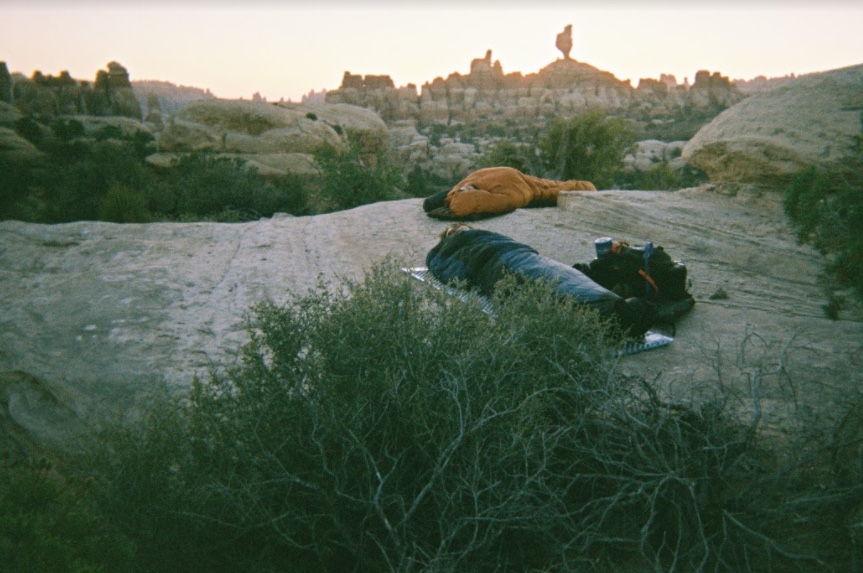
Desert campout

cyclespeak
That sounds a very grounded, down-to-earth approach to business?

Gus
Way back, Lachy and I had talked to 3T about the Exploro bike. That was originally going to be called the Thereabouts bike.

cyclespeak
No way.

Gus
Yeah, we worked with Gérard Vroomen. Discussions going to and fro about the design and the whole, fucking gigantic legal process of royalties. We both thought it would be sick to have our name on a bike but the project kind of stalled. And we then went through a similar process with a number of other companies. Sitting around the table with all these heads of brand and they’d be talking about incorporating what we were doing with Thereabouts into their shit.

cyclespeak
But nothing came of it?

Gus
I kinda thought that having a bike was impossible. You’ve got to jump through so many hoops and then at the eleventh hour the process reaches a point where it stalls. But with Matt, there was none of that [laughs]. We called him and asked about making a bike and he said, ‘Yeah, sure.’ And it was really that easy. One person, their own brand, doing their own thing and just interested in making stuff that excites them. And that’s like, very rare, I think. Just wanting to get it done.

cyclespeak
In the Thereabouts podcast episode that features Crust, Matt says he doesn’t care what the cycling industry thinks.

Gus
That’s right. He doesn’t [laughs].

cyclespeak
So I wondered where you sit? And whether your self-perception is one of outsiders?

Isaac
That’s an interesting topic [Gus laughing in background]. I think to a degree we’re outsiders but, in the same breath, we’re still kind of part of it all. And going back to my earlier point about collaboration, we still need wheels and a group set to complete the build. So, no matter what, you look to different people to help bring your vision to life. And we value and really care about our relationships with those individuals or brands that build bikes and I think it’s really inspiring what people like Matt and Cheech are doing at Crust.

cyclespeak
So, after deciding on Crust for the frames, I guess you had a free rein for the componentry?

Gus
Exactly. Isaac was like, let’s do this or use this. And that’s sort of how this all works. One of us will come in with an idea – for a film, podcast, whatever – and the other one will either be, that’s great, or no mate. There’s a sense of checks and balances but when it came to the  equipment it was very much what’s the sickest thing we could put on the bike. I suppose the best way I can frame it is to ask if you know that much about tractors?

cyclespeak
Tractors?

Gus
Well, Lamborghini started out making tractors. My Dad used to have a Lamborghini tractor on the farm. And I kind of picture the Crust in the same way. It’s got really fucking fast shit on it but it’s still a tractor [laughs]. You’re not going to race this in the World Tour but it’s specced out like it expects to be. So the thinking went, what’s the most do-anything robust frame? And that’s how we arrived at the Crust Bombora. And then we asked ourselves, what’s the most badass shit we can put on it so we can make this tractor go as fast as possible over any terrain.

Isaac riding the Thereabouts Crust

cyclespeak
It sounds like a fun process?

Gus
Just completely unorthodox. And going back to that question of whether we see ourselves as outsiders. From an ideological standpoint, then absolutely, we’re outsiders. We’re talking about using the bike in very different ways but, at the same time, we have to co-exist inside this industry and we’ve got really great relationships with brands like SRAM, Rapha and Specialized. It’s just that we tend to look at ways of using a bike that lie outside the regular realm of riding.

cyclespeak
In the film Sometime Thereafter, you explore the idea of a shared journey experienced through individual perspectives. So when the finished Crust was standing in front of you, how did you both feel seeing your name on the bike?

Gus
I guess I look at it this way. A bike is greater than the sum of its parts and we were lucky enough to know these people who make derailleurs, wheels, tyres. Who make bar tape and saddles. They’re all creating these elements and there’s all these personalities and characters behind those components. And Isaac was able to pull them all together into an epitome of what we are and what our view of the sport is. And as a result, we put our name on it because it’s a physical representation of where we currently see Thereabouts and what we want to use a bike for. That unquantifiable essence of a bike and how it moves you through space. That’s us, putting our name on it. Like putting an intention to your day [laughs].

Isaac
The parts arrived as Covid was happening so the bikes were built up during lockdown in Portland. I drove everything over and then, a few days later, you’ve got a fully-built bike. Which was crazy because they looked way different than I was expecting.

cyclespeak
And then you got to ride them.

Isaac
It was mine and Gus’ first escape from lockdown restrictions on a trip to Southern Utah. I loaded the bikes into my car and we drove all the way south.

cyclespeak
Was this Utah trip a case of ticking boxes – a testbed for the bikes – or more about asking questions?

Isaac
It was heavenly.

Gus
It was.

Isaac
The riding was pretty out there and our bikes were completely fucked up but they survived.

cyclespeak
Once again, returning to the theme of a tool for a purpose?

Gus
Exactly. In terms of putting your name on something, we’re storytellers and this build fits in a kind of abstract way to that end. A tool that will help us to tell a story and hopefully empower people to make their own journeys.

Gus and Isaac

cyclespeak
You mentioned how your Crust bikes were built up during the Covid lockdown. Has the pandemic influenced the direction you’re going with Thereabouts?

Gus
Looking back on the past year, having everything scratched gave us time to rethink our approach and strategise a bit.  Along the lines of what we want to do and how we’re going to do it. So we spent a lot of time reformatting the business plan. How we can make and tell these stories and get them to the widest audience in the most beautiful way. So we’ve got a lot of exciting things in development and a shitload of work to be done over the next six months. But we’re getting there [smiles].

cyclespeak
For many people, the pandemic has been life changing and not always in a positive way. But maybe adversity can sometimes push you to question and reassess how you’re living? To explore new directions and appreciate what we might have taken for granted?

Gus
At least from my personal point of view, I’ve always felt the urgency to do things and get them out. The last two years have really changed that for a number of reasons but as a result I feel we now have a more sound perspective which will hopefully help us make a bigger difference in the work that we do. At the heart of Thereabouts, it’s about telling stories that inspire people. We want to show the positive impact sport can have on society at whatever level you choose to engage. Sometimes it feels the way we go about this might not be the easiest way to do it. But, for us, it’s certainly the most rewarding.

Gus Morton / Isaac Karsen / hereorthereabouts

All images with kind permission of Thereabouts

Thereabouts Outspoken Ep011 – Crust Bikes

Crust Bikes