Rapha Manchester Women: A road shared

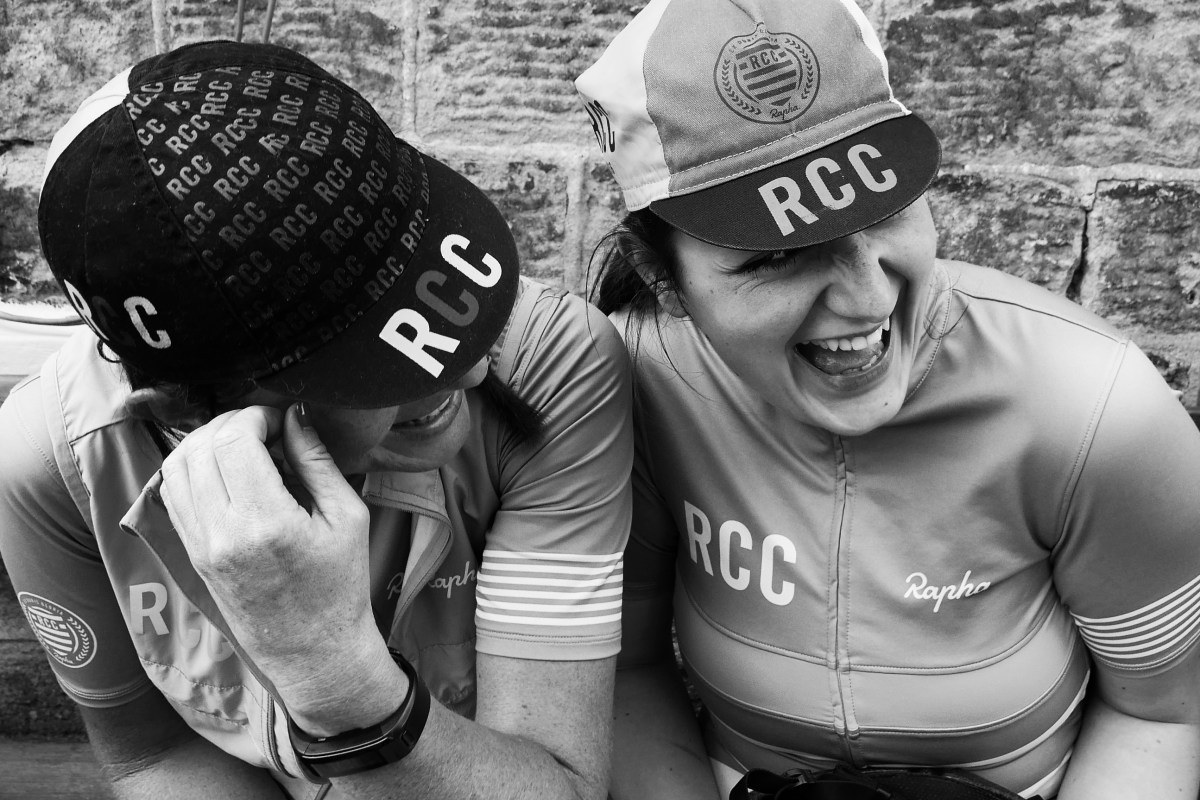
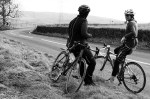
Every fortnight on a Saturday morning – all year, all weathers – the Rapha Manchester Women’s Ride meets at the clubhouse for coffee before rolling out in search of Peak District climbs or quiet Cheshire lanes.

Since these regular rides were first launched in March 2016 the group has seen significant growth with both experienced riders and individuals new to cycling. And as another year draws to a close, in their own words the members of this group tell a story of goals achieved, encouragement given and a road shared.

‘We’re all on a journey and to play some part in helping encourage another female rider; well, that’s a privilege I value enormously. And it’s an honour to lead and ride along with such an amazing group of cyclists. Our adventures never fail to make us smile no matter what the weather throws at us.’ Sarah (group leader and Rapha Ambassador)

‘So grateful to be welcomed by the Rapha Manchester ladies. Their support  and expertise encourages me so much! Great company and routes and I always look forward to the next time we get together. Cycling with friends that motivate each other makes all the difference and it’s been an amazing year.’ Belinda

Version 2
Miriam, the group’s ‘go to’ hand model.

‘Pym’s Chair can be a breaking point for some cyclists but, for me, a chance meeting with Sarah and Belinda on the climb opened up a whole new world of cycling. I was officially recruited into the Rapha Cycling Club! I had already met them briefly a few hours earlier at a feed stop where we exchanged compliments on our kit. And since then, the Saturday rides and RCC Sundays have opened up a world of amazing people, fabulous routes and a support network that has enriched my cycling life.

Riding with Rapha Manchester has transformed cycling from a fitness activity into an adventure. Exploring the countryside that surrounds the city centre has been so very enjoyable – it’s beautiful round here – together with a social life full of coffee, cake and laughter.

I have achieved things I never thought were possible; sharing the road with amazing women. An Olympian, crit and cross racers, experienced athletes and those new to the sport. Every ride provides more tips, advice and encouragement in a way that empowers me as a cyclist. I never believed I would ever manage to ride up the Rake, complete the hilly Women’s 100 route, blast round the Cappuccino 180 or sprint down the Tatton ‘wall’ at 29mph. And I know I wouldn’t have done any of these things without the support of this amazing group of people. Thanks for finding me on Pym’s Chair and thank you team RCC.’ Sue

Version 2
Riding out of Manchester, you always need one eye on the weather.

‘Though I love cycling, I very much doubt I’d be the cyclist I am today if it wasn’t for the Rapha Manchester ladies. The group rides have built my confidence on the road and are excellent motivation. All these elements build together and push me further. Two years ago if someone had suggested I’d be climbing the Rake or heading for 2,500 miles for the year I’d have thought they were crazy. The rides are very inclusive and a great laugh. Roll on 2018.’ Kelly

‘Our riding group is the motivation that gets me out of the door when the weather is inclement. Knowing that you’re going to have a great day with a group that is fun and supportive. Taking me into the Peak District and exploring Cheshire lanes that I wouldn’t otherwise venture through on my own. I’ve made many new cycling buddies and it’s challenged me too; making me a stronger rider.’ Shelley

Braver Than The Elements

‘I rode the Women’s 100 last summer and because everyone was so friendly I started going out on a Saturday with the Rapha Manchester ladies. I wanted more options; to ride in a mixed group with faster people so I could get stronger. And cycling means so much to me. It keeps me sane; makes me feel happy.’ Hannah

‘I feel so lucky to have discovered the Rapha Women’s rides this year. They’ve taught me the many values of riding with a club; that perfect combination of ambition and motivation whilst not taking yourself too seriously on the bike. I’ve learnt that the way to achieve goals is to laugh through the challenges. You can then guarantee you finish every ride with a smile on your face.’ Jen

‘This is my first year on a bike and it’s been an incredible journey with many highs and even the occasional low. But after a few false starts and fuelled by a multitude of flat whites, I’ve conquered my demons and achieved goals I never thought were possible. Making new friends in the group has given me the confidence and inspiration to keep going. Even when I’ve doubted myself.’ Miriam

For more information on the Rapha Manchester Women’s Clubhouse Rides.

#ccmcrwomen

All images @openautograph


Conversation: Andy Doyle

Many contemplate what Andy Doyle’s undertaken but few actually take the plunge and invest the time and financial outlay. After completing his framebuilding course with Bicycles by Design, Andy took the time to reflect on the experience before considering his next steps…

How do you define yourself as a cyclist?

I started with two other guys riding fixed gear. Going out around Manchester in the rain, in the middle of winter, in a pair of shorts. Sitting in a pub beer garden soaking wet and having a couple of pints before riding home. And I think where you ride influences your attitude towards cycling. The Peak District is my stomping ground so I guess I see myself as an all-weather cyclist. Not in the sense of sunshine and rain but gritty when it comes to how I ride.

And is there a why?

It’s my medicine. My headspace. I once toured with a punk band and one of the reasons I became more involved in cycling was that it was a healthier way to spend time around people. And it’s a good way of expressing yourself. Releasing all that pent up energy from the working week; the stresses of everyday life. Sometimes alone – head down and out in the Cheshire lanes for 4 or 5 hours – but also with Rapha and the friends I’ve made over the years.

You’ve recently had a bike built by Rourke Cycles?

I’ve wanted a custom bike for a very long time. I suppose in a way like many cyclists do. An opportunity arose that meant I could actually commission a build and I went with Rourke’s because I felt their attitude to frame building kind of fitted with mine. They have a very old school, straight forward approach to the way they fit and build bikes that just appeals to me.

And then you decided to build your own?

My Rourke’s built with Reynolds 853 and rides superbly. Stiff in all the right places and exactly to my measurements. It listens to me and you can’t ask for much more in a bike. But it’s one thing to ride and appreciate something a master craftsman has built. To attempt the build process yourself takes this to another level.

You enrolled on a course with Bicycles by Design.

I was taught by Pete Bird who has a perfectionist approach to fabrication that I really appreciate. And there’s all the insights into the trade that you get to learn although some were rather unexpected [laughs]. Pete mistakenly touched a part of the frame that was really hot and then immediately put his fingers to his earlobe to sooth the burn. Apparently it’s an old goldsmithing trick.

IMG_9589

What emotions were you feeling as the day approached?

I’ve been planning this for close to 5 years so I was naturally very excited but also incredibly anxious. Questions in my head about whether I’d be any good. Would I actually be able to build my own frame. And then there’s the hopes and dreams that this might eventually turn into a career. It’s not going to happen overnight but one day it would be nice if I can earn a living from building bikes for people. Creating something with my own hands that I’m proud to call my own.

What decisions did you have to make before the course started?

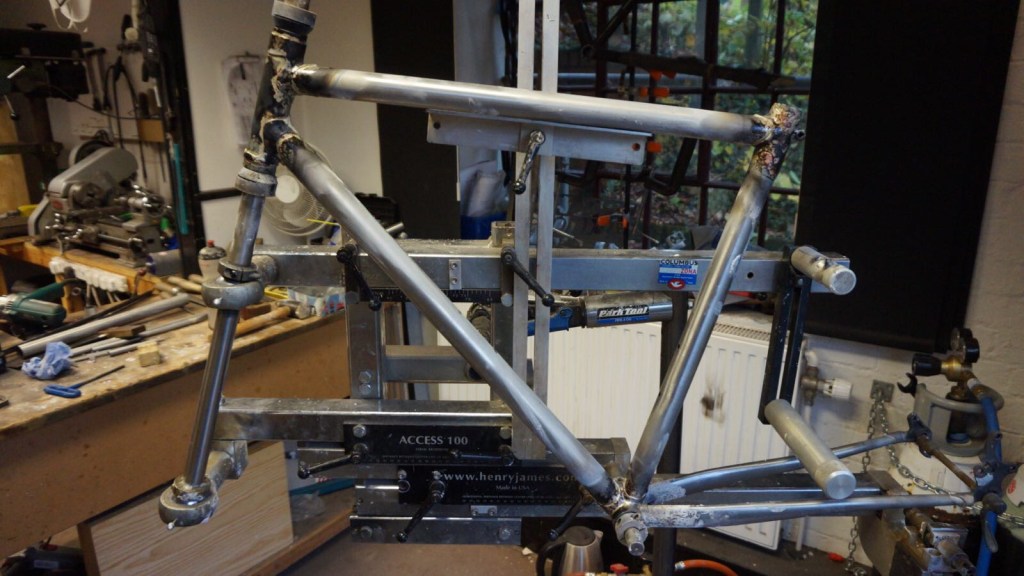
I wanted to do lugged construction as opposed to fillet brazing. My thinking being that this is how they first built frames as we know them. So I needed to consider the design of the frame I was going to build before choosing all the necessary components from a site called framebuilding.com. Rather old-fashioned but it’s got everything you need.

Then the day finally arrived.

We had a cup of coffee and a brief chat before cracking on with the fitting. From there it was just a matter of transferring all the measurements onto BikeCAD and leaving it to work its magic in terms of crunching the numbers. After a quick break for some lunch I was straight in the workshop trying my hand with the brazing torch. Quite an eye opener in terms of a learning curve [smiles].

And from there?

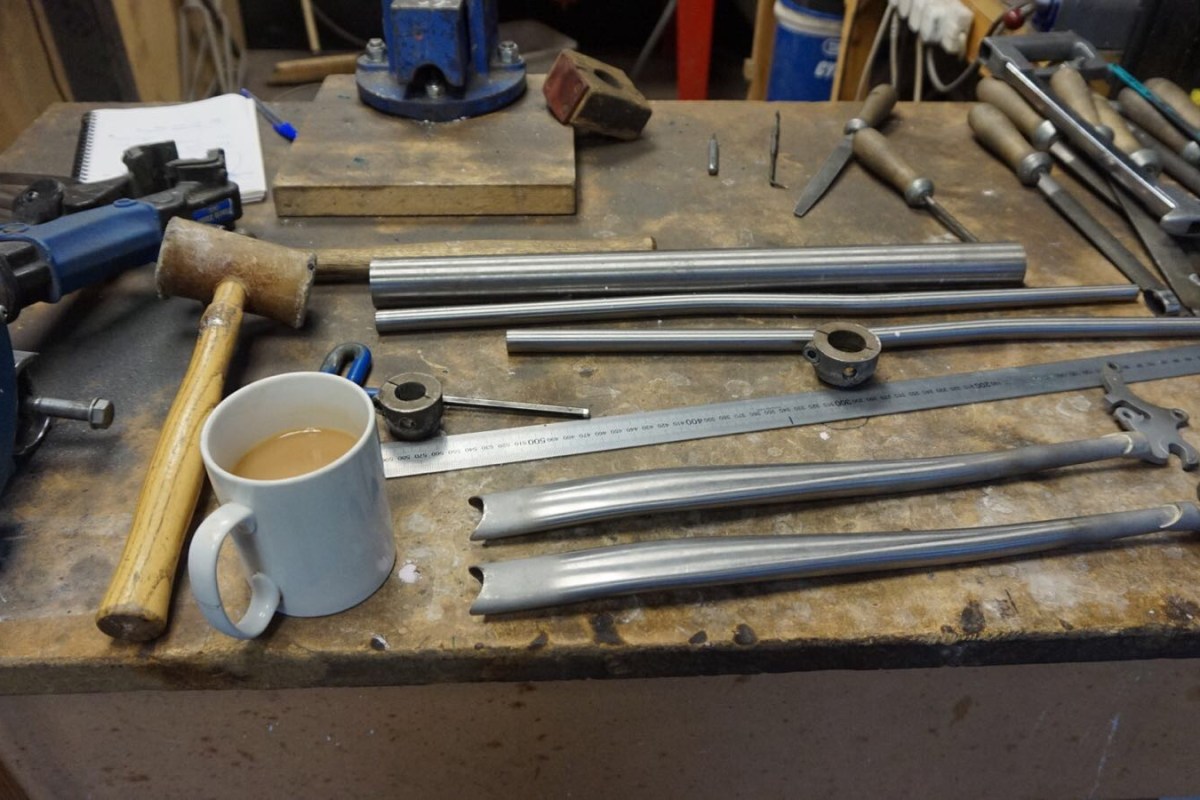
Surprisingly – at least for me – on the second day I was encouraged to do all the mitring by hand. Cutting down the tubes to size before using files and a bench grinder to create the shapes I needed. There are shortcuts – Pete explained that you can print out templates – but I was there to learn and my attitude is that you shouldn’t necessarily take the ‘easier’ option. I’ll be honest; it was frustrating. But it gave me a real understanding of the spatial relationships between the different tubes and how they work together.

So you had all your mitres.

The third and fourth days I can best describe as the business end of the course; using a jig to set up the correct geometry before brazing the tubes. And it was particularly during this part of the process that I noticed some of the really idiosyncratic aspects of engineering; quickly moving from the precise measurements on the jig to banging out adjustments on your tacked frame with a lump of wood. I love that there’s a ‘get a hammer and whack it’ approach.

And the finishing touches?

The fifth day was all about the final small details. Brazing on the cable stops and the disc-brake mounts before all the filing and cleaning. Probably the hardest day as I was a little frustrated with the fabrication of my seatstay bridge and I was exhausted by that point. Physically and mentally. You’re so close to actually being finished but still have a way to go.

Did you learn anything about yourself?

It was quite a challenge to take on this build with the knowledge that I had absolutely no idea what I was doing. And I think, as you get older, that you tend to stick in your comfort zones. For me to continually have to ask if I was doing something in the right way wasn’t particularly easy. There was always that unspoken thought prior to the start of the course that I wouldn’t have the necessary skills or abilities to make my own frame. And I was surprised at the raft of emotions you feel when you’re doing something like this; the extreme highs and lows in terms of confidence that I experienced over my week-long course.

And now that you’ve finished the course?

I came away with a quality frame so there’s an immense amount of pride. And I had a whole week of one-to-one tuition which is priceless when you consider the things I’ve learnt. It’s given me a base level of knowledge and the confidence to do more.

So what’s next?

I’m under no illusions that if I want to continue with this, it’s going to be a long, hard road. There’s no shortcuts. You can’t be good at something like this overnight. Or even after a week-long intensive course [smiles]. You need to put in your 10,000 hours before you can truly call yourself a frame builder. This may only be a very small step into the world of frame building but it’s a step forward nonetheless.


For more information about Bicycles by Design.

Build images: @hellbentforlycra

Frame images with kind permission of Lucy Valentine.

Dov Tate / Parcours

‘I’ve had at least three or four people in the industry tell me my biggest problem is that the wheels are priced too low,’ explains Dov Tate when considering the challenges of bringing his brand to the market. ‘But I believe that we can deliver a quality product that’s at least as fast as our competition and at a price point where you don’t need to take out a second mortgage.’

Having launched Parcours during the summer of 2016, you’d need to turn the clock back a further 12 months to discover the original inspiration behind this venture. ‘I can tell you exactly where and why it happened,’ Tate comments with a smile. ‘I was racing a triathlon around Eton Dorney rowing lake on an old set of tubs and punctured for the second time. So, race over, I threw my toys out of the pram before deciding I needed some new wheels. But then, after going online that same evening, I discovered you could either go down the budget eBay carbon wheel option or pay thousands of pounds for the more recognisable brands. It struck me that there wasn’t really anything in between. A wheelset with a reasonable price point but supported with data and hard numbers to back up what you’re buying.’

Deciding to address this observation and having trained as an engineer with time spent working in the aerospace industry, Tate applied his understanding of aerodynamics and material science to some initial wheel designs before looking at what was available in open moulds and booking time in a wind tunnel.

2017-12-03-PHOTO-00000005

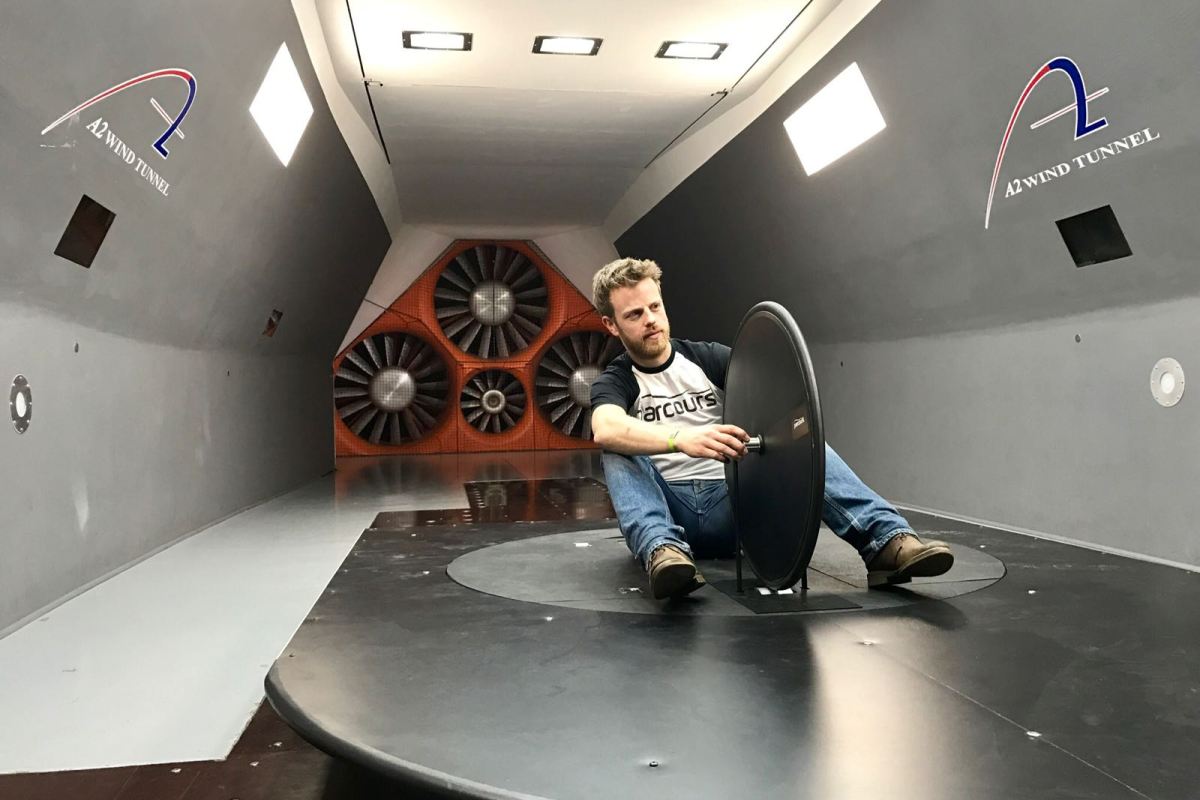
‘Originally I looked at testing in the UK but it’s actually more economical to fly over to the States and test there. We used the A2 facility in North Carolina as they have an excellent track record working with the cycling industry and we came away really happy that our wheel design was demonstrably fast. I then needed to focus on the actual manufacturing process; asking myself how to avoid some of the horror stories you hear associated with carbon wheels such as brake track delamination.’

Acknowledging this need for robust quality control systems and with his wheels manufactured and assembled in China, once they arrive in the UK they undergo a second round of testing and inspection prior to being sent out to customers as and when they’re ordered.

‘There’s far fewer Far East manufacturers than you’d imagine. If you go the direct route online, I would suggest that 90 – 95% of the people you come into contact with through eBay or Alibaba are agents. They work with the manufacturers but they’re just re-sellers. So you have to peel back that first layer in order to contact the manufacturers directly. The single most important aspect of starting my business was spending a couple of weeks out in China visiting factories and telling them what I wanted, how I wanted it and why. And the expertise is out there. It’s no secret why the vast majority of the bike industry manufactures over in the Far East. Controlling your costs is important but it’s the knowledge and skills they bring to the table that’s so very crucial.’

2017-12-03-PHOTO-00000007

In reference to the aesthetic of his brand – both the website and the wheels themselves have a markedly understated design – Tate acknowledges that the pared back approach of companies such as Rapha had a huge influence when he first created his brand’s look and feel. ‘I wanted to keep it simple,’ he suggests with a grin. ‘To focus on the wheel itself and the way it performs and rides. Of course it’s an absolute bloody nightmare in terms of getting prospective customers to easily recognise your products.’

So having secured his manufacturing supply lines and deciding on a direct-sales approach to distribution, Tate next needed to build his brand. ‘You have to take your product to every website, every magazine, journalist, podcaster, blogger. And as much as you want to let your product speak for itself; it’s down to you and the story that you tell.’

‘Naturally this all takes time,’ continues Tate. ‘When I first launched Parcours, I had this idea that I’d probably spend most of my time split between engineering and sales. In actual fact, it’s spent managing social media content and logistics. Depending on the time of day you catch me, Instagram can be either the best thing or the worst thing that happened to the world.’

2017-12-03-PHOTO-00000006

After spending the past months riding his latest prototype designs, Tate feels excited about the current launch of his disc brake wheel range. ‘Eighteen months ago,’ he comments, ‘Parcours didn’t exist. There was an idea in my head but no company, no website, no branding. Zero awareness. Fast forward to where we are now, I like to think we offer a credible alternative to people in the market for a set of wheels but without the need for an unrealistic outlay. And it’s great when someone takes the time to send you an email saying how much they enjoy riding on your wheels. That, for me, is where the real pleasure comes from.’

All images with kind permission of Parcours

Portrait: Dominique Gabellini

I’m told it’s downstairs in the basement showroom of the Condor bike shop. And sure enough, when I descend past the window that fronts onto the busy London thoroughfare of Gray’s Inn Road, I find a matte black bike with deep section tubular race wheels waiting its turn with the Condor mechanics. Apart from a pink stripe that paints a line down the centre of the saddle to reappear on the flattened profile of the aero bars, it looks fairly understated. Obviously built to go fast with brakes hidden away in the front forks and tricked out with an expensive groupset, what makes this bike particularly interesting is that it was designed to race at the Hillingdon Circuit by its owner; Dominique Gabellini. And that’s just Hillingdon.

Later in the morning, when we meet over coffee in the ground floor cafe at Rapha HQ, Dominique sets the design considerations of this particular bike in some context: ‘For Hillingdon, I knew I needed a very aerodynamic frame so I went to see Condor and said I wanted this, this and this and they spoke to the engineers in Milan and the discussions went back and forth from there.’

Perhaps unusual for an individual to have such easy access to a design team for what is, in effect, a one-off build? But this simply goes to illustrate the breadth of the relationships Dominique has built through an amateur racing career that began in the south of France as a teenager before a return to competition in and around London at the age of 45.
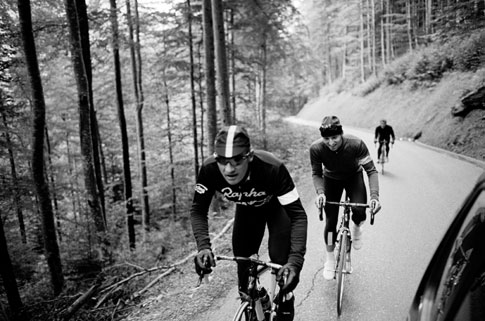
Although playing table tennis to a good standard in his early teens, Dominique grew bored and took up cycling; winning races by the time he’d turned 17 before signing with an amateur team. 3 years later he’d decided to quit and go to university; a decision he levels at the mental challenge of stepping up to an elite level of racing. ‘I’d been told when I was younger that I’d be very good and then, on the first day of my first stage race, I was dropped. There was an echelon and I didn’t have the experience, the understanding of what was happening. I was always at the back and then out of the door.’

‘And this was difficult,’ Dominique continues, ‘because I’d been winning races – winning quite easily – but when I moved up to stage racing it was beyond my standard. It was very hard and, mentally, I wasn’t prepared for it. I was too inexperienced and I’d started racing too late.’

Admitting that these are not particularly fond memories, the contrast to the time he spent racing prior to signing his amateur contract is all the more intriguing. ‘I was part of a group of riders that we called a mafia. We did all the one day races and made a good living from the prize money.’

Describing how he travelled by car between provincial French towns, his voice and gestures animate as he recollects contesting one race after another. ‘If it was a nocturne we’d usually start at eight in the evening before driving to the next town in the morning. And we made so much money. Enough that I could buy a car – a Fiat 127 – at the end of the season. And alongside the prize money you’d win a leg of lamb or a case of wine which we would sell to the hotel.’

‘But we had to work hard for the wins,’ he relates with a smile. ‘When you had two or three mafias turning up at the same race, it was a fight. The race was so fast. And it’s important to remember that for my team-mates – who were much older than me – it was their job. They cut wood in the winter and raced their bikes in the summer.’

Contrasting these obviously good times with his later experience of stage racing, with maturity Dominique has since placed this in some context. ‘I never, ever, finished in the peloton in any of the stage races I contested. And looking back, do you realise how depressing that must have been for a 19 year old? Sometimes I was finishing 20 minutes after the main field. The last rider to be massaged, the others had finished their dinner by the time I sat down. That was my life. And I was riding with guys in their late twenties, early thirties, who’d all left school at 14 because they went into cycling. But that hadn’t been my path. I had a baccalaureate and the conversations we did share were limited as we had so little in common.’

Needing time to reflect on future plans, Dominique attached a rack and panniers to his racing bike and set off for Italy to see his parents. On his return he rode and won one last race before climbing off his bike and informing his father that he was continuing his education and enrolling in university. He wouldn’t compete again for another 24 years.

After graduating with a degree in International Relations, Dominique moved to the UK to study English before settling in London and establishing his own language school. ‘I was working in excess of 50 hours a week – Saturdays and Sundays – but I enjoyed it because I was creating something that didn’t really exist at that time.’

Referring to a business model that had his employees teaching in their clients’ homes or offices, at the time this proved a groundbreaking innovation. ‘We didn’t have any spare money for premises,’ he adds rather ruefully. ‘Everyone does it now but back then it was a novelty.’

It was his cruciate ligament, injured whilst playing tennis, that led to his doctor suggesting he start riding a bike to help build the muscle. As his office was located 10 minutes from the Condor shop, he called in one morning to purchase a bike. ‘When I mentioned I used to race,’ he recalls, ‘I could tell from their reaction that they didn’t believe me.’ Nonetheless Dominique started to train; riding laps of Regent’s Park where he made some friends who encouraged him to consider a return to competition. ‘They took me to a race and I won. Two years later, when I was 47, I won 30 races before realising that when you reach a certain level and you race on your own it gets very hard. So I approached some other people and asked them to ride with me and this became the foundation for the first Condor team.’

Speaking over the phone to Grant Young, son of Condor’s founder Monty Young, it’s clear that the seeds for a close friendship were immediately sown when Dominique first walked in off the street to purchase a bike. ‘We bonded the first time we met,’ confirms Grant, ‘and from day one he was a very loyal customer. A relationship that became, over time, more of an ambassador role and led to us establishing a small race team. We were happy to offer our support as it worked really well and everyone wanted to race with him.’

And it was also around this time that Dominique first met Rapha’s founder and CEO Simon Mottram and learnt of his plan to set up a new company that would retail high quality, carefully considered cycling clothing. As Dominique recalls: ‘He was just starting the brand and asked me if I’d model for them. We went down to the south of France for the shoot and for the next four, five years I continued in that role. And, looking back, those images were seen as being quite iconic in the way they were art directed and subsequently used in marketing campaigns.’

With this relationship now firmly established, when the Rapha Cycling Club was founded in 2015 it was a natural step that Dominique take on the role of ride ambassador; leading groups of members on rides into Hertfordshire and the Chiltern Hills or seeking out lesser known trails and pathways on his cyclocross bike. A role that compliments his continued love of racing as it’s clear that Dominique still has the same passion for competition that first prompted him to take up the sport as a teenager. ‘I perform best in crits,’ he confirms. ‘I like the adrenalin, the speed.’

Excited by the current crop of cycling talent and encouraged that women’s cycling is gaining more media attention, at 61 years old Dominique recognises that the way he competes is, by necessity, different to his earlier racing style. ‘Now that I’m older I know I can’t make the break in an elite field. I stay in the peloton, making sure I’m in the first fifteen and, if there’s a sprint, I try my luck from there.’ With a trim figure honed from weekly 5 hour cyclocross sessions, he continues: ‘In a race you’re constantly weighing up the field. You know who to follow and who won’t have the legs. Sometimes you make the wrong decision – I often make the wrong decision – but that’s racing.’
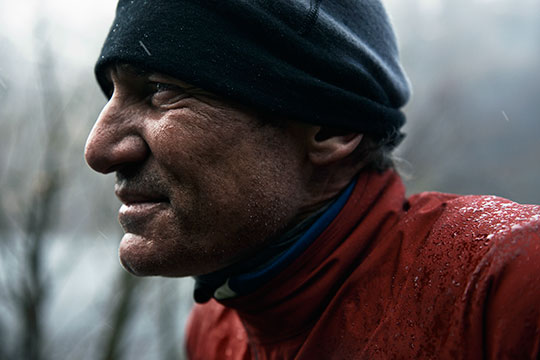
As our time together is drawing to a close – the cafe is beginning to fill as lunchtime approaches – I ask whether Dominique has any regrets in a life, appreciably in two distinct phases, spent racing? At this, he smiles before answering. ‘I enjoyed many good times but I don’t regret going to university. I saw the doping. Knew of the ‘understanding’ certain teams had with race organisers. And there were no miracles back then. You trained and worked hard. The people that were so far above us; they had something else.’

Still racing 2 or 3 times a week in London – riding to the circuit, competing and then riding home – perhaps rather typically he describes how his mood alters if he can’t get out on his bike. ‘I become unbearable. My whole life revolves around cycling and my roles with Rapha and Condor.’ A relationship that Simon Mottram is quick to acknowledge when reflecting on Dominique’s involvement since the launch of the brand in 2004. ‘Dominique has been central to the whole story of Rapha and our success to date. He’s been a model, product consultant, ambassador and connector for the brand. But more than that, he’s been a riding companion, friend and inspiration to me for thirteen years.’

And judging by the number of times our conversation has paused as friends stop by the table to greet Dominique and share a few words, it’s clear to the extent he’s held in such affection. ‘I know them all,’ he remarks as his gaze takes in the various groups of people sitting at neighbouring tables. ‘They are a family to me.’

All images by kind permission of Rapha