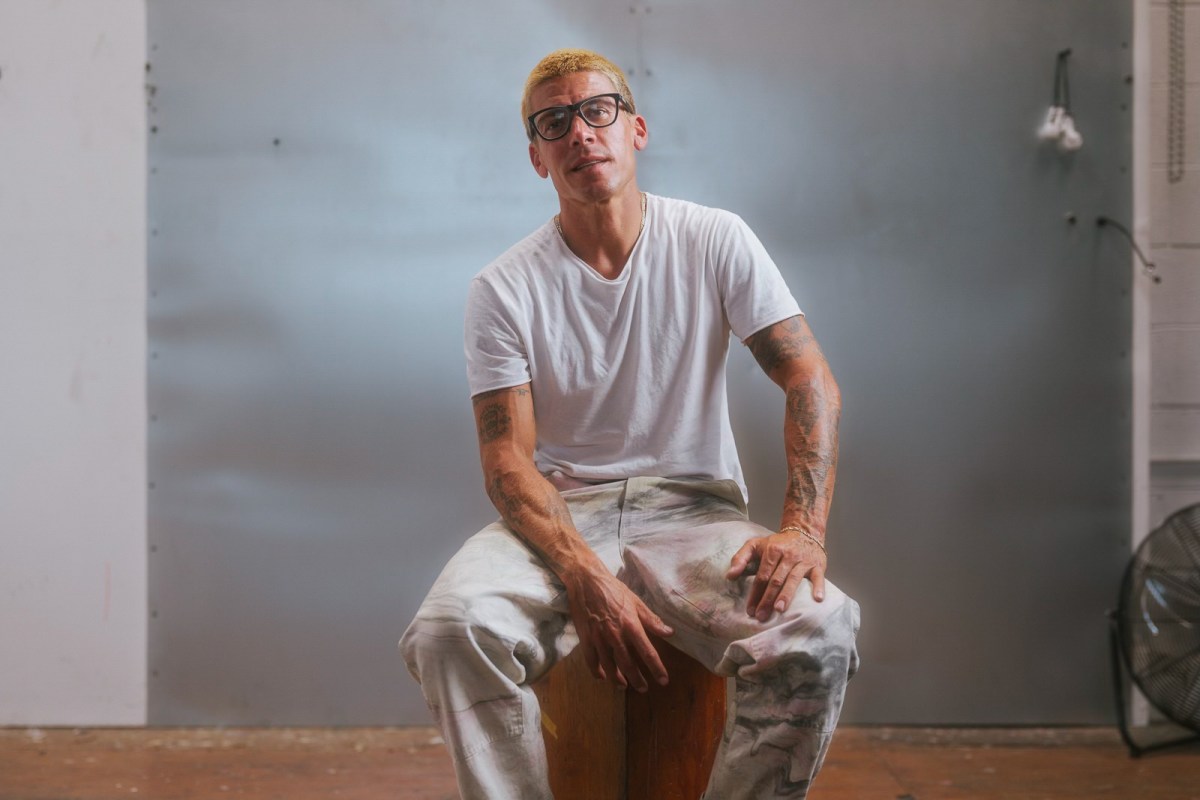
Chas Christiansen / New horizons

“Nothing is more damaging to the adventurous spirit within than a secure future.

So says the poster—sold out I might add—on Chas Christiansen’s online store.

But change—whether chosen or forced upon us—inevitably brings with it a sense of uncertainty. A situation the artist, fixed gear legend and relentless optimist freely admits is a struggle as he considers the what next. Questions and contradictions he addresses in a searingly honest conversation balanced with humour and heartfelt reflection, that sees Chas offload on the what-was-then and the new directions of the now.


cyclespeak
You’re sitting outside in the sunshine. Are you at home?

Chas
I’m not. I’m at a friend of mine’s house. About an hour away from Oakland on the coast. Which is funny because it’s a place I usually ride by…

cyclespeak
But this time you stopped.

Chas
It’s good to spend some normal person time every once in a while.

cyclespeak
We’ve kind of already told the greater part of your story…

Chas
But I’m definitely going through life changes at the moment. This will be my last year riding professionally before I move in a different direction. So it seems to me like a good time to sit down, talk about it all, and reflect a little bit.

cyclespeak
Because the last time we spoke you were days away from ACL reconstruction surgery. And I was wondering which was the most challenging part of the process: the physical recovery or the mental task of managing worries and concerns?

Chas
You know, it was probably the mental aspects. And what’s funny is that when I look back, even though I was going through so much, it was such a simple period in my life. The first time in 20 years I’d ever stopped and taken a break.
Click an image to open gallery

cyclespeak
It sounds like it was needed?

Chas
Physical stuff is fine. I’ve been a pro-athlete long enough to understand the importance of following a PT recovery plan. If anything, that gave me some day-to-day structure and a sense of purpose to work around. But the mental side was tough. Because for a while I’d been having feelings to suggest that I wasn’t at my happiest doing this job anymore. And having that enforced period of not being able to ride maybe gave me the time to explore that for a little bit? Which in turn started the whole process of where I find myself right now. A catalyst for change, if you will.

cyclespeak
I’m reading between the lines but is this a question of identity? Almost as if you’ve inhabited this character for so many years…

Chas
Notchas? With the question now being who’s actually Chas?

cyclespeak
And the answer to that question is part of the journey you’re now on.

Chas
But what’s funny is that when I’d recovered from the surgery, I’d been so single minded at getting back to where I’d been before—I’d built up so much momentum—that it wasn’t until earlier this year that I finally came to a reckoning and started to ask some serious questions about what it all meant.

cyclespeak
Before we explore all that in more detail and just to satisfy my curiosity, can you fill me in on the Zombie Knee™ reference?

Chas
I aged-out of them taking one of my own tendons to repair my knee.

cyclespeak
That age being?

Chas
Younger than 40. And the injury that prompted this surgery happened two days after my fortieth birthday so I have an achilles tendon from a man named Dan in my knee. Which explains the zombie reference as a way of acknowledging that gift and I had the donor’s name tattooed on my knee as soon as I’d been discharged from physical therapy. I guess there’s limited factory parts for me now [smiles].
Click an image to open gallery

cyclespeak
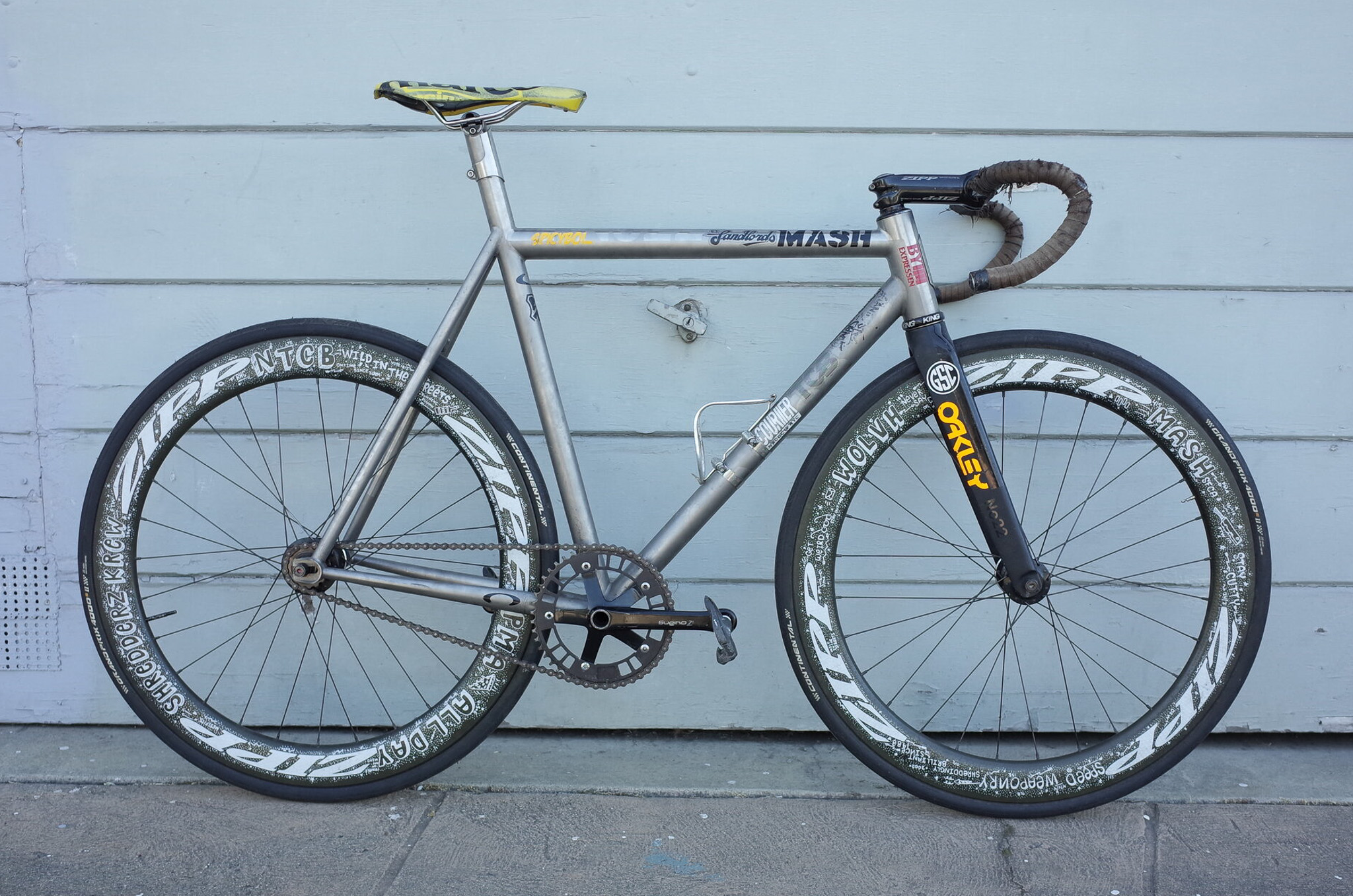
Speaking of parts—or featherweight components—is your MASH / Santa Cruz Stigmata still the lightest tracklocross build ever at 15.2lb?

Chas
Your timing is really good because that’s the bike I hurt my knee on. And I’ve only recently got it rideable and then raced on it for the first time since I crashed two years ago. And I can confirm how astonishingly fast and light that bike is but after I posted to dare anyone to make a lighter bike, sad to say, someone did. And to the tune of half a pound lighter.

cyclespeak
More bike talk in the shape of the limited release collab you did with Engine11 and the AARN double sided track rings. Do you by nature get a buzz from working with others?

Chas
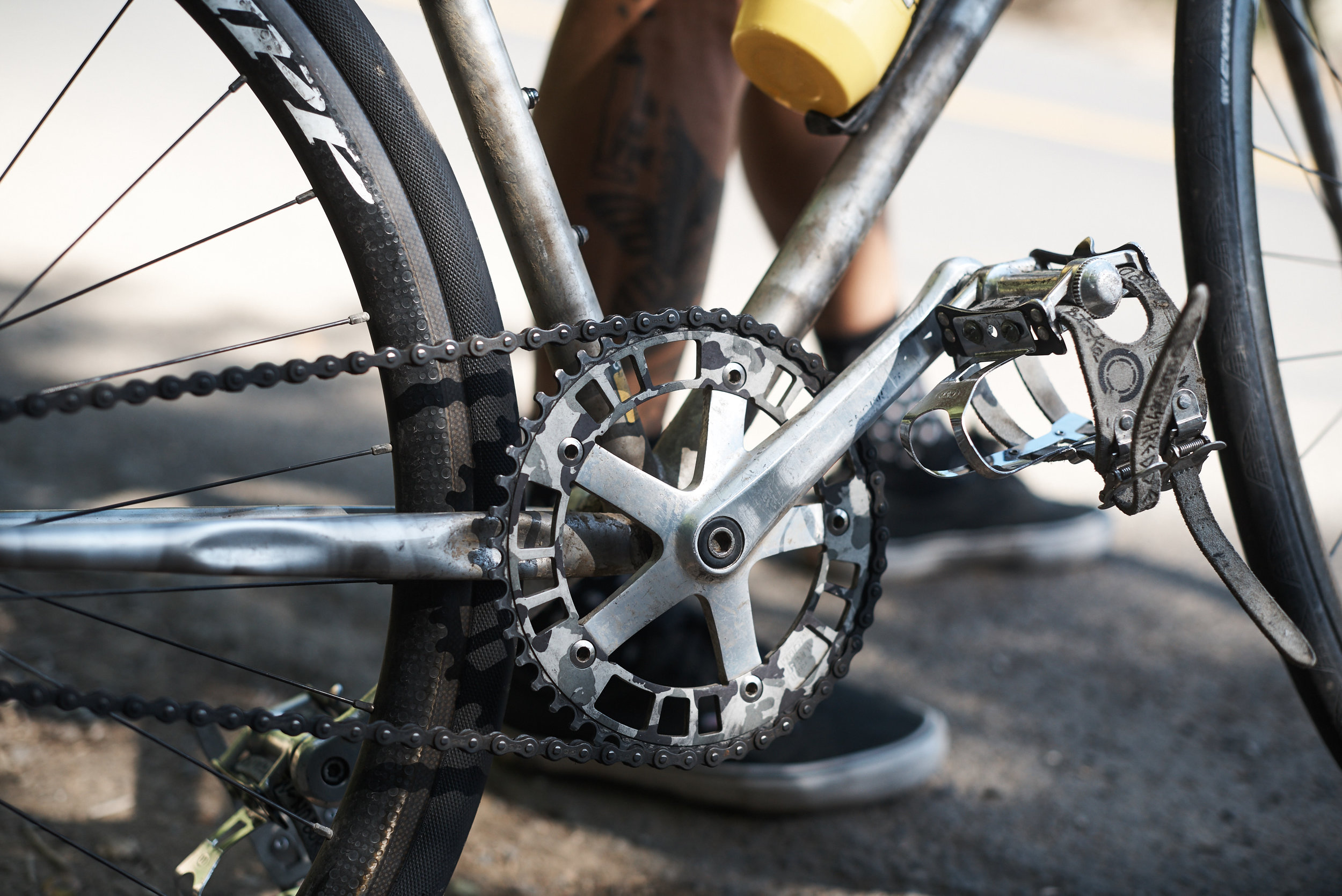
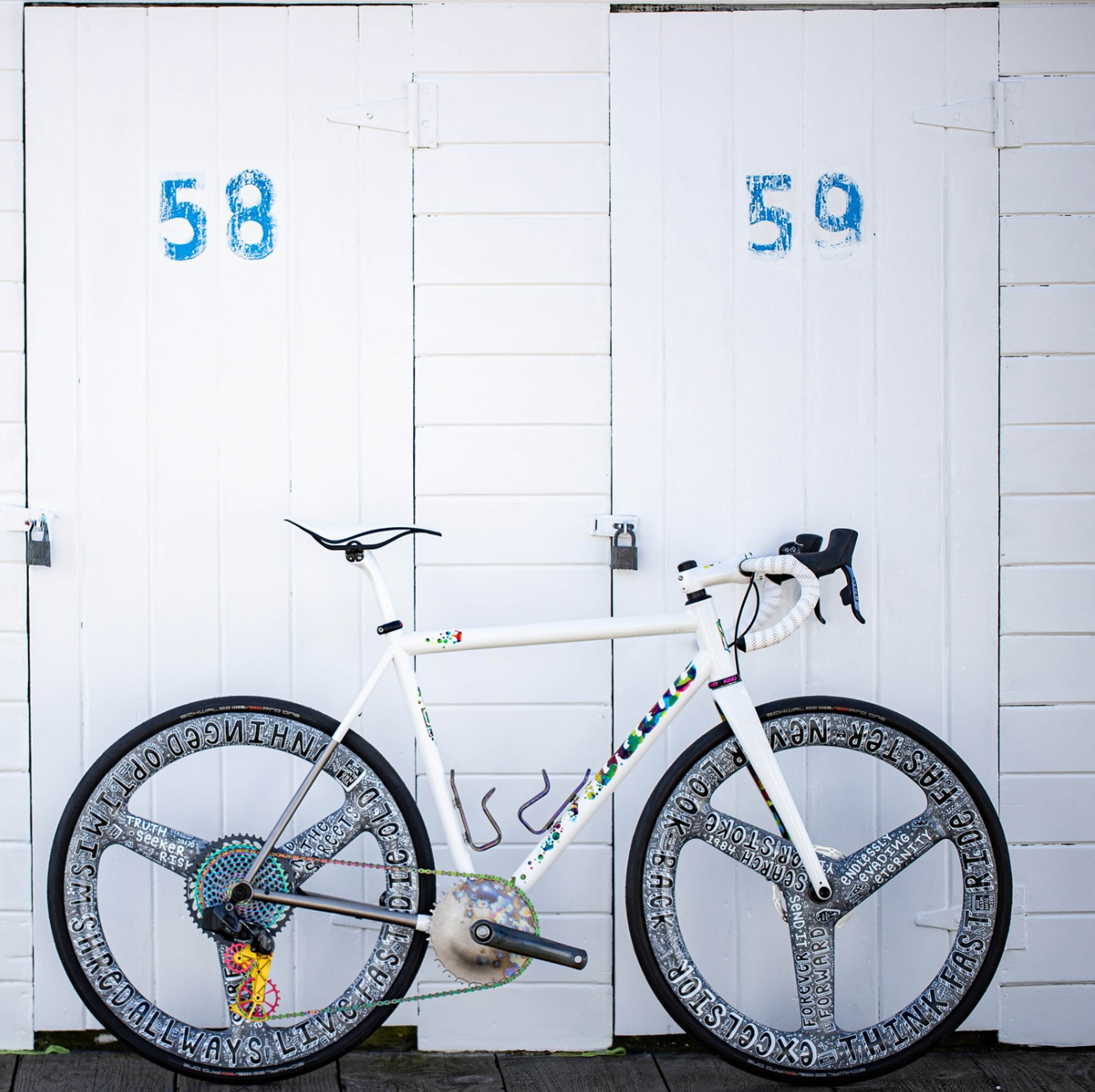
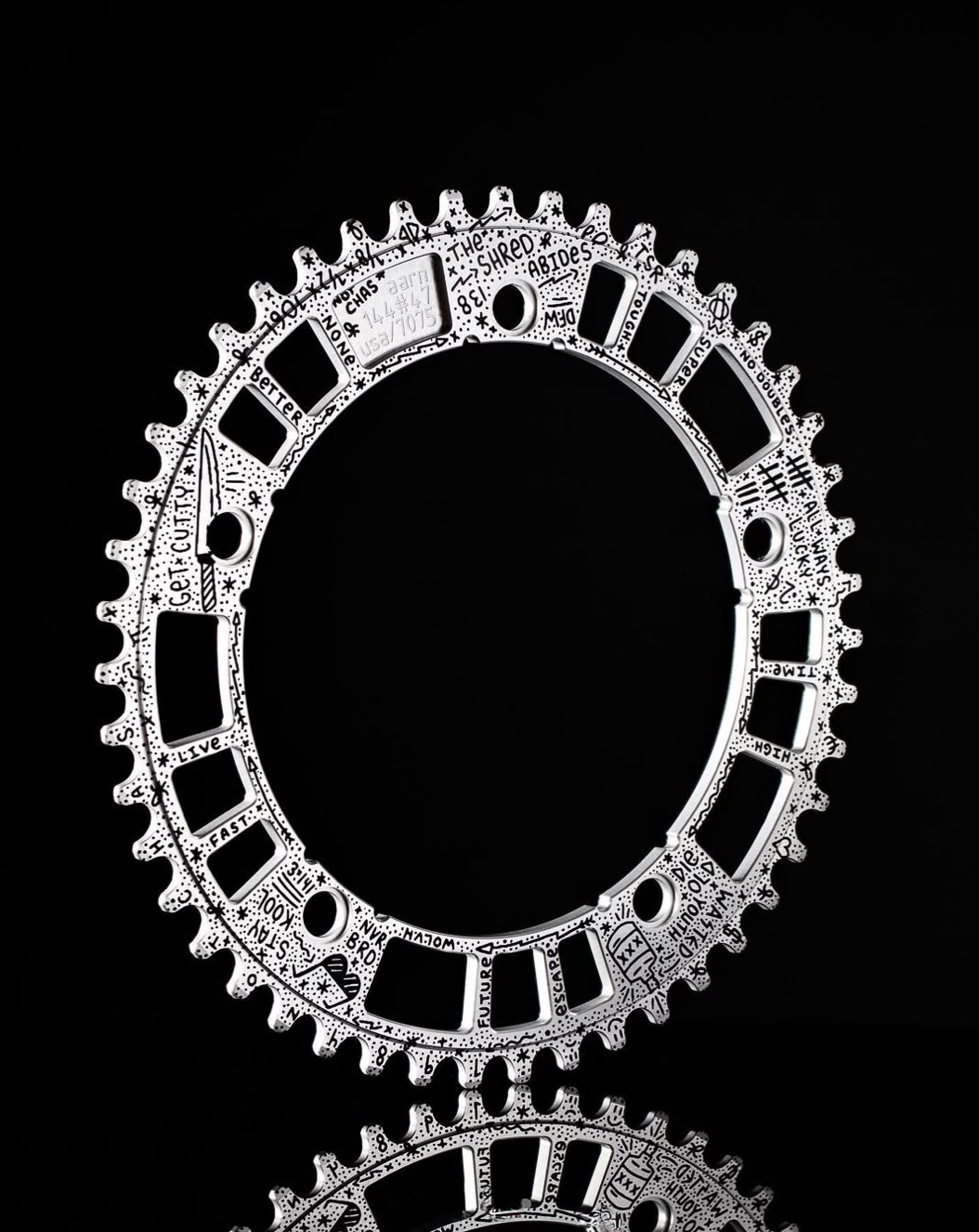
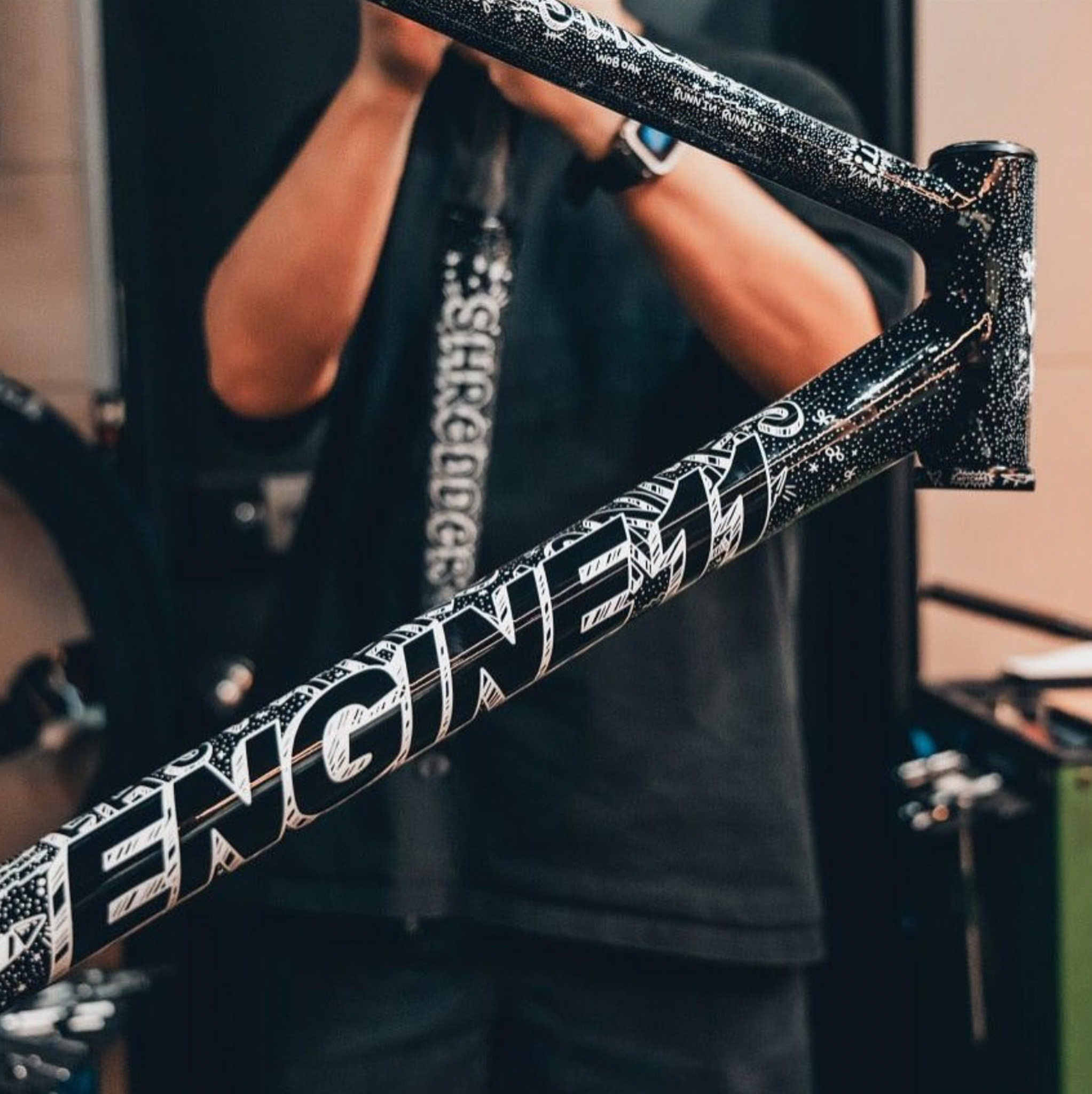
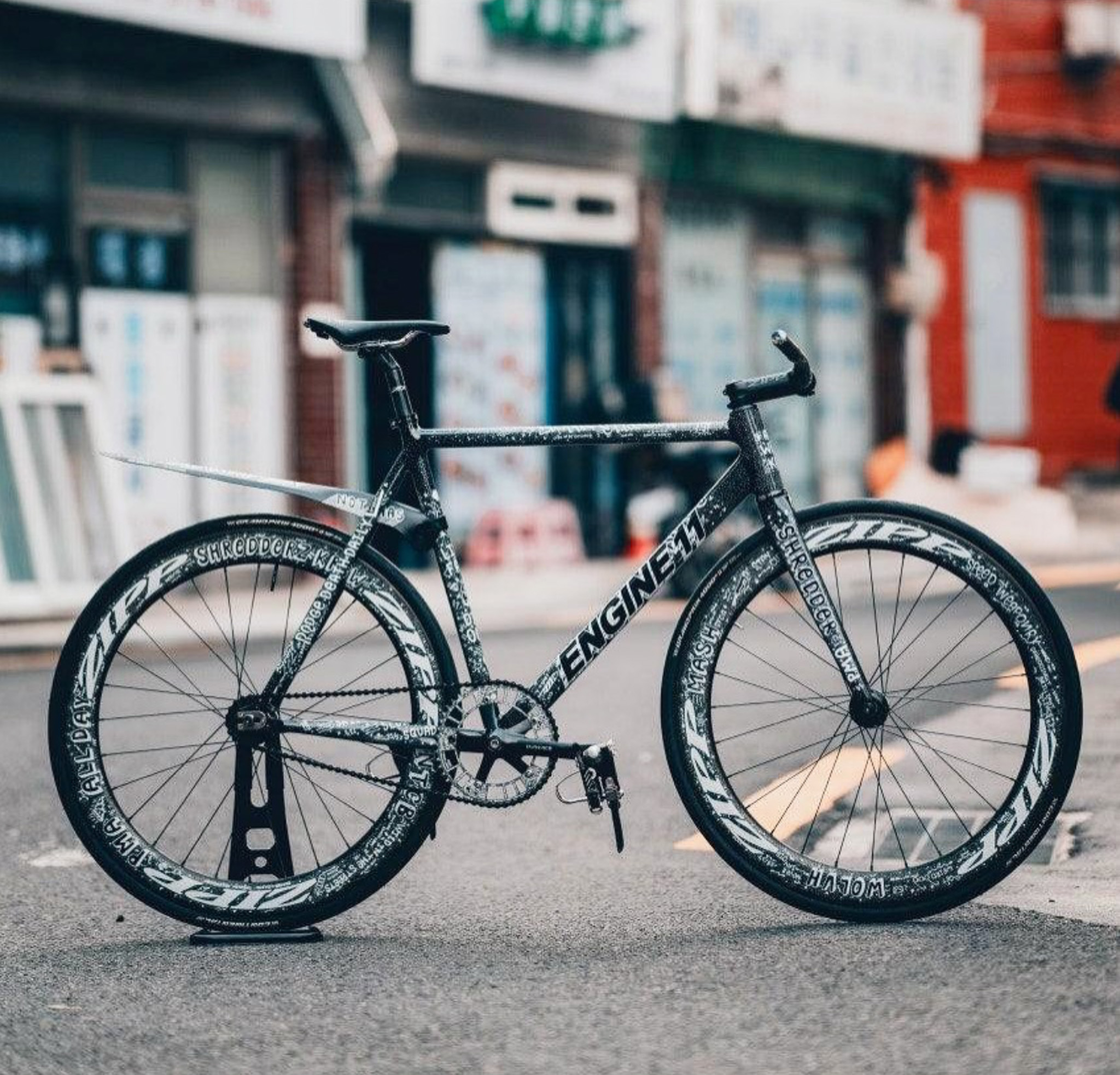
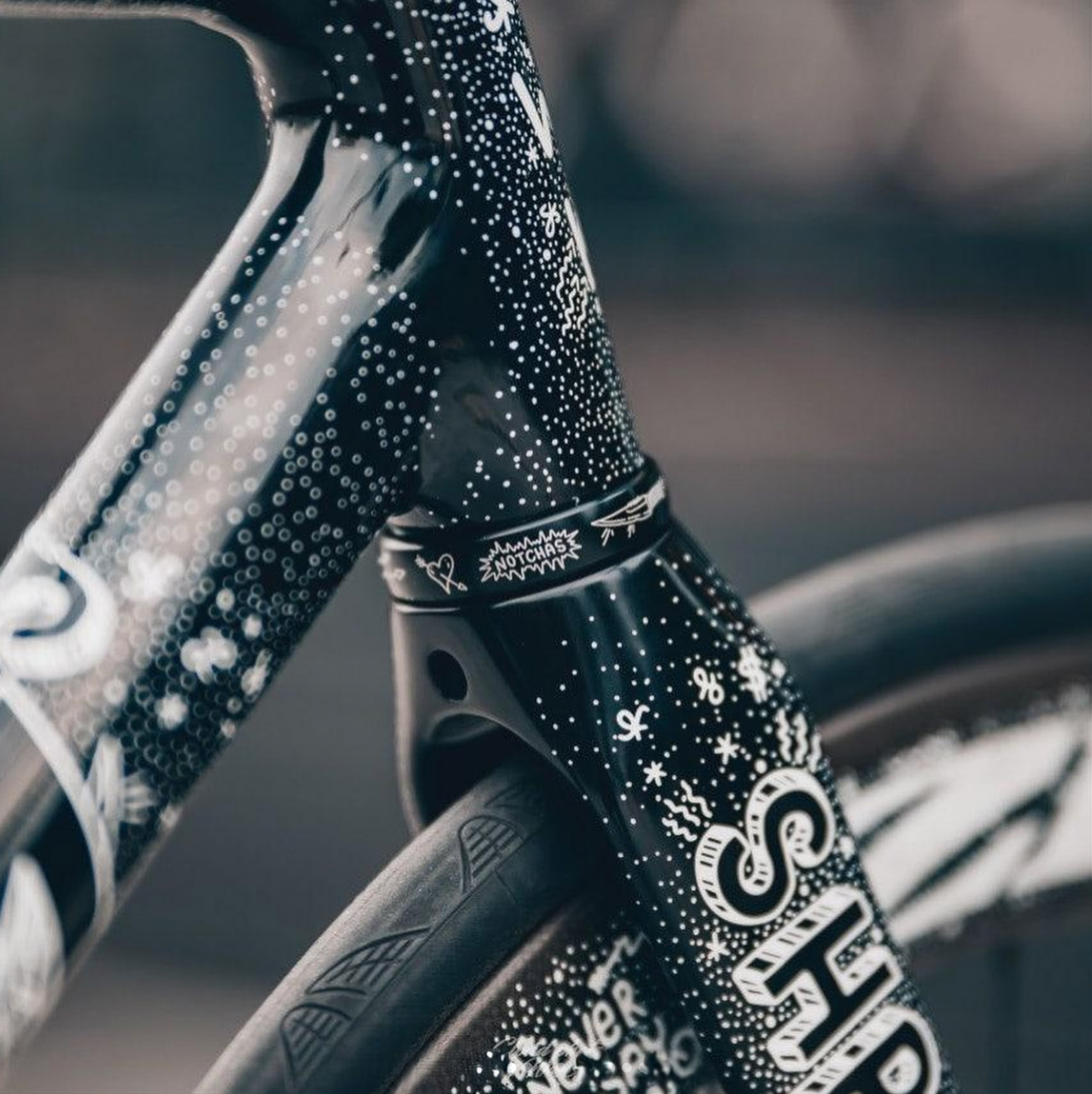
Collaborative design is amazing. Because, for me, it stretches the boundaries of my art. Which I freely admit is a little lowbrow. 2D doodles on paper or on this or that component. So you take the Engine11 frame and the AARN chainrings, not only are you considering a physical object and how you’re going to cover it, but there’s a production process to also factor in which brings another level of complexity to my designs.

cyclespeak
So there’s a certain sense of satisfaction in overcoming these challenges?

Chas
That’s one way of putting it. I’ve worked with Aaron Panone of AARN for over a decade and on the first ever edition of the rings we did, I forgot to mirror the design on the other side so a lot of the art is backwards. Which I just smooth over by saying those were limited edition pieces and hence collectable [laughs].
Click an image to open gallery

cyclespeak
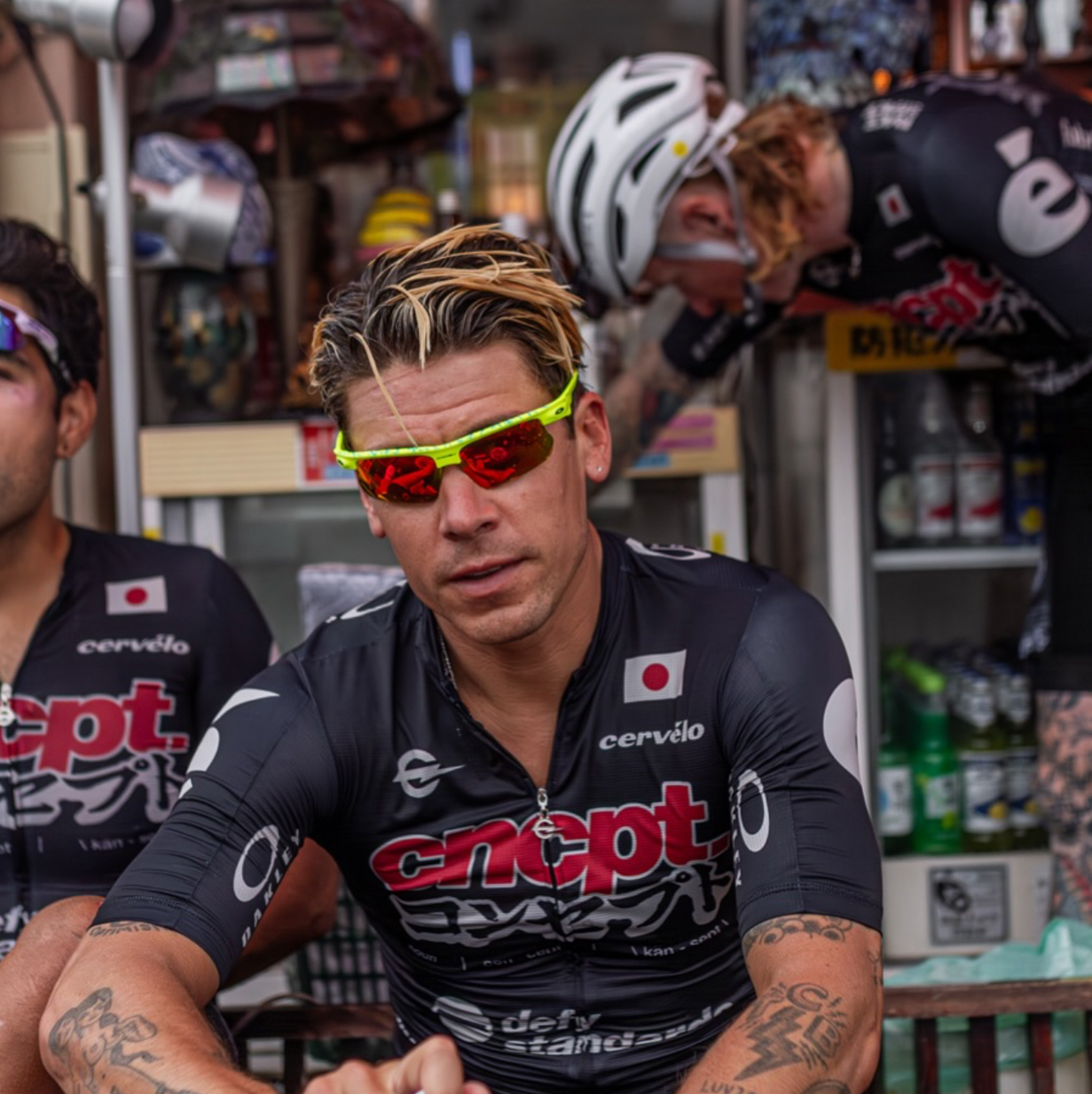
In May 2025 it was announced that you were joining the CNCPT team and then a little while later you set off on a tour of Japan with Alonso, Sean and Alvin.

Chas
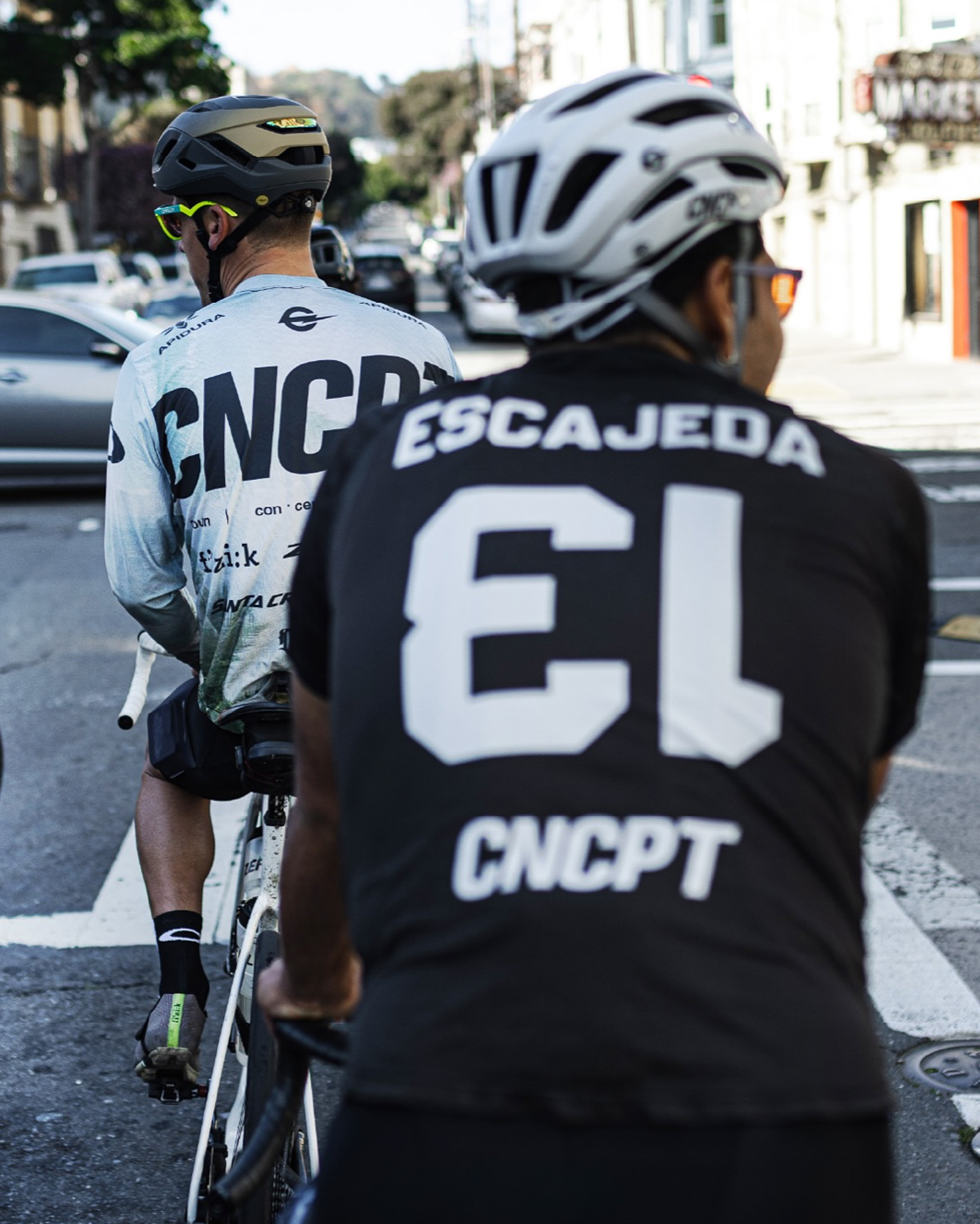
I’ve been friends with the CNCPT boys for as long as we’ve been racing bikes. So being teammates seemed like something that had already existed throughout that time. But now I get to wear the jersey.

cyclespeak
And Japan?

Chas
One of the funniest things I remember from that trip is that, early on before we’d even got going on our tour, we were messing around in a mall where they have all those machines where you can buy little plastic toys. And as a joke, we all bought these tiny recorders which we somehow managed to learn to play some tunes on. So we’d pull up at a convenience store in the middle of rural Japan and it was never a spoken thing but one of us would start playing and the others would join in; four sweaty, grown men in cycling kit, loitering outside under the porch, tootling away together. The looks we got were priceless.

cyclespeak
Loitering with intent to make music.

Chas
Loitering with intent about sums it up [smiles].

cyclespeak
You acknowledged the advent of your truck rolling over 300k miles in a post and then later this year had a number of kit and component auctions to fund an engine rebuild.

Chas
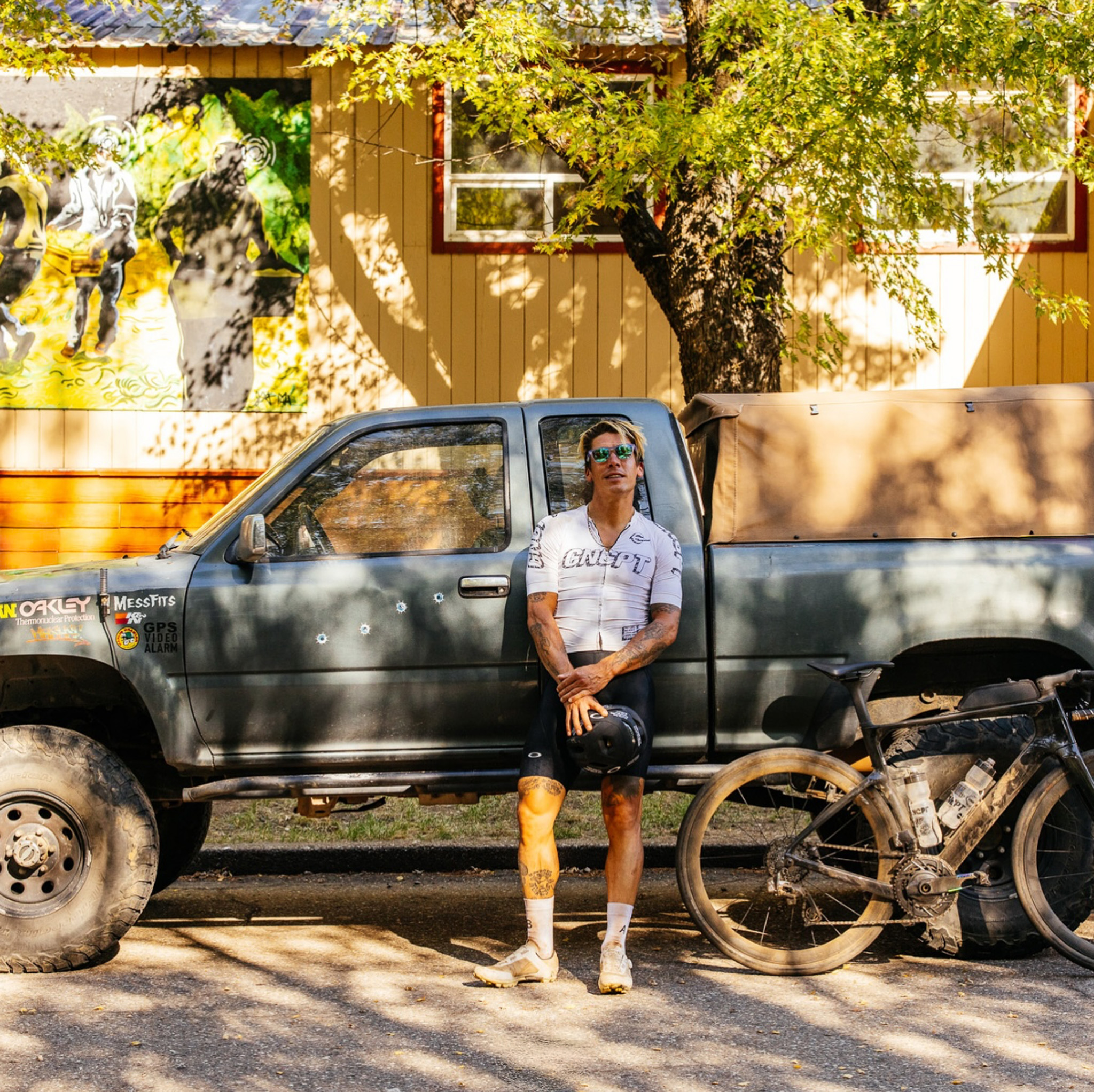
That’s funny you mentioning my truck because tomorrow I’m picking it up from the shop after two months of them working on it. And it’s not that I place much importance on physical objects—I’m more of an experience based person—but that truck, for me, is a symbol of freedom. In the way that it handles and drives, it’s just like a track bike. And like my knee, the engine got a rebuild and we’re both good to keep on going.
Click an image to open gallery

cyclespeak
Looking back at your auctions to fund the engine rebuild, what’s your relationship with stuff?

Chas
It actually comes with a significant amount of stress. So the truck gave me the impetus to shift a lot of it in order to raise the funds I needed to get the engine fixed. And you want to know the worst thing? It’s the fact that none of it was being used. All that race gear might hold a sentimental value to me but it means a lot more to know that someone else is wearing my old MASH kit out on their rides.

cyclespeak
So a cathartic process?

Chas
It was. A trip down memory lane when I was sorting everything out. Race kits with a hole in and I was like, “I remember that crash.”

cyclespeak
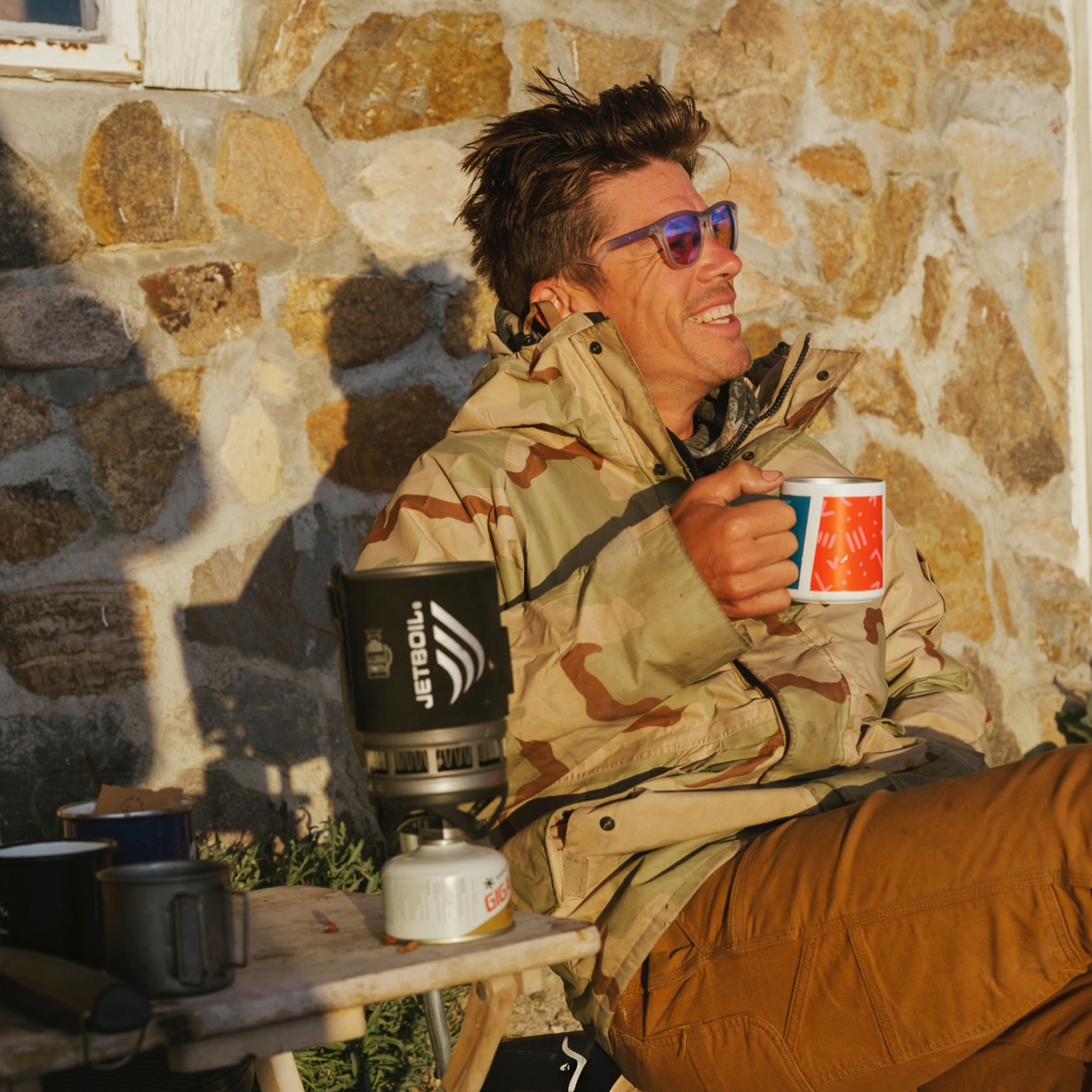
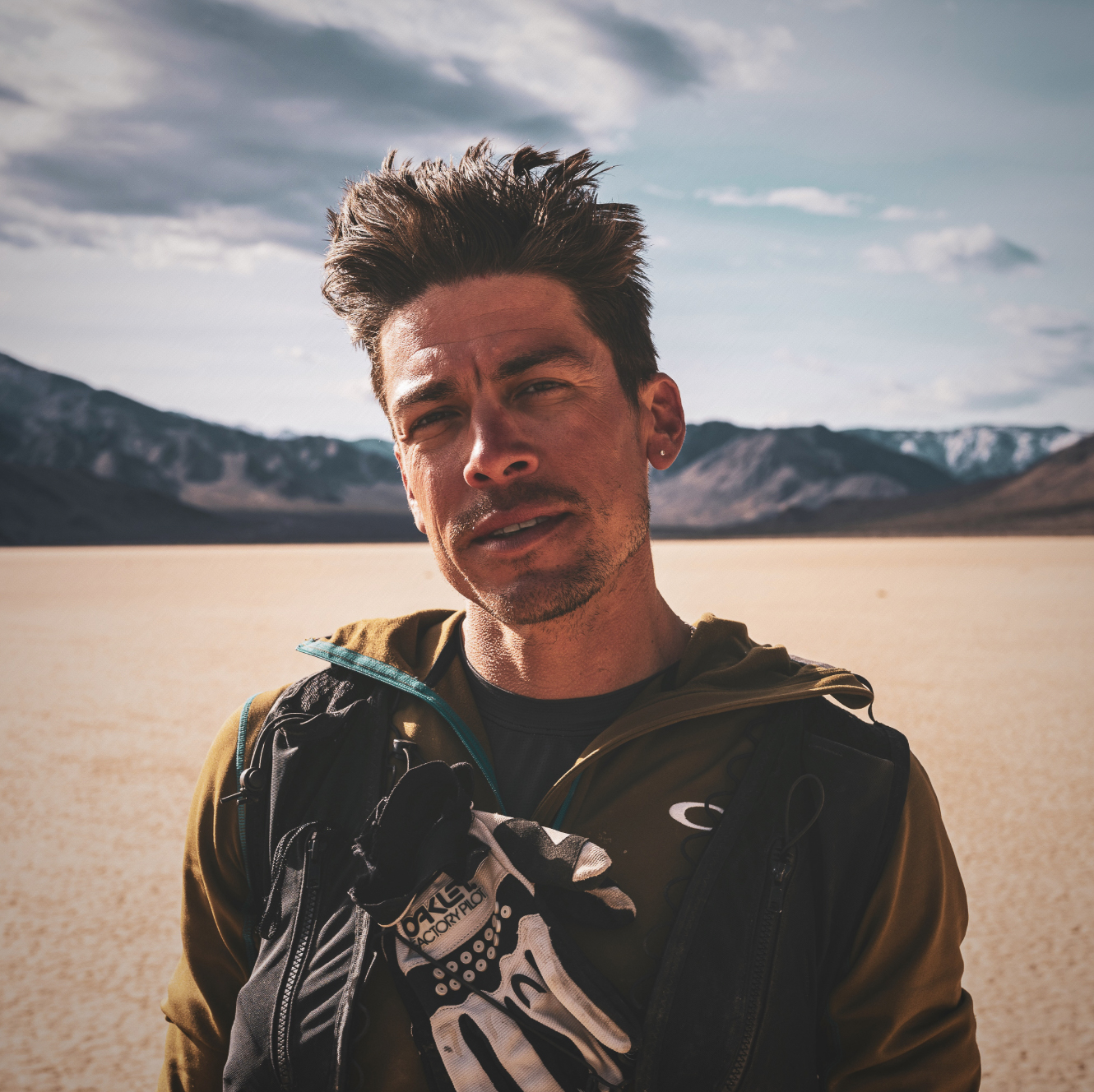
You frequently mention the freedom of travel and new experiences. And Death Valley seems to have a pull on you in that sense. Is that where you do some of your physical and mental sorting out?

Chas
There’s something about the expansive nature of that locality combined with the utter remoteness and the necessity to be self-supported. All that gets me to a place where I can mentally cleanse myself. Sometimes that’s by myself, other times when we organise our annual group ride. Which, when they first started, were really small but this last year we had 28 people and was probably my favourite thing I’ve done this year.

cyclespeak
Going from the social media posts I saw, you had 28 people and a whole bunch of fireworks.

Chas
Hey, woah. It’s a national park. I don’t know what you’re talking about [smiles]. But you know what? I like a little childlike fun in my life. And for whatever reason, fireworks take me straight back to the twelve-year-old Chas.
Click an image to open gallery

cyclespeak
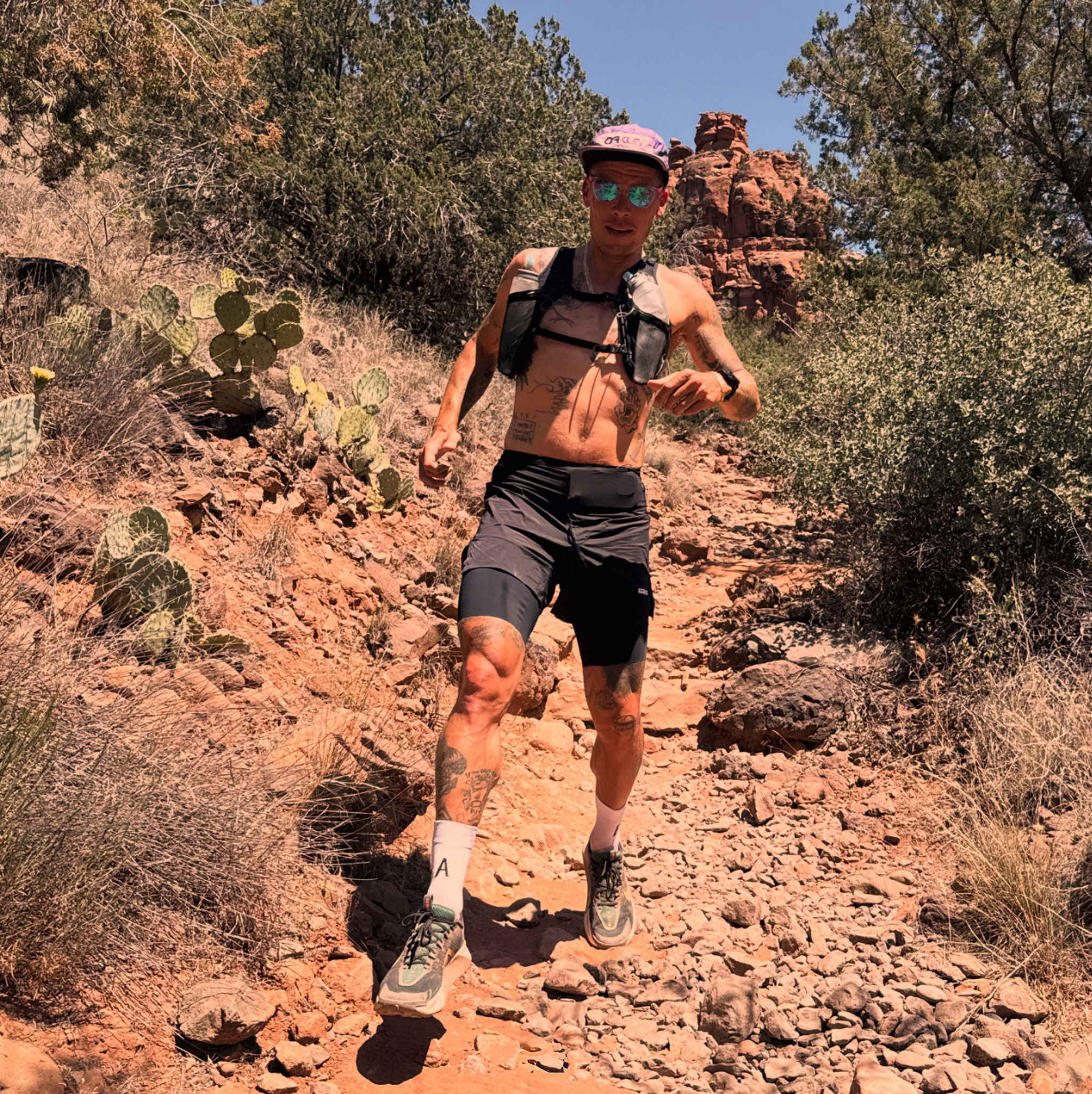
From riding to running, and I’m not talking about a quick jog round the block. One of your early sorties saw you take on a 40 mile ultra in Arizona.

Chas
As I was recovering from surgery, my PT told me that if I ever wanted to run again, I needed to get moving. I guess you use it or lose it and my mind has to recognise that the impact on my reconstructed knee from running is a good thing. And then as I’ve been starting to transition away from pro cycling, it’s a space where nobody knows who I am. Which means that my running acts as this release valve because it allows me to still use my body and get what I need out of sport without all this weight of outside expectations. And here’s a little sneaky secret. Running led to swimming so I’ve registered for a half Ironman. Which makes me question who I’ve become because if you’d asked Chas, 15 years ago, if he’d ever do a triathlon, he would probably have punched you in the face.

cyclespeak
I was researching the 50k Taco Bell run in San Francisco that you competed in and it stated that no outside nutrition is allowed except supplements like tequila and caffeine.

Chas
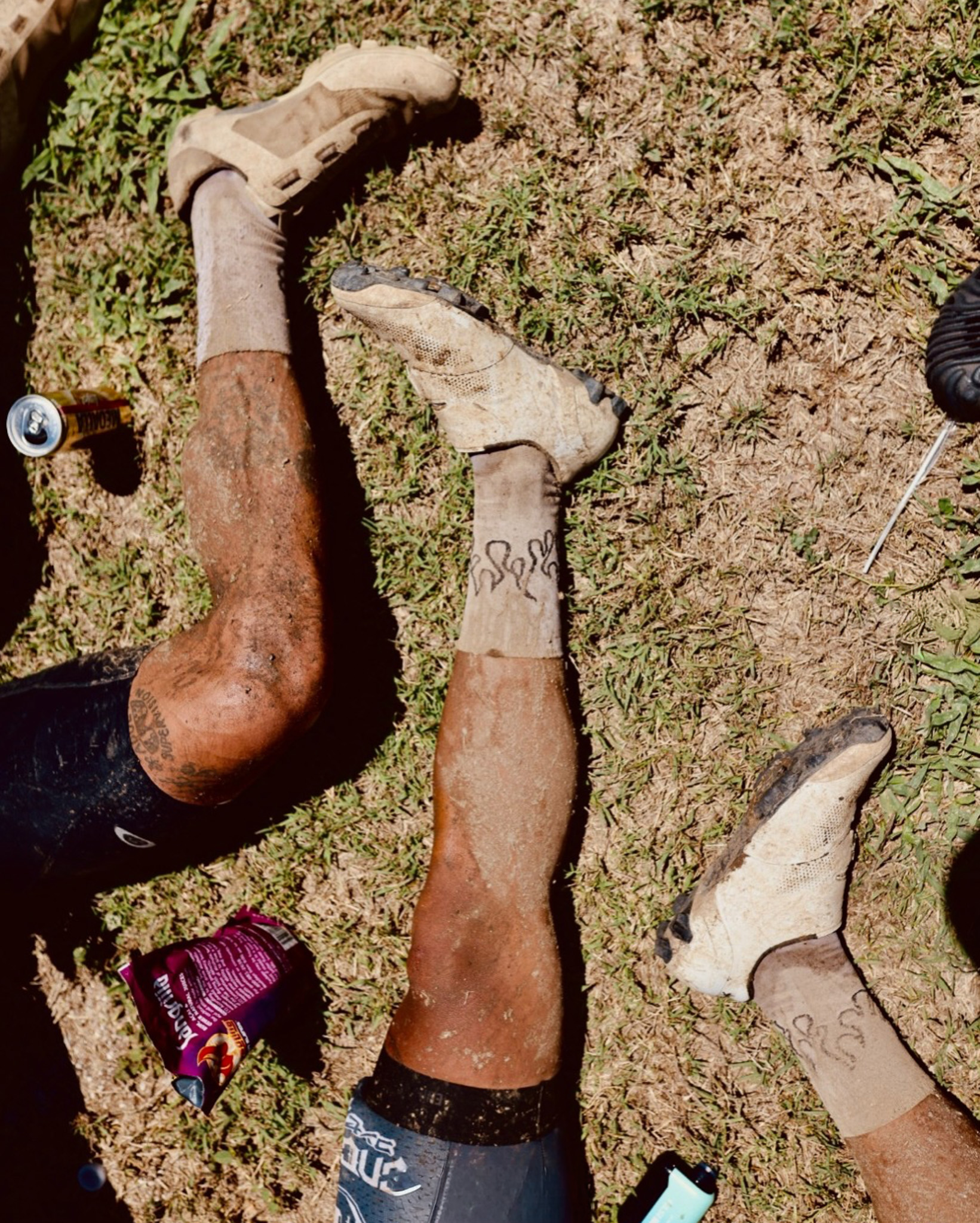
It’s a wild event. An unsanctioned version of a totally legit, sanctioned race that takes place out in Colorado. And I’m lucky to have this great group of friends that, like me, don’t take themselves too seriously. An attitude that matches this event perfectly because to run 50k—in a weird, mildly painful way—is no small feat.
Click an image to open gallery

cyclespeak
Weird, painful?

Chas
You run between nine different Taco Bells and only eat whatever they have to offer. However, if it’s a Taco Bell Cantina, you can substitute the food for a shot of tequila. But just watch out for those hot sauces. Too many and they’ll catch up with you.

cyclespeak
You lined up for The Rift in July. The 330 km ABYSS ultra route. Was that in any way a shakedown event for the Silk Road Mountain Race?

Chas
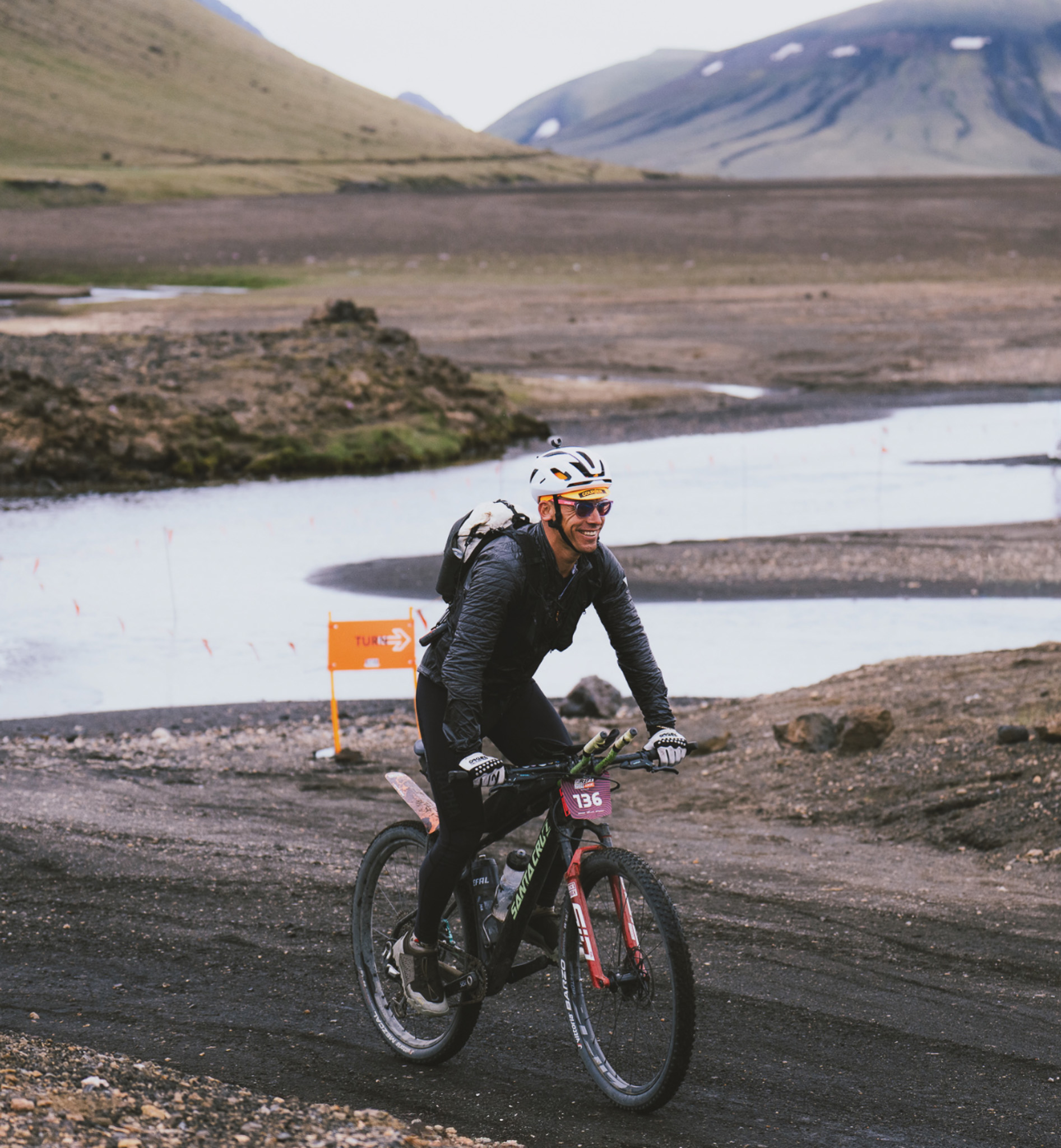
I’ve always loved racing in Iceland and my buddy Chris Burkhard hit me up about the event. The timing for Kyrgyzstan worked out as I could return home for a couple of weeks before heading out again for Silk. But then, with my decision to not travel out to Kyrgyzstan, this changed how I felt about The Rift. Would this be the last ever time I raced professionally?

cyclespeak
Which sounds quite momentous?

Chas
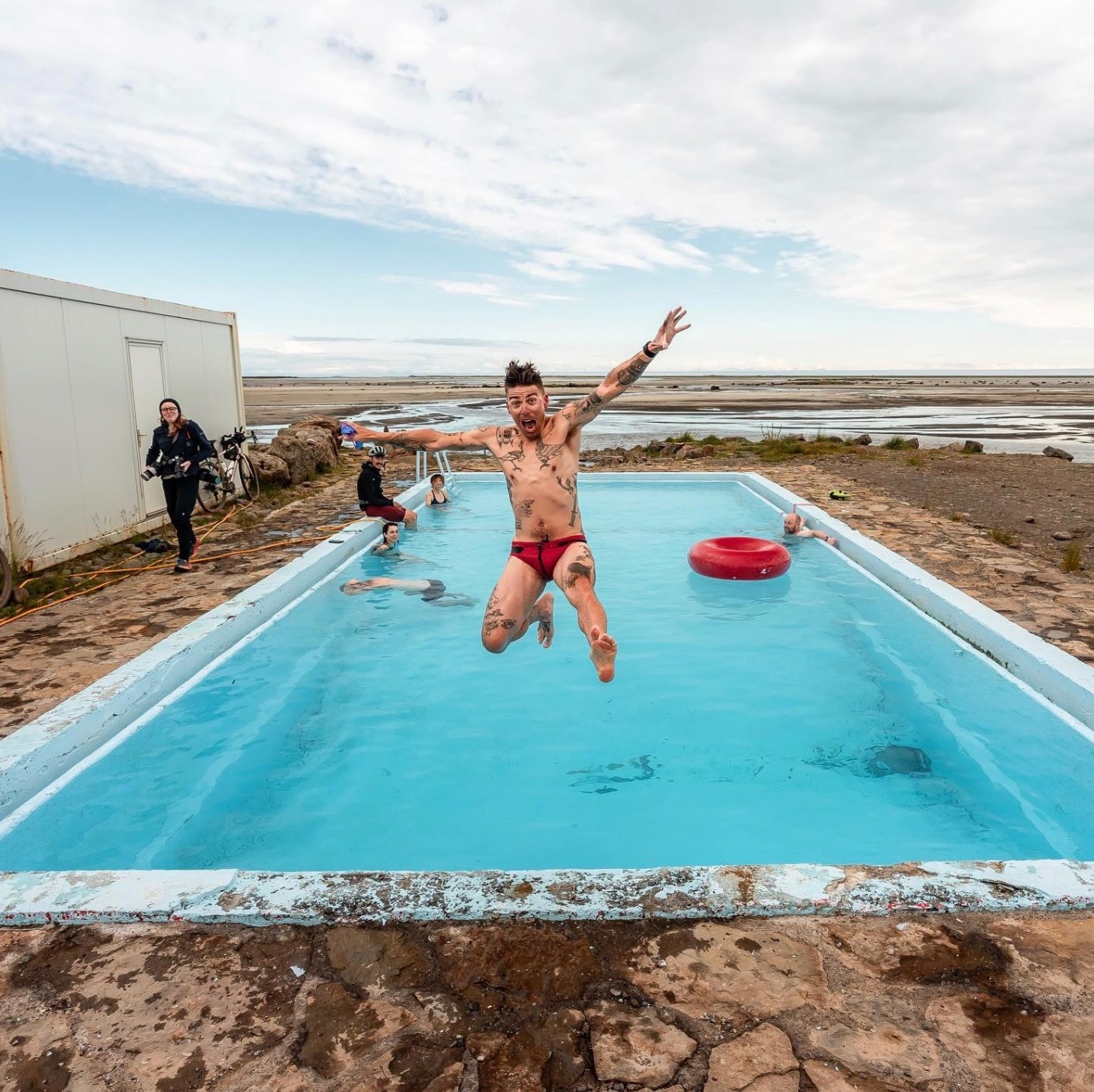
In some ways it was my swan song. An opportunity to take it all in, enjoy it, and acknowledge what an amazing journey this has all been. And Iceland is the perfect place to have all those thoughts because you’re riding at four in the morning through what is essentially another planet. So it proved to be a really positive experience and a reminder that I still love to race my bike and have all those great sensations.

cyclespeak
Which brings us to July when you posted the following: I’m not racing @silkroadmountainrace this year because my heart and head are not there…and that’s ok.

Chas
Silk had been on my calendar for years. The race I was supposed to race but then my knee surgery got in the way. And even throughout my recovery, it was the shining star of motivation. So a good couple of years working towards it but also, if I’m honest, a couple of years knowing that it’s not really what I want to do.
Click an image to open gallery

cyclespeak
Can you put a finger on what lay behind those feelings?

Chas
I’ve been working on a bike for 20 years. I started as a bike messenger in 2006 and I’ve been a professional cyclist for the last 12. And you get to the point where you’re doing things because it’s your job. And there’s nothing wrong with that. That’s the reality for most folks. But I was travelling to all these different places and having what you could describe as once-in-a-lifetime experiences and my heart and head weren’t in it.

cyclespeak
So stepping away from Silk?

Chas
Was a way of wilfully breaking the cycle. Because our trip was fully funded, we had money to make a film, kind of a dream scenario. So walking away meant something.

cyclespeak
You’re talking about accountability?

Chas
When I first started to earn a living riding my bike, I promised myself I would say yes to everything. So to flip that on its head and say no to Silk was a pretty big deal. And let’s not forget that I was down to race as a pair with my buddy Alvin. Which brings with it a whole other level of consideration if I were to line up with him, knowing that mentally I wasn’t there. We’d done a bunch of training and I knew that he was super motivated and one hundred percent good to go.
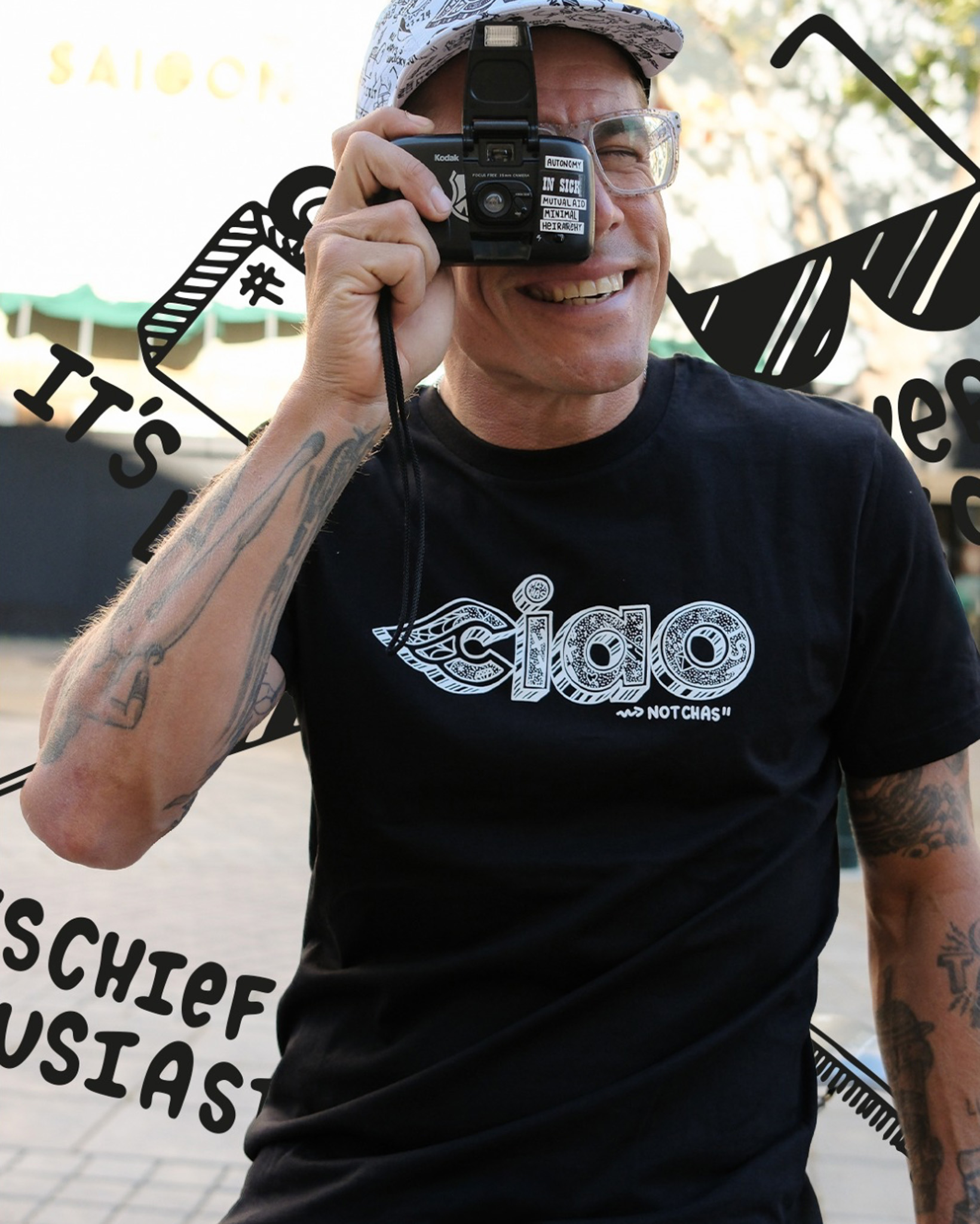
Click an image to open gallery

cyclespeak
So saying no to that…

Chas
Was me wanting to take a step back. And although it’s scary, I do believe I’m regaining agency about what makes me happy and what I want to do with my life. Something I’ve not been feeling in a really long time.

cyclespeak
Was it important to announce this decision to the wider world?

Chas
I think I’m big on accountability. And I’d been talking about racing Silk a whole bunch so it seemed appropriate to make a statement and close the circle. As opposed to simply ghosting away. Because the past couple of decades have seen me experience incredible emotional highs but there have also been really low points that I never gave credence to. I just steamrollered on to the next high. And it had got to the point where I was travelling three weeks out of every month, 10 months of the year. So logistically, in a real world sense, I never stopped and took the time to work through any negative feelings I was having. But here’s the rub…I love this. It’s the coolest job; travelling the world to race bikes with my friends in crazy places. So I knew that if I didn’t make my decision about Silk public, I’d just keep backsliding and nothing would change.

cyclespeak
Is there ever any pressure to inhabit the best-of reel of these highs that you mention? Almost as if you’re playing a character?

Chas
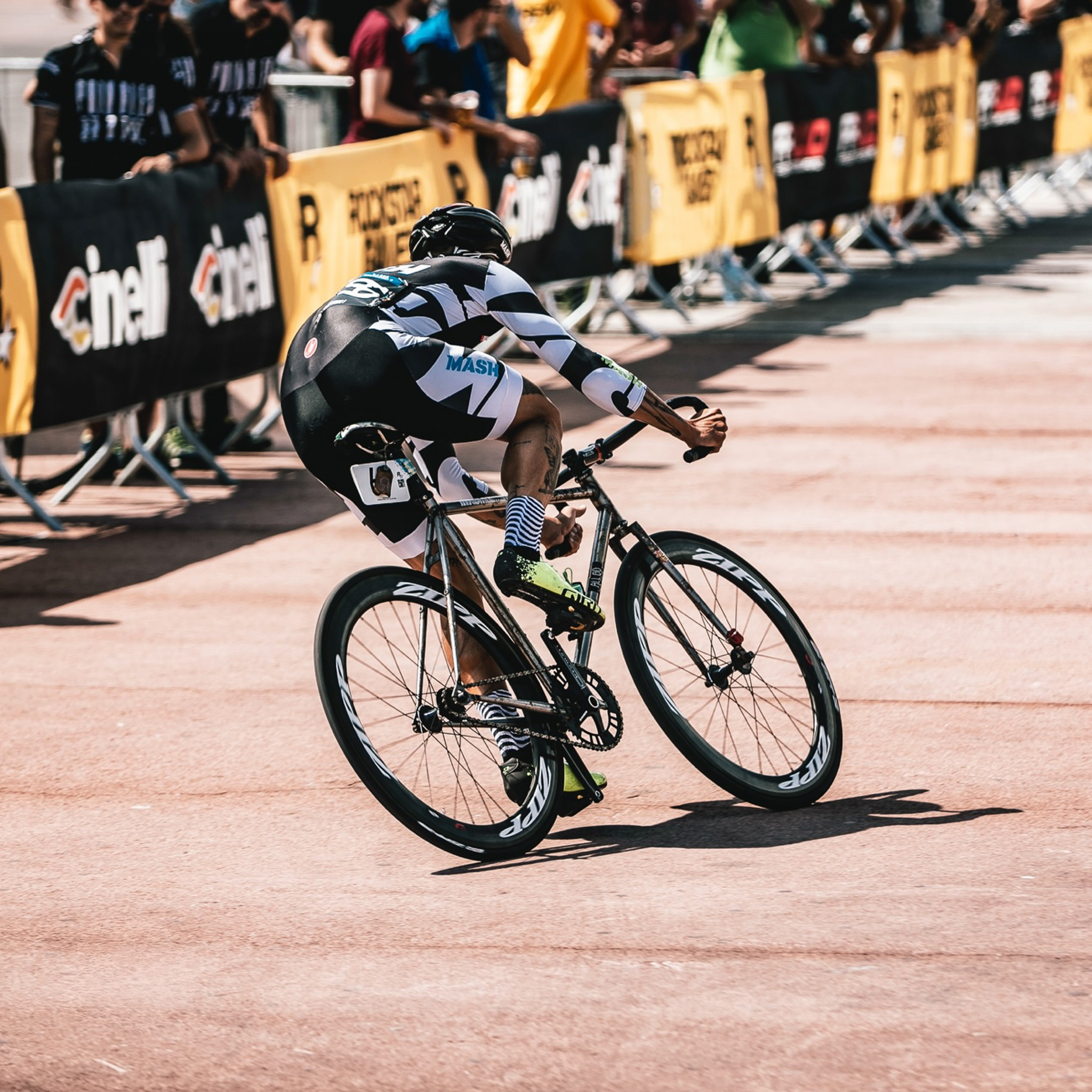
There’s no doubt about it. I’m Notchas. And that’s one hundred percent authentic which I guess is why it resonates with so many people and the brands that have supported me over all these years. But that being said, I kind of lost sight of what I actually need in my life. The things that will sustain me both physically and mentally in my search for the stoke. Because the search is real and like you said, my life had turned into a highlight reel.
Click an image to open gallery

cyclespeak
Personally, I believe we’re living through troubling times. There’s still joy to be found but also hardship and uncertainty. So where and how do you seek strength and support?

Chas
That’s a big question because when I look at all these changes that I’m going through, for the longest time I simply ignored any perceived problems because I had this singular focus on the trip, the travel, the race. So I’m now having to learn how to deal with all that. Which is why I’m trying to focus on the things that I care about—the friends and the family that bring joy to my life—rather than simply burying it all and getting on the next flight.

cyclespeak
So what’s next?

Chas
TBD. Partly because I didn’t fully realise how structured my life has been. I thought it was the exact opposite but, when I took a step back, it all started to make sense. There’s contract season which needs negotiating, then you get your race calendar set up, which in effect sets in stone the whole year. Factor in the January training blocks and next thing you know it’s November. So I’m still going to race bikes but I’m really leaning into the idea of things being less structured. And what that will look like is me being self-funded—which might prove interesting—and with more focus on quality over quantity.

cyclespeak
So when you wake up in the morning, what’s the first thing that goes through your head?

Chas
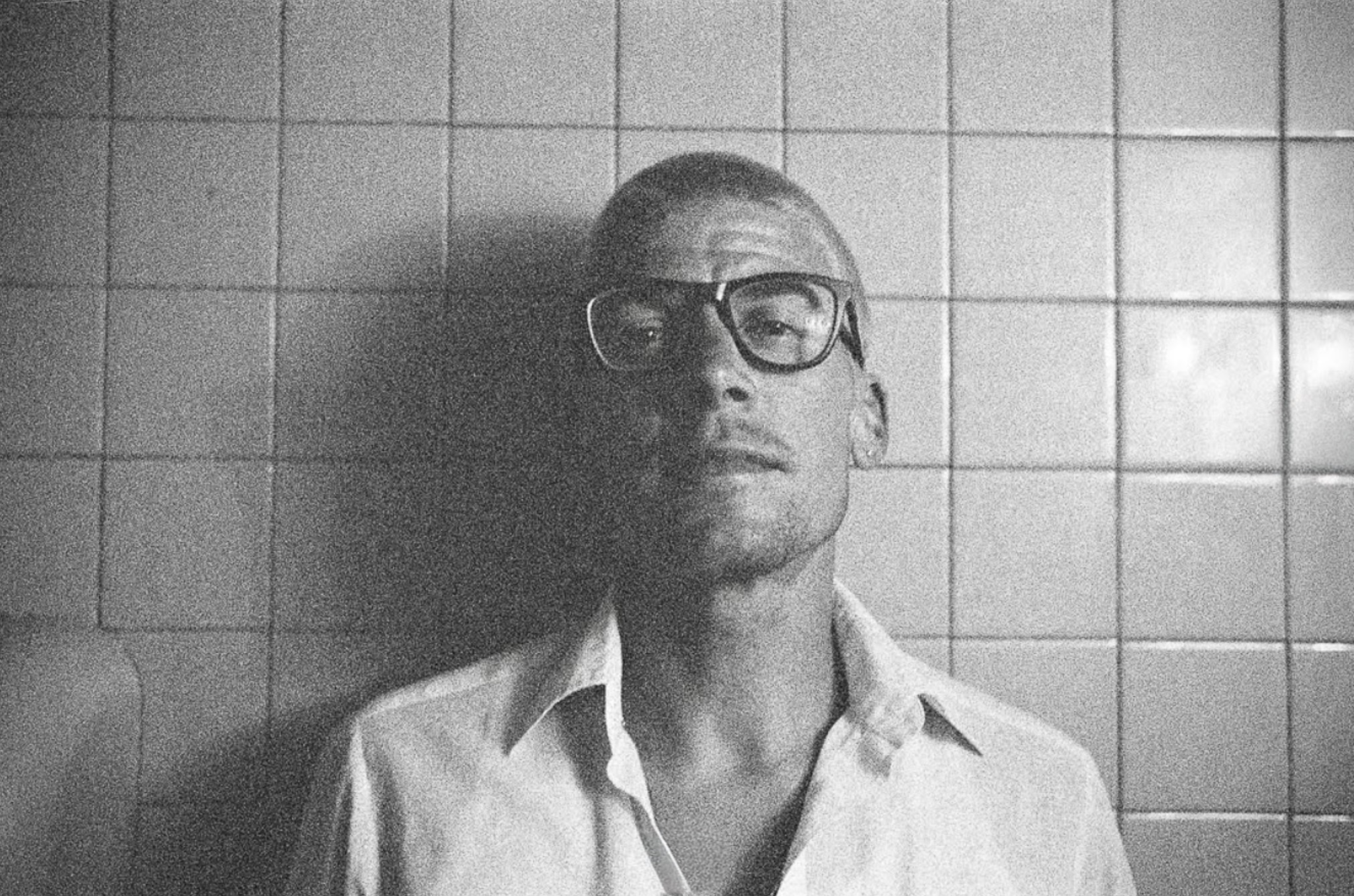
Right now? If I’m being honest, it’s fear. For the past couple of decades it’s been the next thing and the next but now there’s a lot of uncertainty in my life. And although this decision was my own to make, there’s an element of what am I going to do today. So I’m excited but also trepidacious. Which is an interesting place to be in life.
Click an image to open gallery

cyclespeak
Can I suggest that a lot of people live their lives as a compromise? They feel they have to do this or that job—that might not excite or stimulate them—to cover their rent or mortgage payments. And they might daydream about breaking free from society’s shackles and perceived expectations but never find the strength or support to take that first step.

Chas
This has been, by far, the hardest year I’ve had in my 41 spins around the sun. And I’ve ridden a fixed gear through city traffic for a living. But the idea of creating life change and seeing it through is pretty scary. And I laugh about it because I still have this PMA* and out of all the challenging things that I’ve done—things that a lot of people would consider insanely hard—this is actually what terrifies me on a daily basis.

*positive mental attitude

cyclespeak
If we can wind the clock back to last December, you posted these poignant words: The cracks are where we grow, everything that goes wrong is an opportunity to get it right. Was the time of that post significant—it being winter—or was it more dictated by these life changes you’ve been describing?

Chas
Full transparency, I separated from my long-term partner late last year. And that has been a significant part of this whole process. And for someone who’s relentlessly—might I say toxically—positive, being able to embrace the cracks, the things that go wrong in life, and see them as opportunities for growth, is something that I’ve been really working on.
Click an image to open gallery

cyclespeak
You’re talking about resilience?

Chas
Resilience is probably one of the most important character traits we can develop but that’s not to diminish the difficulty of picking yourself up off the ground when things go wrong. That can be hard. And what I’m coming to terms with is that it’s okay to take a knee and acknowledge that things are difficult. Which isn’t easy when you have this idea that there’s only one path forward—which when you crash in a race means getting back on the bike and getting to the finish. But where I’m at now, is questioning whether there are other goals that I want to pursue. That it’s okay to take some time to reset before going in a different direction.

cyclespeak
What I find super inspirational is how you acknowledge these tough times but still come out swinging.

Chas
You take Instagram as an example. There’s this feeling that everyone on the platform is leading this perfect life and I’ve certainly been guilty of only showing the good parts. But that’s not everyday life, I don’t believe anyone gets to live like that all of the time, and why would you want to? You need the downs to define the ups. So in sharing all this, maybe I can signal that it’s okay to have difficulties. That you can embrace them and process them. Which is something I never did before but I’m trying real hard to do now. And when all is said and done, the really important part is you just get back up and do something.

Feature image by Matthew Reamer

All other photography with kind permission of Chas Christiansen (photographers credited individually)

notchas.com

Chas Christiansen / In search of the stoke

Former bike messenger, fixed-gear legend, artist, photographer, and bike aficionado; Chas Christiansen offers up an intriguing narrative on embracing each and every opportunity. Threaded through with a rich vein of self-deprecating humour, this Oakley wearing modern day Renaissance Man offloads on the hits he’s taken, the hardwon moments of clarity, and his continuing search for the stoke.


Chas
Hey! Whatsup?

cyclespeak
All good here. Especially as the stars are aligned for our call. I was driving into Manchester early this morning, only to pull up behind a plumber’s van and see one of the stickers adorning the rear doors spelling out CHAS.

Chas
Well there you go.

cyclespeak
You’re calling from home?

Chas
This is my basement studio space. Or more technically—because there’s a risk of earthquakes in the San Francisco Bay Area—my first floor above ground.

cyclespeak
We find that all very confusing because your first floor is our ground floor.

Chas
Oh, I hear you. And, in the States, if you do see a button marked G in an elevator, you might press it expecting the ground floor but in fact it takes you to the garage.

cyclespeak
You mentioned San Francisco as home?

Chas
Actually it’s Oakland. And that’s a big distinction for the locals.

cyclespeak
So it’s important?

Chas
Oh definitely. It’s a little like comparing Manhattan to Brooklyn.

cyclespeak
So which one is a) cooler and b) more affordable?

Chas
That’s a tough question [laughs]. And I’m going to say Oakland for both.


Click on image to enlarge

cyclespeak
Has Oakland become cooler since you took up residency?

Chas
Not at all [laughs]. But what I can say is that a lot of what I liked about San Francisco has changed—which is the nature of cities—yet Oakland still retains those key aspects that make it feel like home. There’s more of an artist based community, things are less driven by money, it’s a little more bohemian.

cyclespeak
I’m guessing Chas is short for Charles.

Chas
It is. Charles William Christiansen.

cyclespeak
Does anyone call you Charles?

Chas
The police and my grandmother. My Mom changed to Chas. And I definitely don’t answer to Chuck.

cyclespeak
You’ve just had a show of your artwork and photography open in San Francisco. I’m guessing a busy, fun-filled, exhausting weekend?

Chas
I have not been this fulfilled in quite some time. On so many different levels. I’ve had all this stuff bouncing around in my head for years, so to see it all come together felt amazing. But it was the response from my community that was especially touching. My whole goal was to recreate the scene from a decade ago when we’d visit gallery after gallery on a Friday night before all ending up at a bar. And at the opening night of my show, I had the same feeling as hundreds of people spilled out onto the street.

cyclespeak
Bikes, bike racing and artistic endeavors all seem intertwined in how you live your life. And your show was titled Born to fuck around, forced to find out. So looking back to your childhood, were you raised in a creative, outdoorsy environment?

Chas
Not really, no. I grew up outside of Olympia, Washington. Lower middle-class, so not poor but we definitely didn’t have a lot of money. We’d go camping every once in a while and I remember hiking a couple of times. As for being creative, I’ve always been into drawing but the house wasn’t filled with art.

cyclespeak
On your Instagram feed, there’s a certain confidence you exude when you engage with the camera. And I was wondering whether you were one of the cool kids at school, possibly an extrovert in class, or maybe kind of shy and retiring?

Chas
I think it’s fair to say that I’ve always had the ability to connect with people. But I was more of a nerd and definitely not one of the cool kids. I was a reader, I worked at the theatre and hung around with the drama kids. And I was a skateboarder, I was into punk and had a mohawk. So quite a mix but, at the same time, I went to all the parties and was on good terms with everybody.


Click on image to enlarge

cyclespeak
A planned career travelling the world in the Merchant Marine was cut short after you were arrested for tagging a building. And after paying your dues, you eventually landed in Portland where you could snowboard. And I believe you were known for driving up to the slopes in your convertible, fully kitted out and wearing snow goggles?

Chas
Yes, sir. That sounds about right [laughs].

cyclespeak
So how did you end up working as a bike messenger?

Chas
I rode bikes as a kid but was never super serious about it. But that convertible got me into some trouble to the tune of 22 speeding tickets in two years. So finally they took away my licence—funnily enough on the way up to go snowboarding—when I was pulled over literally a hundred feet from the resort. They arrested me, took me down to the station, impounded my car and that left me without any means of transport for getting to work.

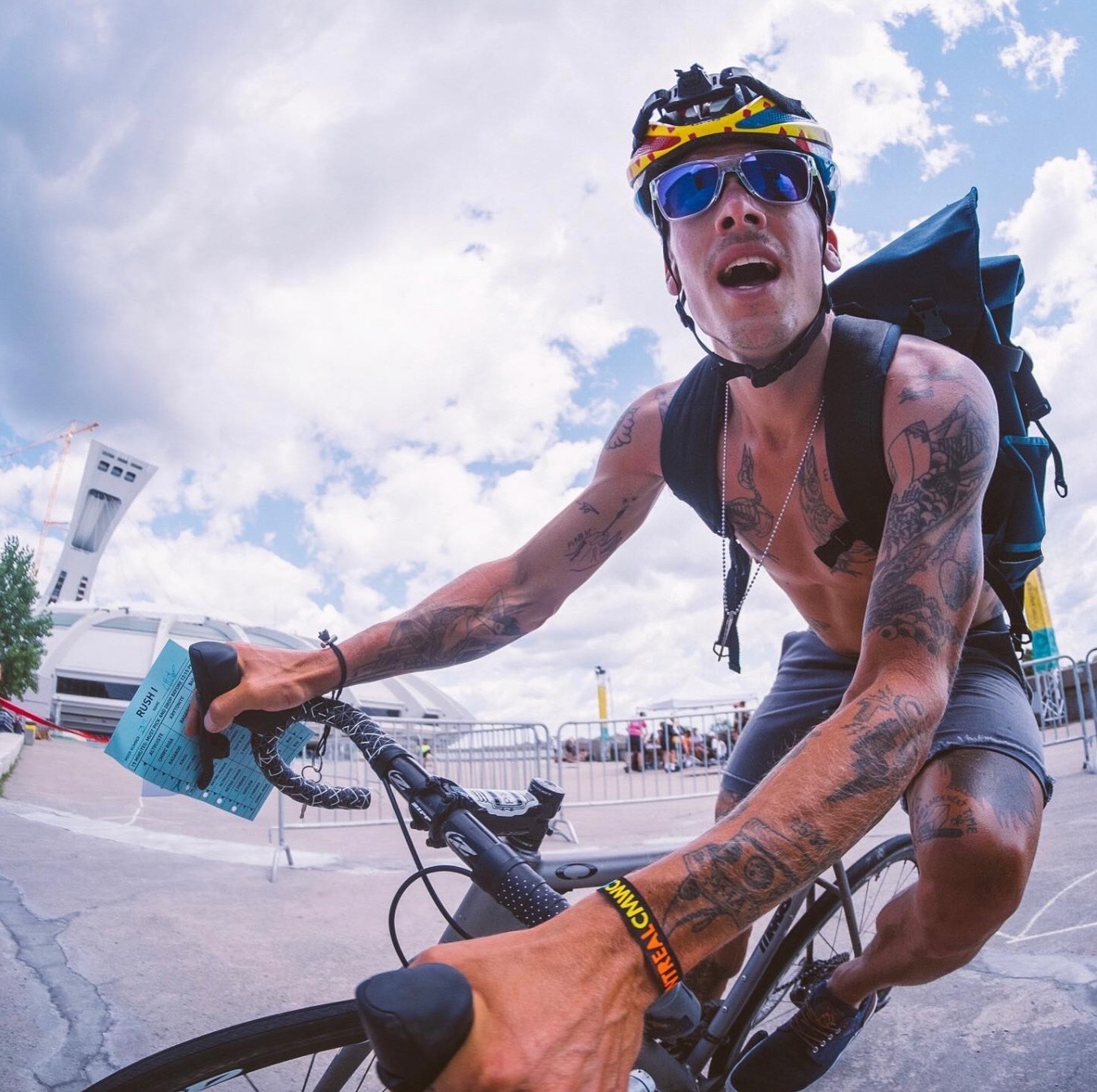
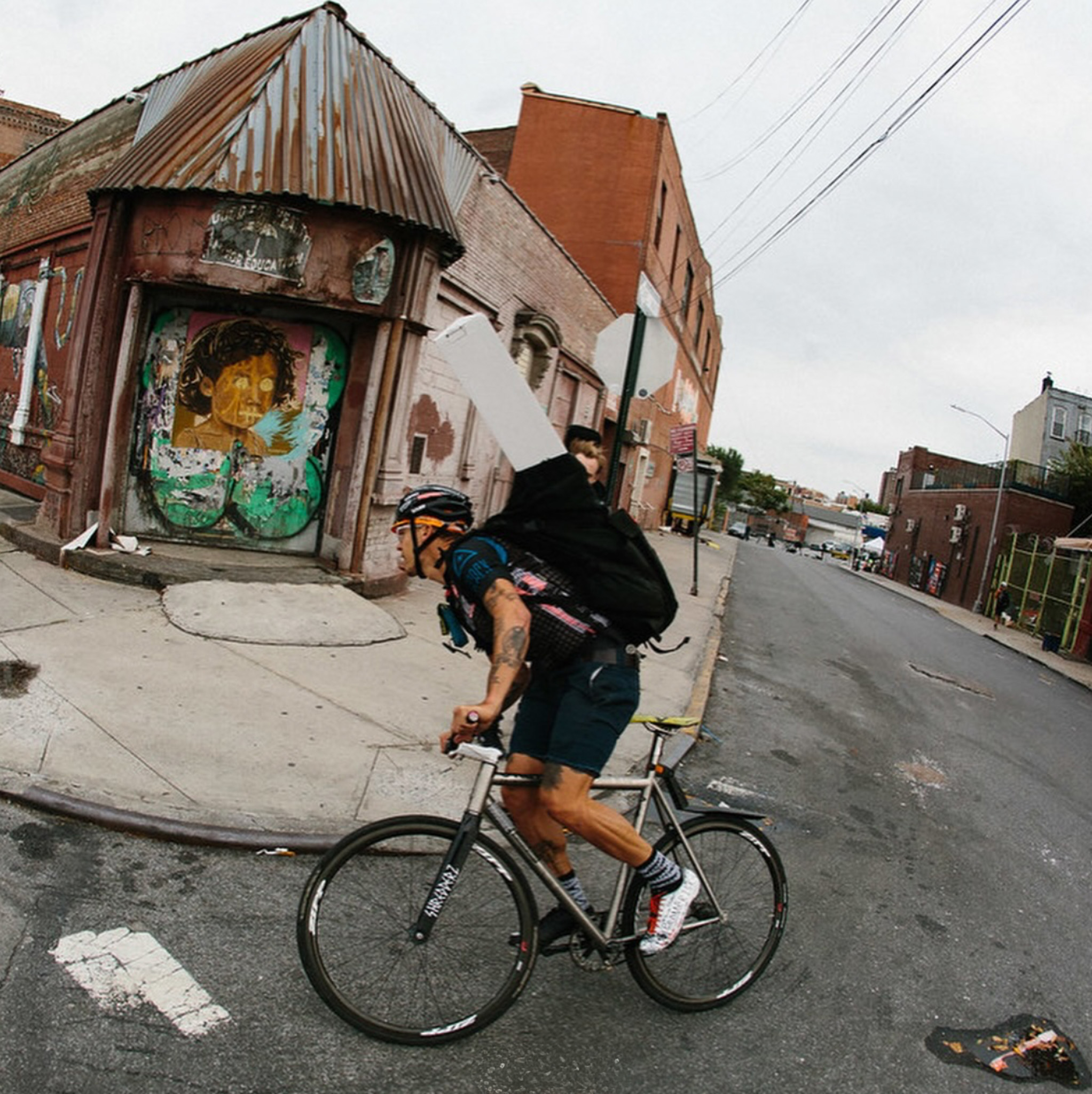
cyclespeak
Which is where the bike comes in?

Chas
I was washing dishes at this super fine-dining restaurant and one of the servers suggested I get a bike. He even took me to a bike shop and sorted me out with this old Fuji cyclocross frame. So there I was, riding to work, and beginning to notice all the different people commuting by bike. The ones that always stood out were riding these super sleek bikes. They all had tattoos and looked cool but it was the way they’d skid that really got me.

cyclespeak
I can see the attraction.

Chas
Eventually I figured out they were bike messengers and there was this alley-cat scene. At that time I wasn’t earning a lot of money, was pretty broke, and the only cycling kit I had was hand-me-downs so I felt really out of place. But they were wearing cut-off shorts and a tee. And it just hit me that these were my kind of people.

cyclespeak
And a potential new scene to explore?

Chas
Absolutely. So in my lunch break—I was now working as a butcher—I would chase them all around downtown and, in the process, get them all super annoyed. Until finally, one of them took me aside and told me to meet them later at the Ash Street Saloon. I showed up at the appointed time, paid my five dollar entry fee, and raced my first alley-cat. And that’s when I had this moment of clarity. Because these people got paid to ride their bikes. I was a fucking butcher and packed sausages for a living.


Click on image to enlarge

cyclespeak
So you decided to switch career paths?

Chas
I kept on racing alley-cats until this messenger guy told me he was leaving Portland and did I want him to put in a good word for me to take over his job. So he did, I went in and talked to the dispatcher, got the job and quit being a butcher.

cyclespeak
It does look amazingly cool but what were the realities of your life as a messenger?

Chas
It’s the best, worst job in the world. You’re essentially given these tasks but then left to your own devices to figure out how to complete them. So there’s plenty of opportunities to learn about self-sufficiency and every day is different. There’s this fucking amazing community but the downside is that this same community can also be really toxic. It’s not a job with a lot of upward advancement and there’s a lot of partying and drug use. So it’s fun when you’re young but if you’re still drinking with the boys and girls into your thirties, it can start to wear on you.

cyclespeak
So a hard life?

Chas
It kills your body and that’s not just the partying. It’s a physical job and you take hits. I’ve had scrapes with so many cars and there’s no health insurance by and large so you inevitably go back to work before you really should. I was fortunate and got out at a good time—it helps to have an exit strategy—but my knees are still shot.

cyclespeak
You did more than get out of it. You founded the messenger company TCB*.

*Taking Care of Business

Chas
That’s another thing. You should never form a bike messenger company if you want to make money [laughs].

cyclespeak
It’s like they say: if you want to make a million in the cycling industry, start with two.

Chas
Exactly. But I’d worked as a messenger for enough shitty companies that I wanted to ensure that everyone who worked for TCB made good money and was taken care of.

cyclespeak
How long did it take before you were riding fixed without thinking about it?

Chas
A couple of years at least. When I first started riding a track bike, I was all over the road. And it honestly wasn’t until I moved to San Francisco and had to really deal with the hills that my confidence grew. But even then I took my fair share of hits and left skin on the ground.

cyclespeak
But eventually there’s a moment when things just click into place?

Chas
It got to the point where I would ride two or three miles through congested downtown traffic and not remember how I got there. Yes, I was conscious of talking over the phone and the dispatcher’s voice on the radio, but the actual movement between drops was a blur. So maybe that was my 10,000 hour moment when I could ride through traffic without the need for conscious thought?


Click on image to enlarge

cyclespeak
Was this the gateway to racing Red Hook?

Chas
I think it was. Because David Trimble started Red Hook so that his bike messenger and road-race friends could all come to his birthday party. But even though I regularly rode alley-cats, I didn’t come from a professional racing background. There had never been any talk of watts, a training plan, stretching, or a racing kit. Recovery, for me, was slamming three beers before crashing out on the couch. So Red Hook was probably the easiest way that I could step into sanctioned racing and rub shoulders with professionals. You spend enough time with those guys and things start to rub off.

cyclespeak
And then gravel came calling?

Chas
That was the Grasshopper adventure series. And back then, they were essentially alley-cats. You would show up at this small town in northern California and they’d give you a spoke card with the route printed on the back. And that just connected with me. You had to figure it out without recourse to a smartphone or GPS device. You were self-sufficient and left to your own devices which is pretty much how being a bike messenger works. And then stepping into ultra-distance racing with the Transcontinental, it’s basically just an even bigger alley-cat. You start here, end there, and there’s four checkpoints you need to pass through. It might take two or three weeks as opposed to four hours but I already understood the concept.

cyclespeak
You scaled it?

Chas
One hundred percent. From racing city streets to racing across continental Europe.

cyclespeak
On your website’s Garage page there’s a ​​No22 Little Wing titanium track bike that you term a forever bike. And that got me wondering why you could never part with it? Is it the memories it embodies, or the way it rides?

Chas
Kind of all of the above. I rode for MASH for a really long time and No22 was the first bike company that supported me after I stepped away from Cinelli. And I was intrigued by titanium—in the room next door there’s a huge stack of broken aluminium and steel frames—and I just hope, when I’m 65, that I’m still riding that track bike down to the coffee shop.

cyclespeak
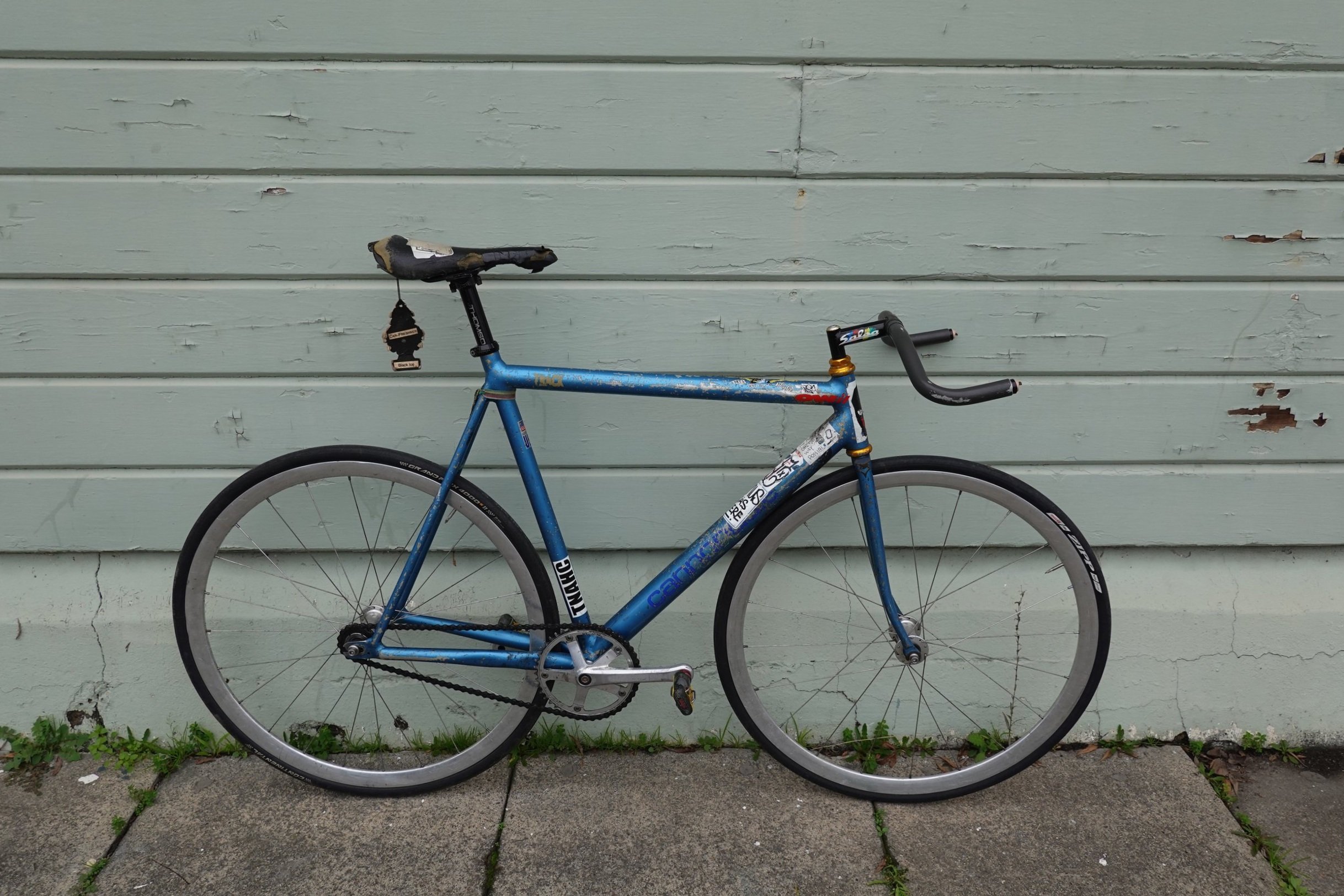
Another Garage bike—I could happily go on, referencing each and every example—is a 1993 Cannondale track bike that you rode the shit out of as a messenger in Portland. A bike you term a unicorn. Can you put into words what it feels like, both physically and emotionally, to ride fixed through the city streets?

Chas
This is going to sound a little trite but there’s this connection to a machine that is purely instinctive. And when you pair that with flowing through city traffic—faster and smoother than any other vehicle—you get this intense feeling of freedom. It’s very intuitive so mentally you’re disconnected from the physical. And because it’s fixed, you’re not thinking about what gear you’re in or when to hit the brakes: it’s this gap, that gap, make the light. You’re not looking immediately in front of you, you’re looking ten moves ahead. Dodging and weaving—your heart rate elevated—and it’s those moments that I feel the greatest sense of freedom because I’m not constrained by anything.


Click on image to enlarge

cyclespeak
Just backing up to your first Transcontinental, on the face of it that was a big leap into the unknown. But you’d already ridden from Portland to Chicago to attend a messenger race. On a track bike, with a paper map.

Chas
That’s what’s so funny about the move to ultras. Because like you said, we’d already been doing it forever. But what got me to the start line of the Transcontinental, was the kit company PEdALED hitting up me and my forever partner in crime, Nico Deportago-Cabrera.

cyclespeak
And what did they say?

Chas
They told us there was this thing and they could get us in if we wanted to do it. And we were like, why not? Because at that time, if pretty much anyone was offering us an opportunity to travel, the answer would be a yes.

cyclespeak
So you were in.

Chas
But with no fucking clue as to how big a deal the Transcontinental was. To the extent that we got a lot of beef when we scratched at the fourth checkpoint so we could go race the Cycle Messenger World Championship. I can remember handing over our trackers at the top of some mountain in Romania and thinking, fuck, how do we now get to Montreal in 49 hours? But we muddled through and when we got home, discovered the internet was really pissed off with us. Nico did the research and it was, dude, this ultra-racing is a really big deal. Which was the main motivation for going back to the Transcontinental the next year and finishing.

cyclespeak
I guess there’s a physical and mental aspect to both a fixed-gear crit and a multi-day, ultra-distance race?

Chas
Mental strength and self-sufficiency play a huge part in both alley-cats and ultra events. However you want to do it, is how you do it. Yes, there are some rules that determine how the race goes down, but no one is really saying that it has to be this or that way. And when all’s said and done, it’s about not taking setbacks as the end of your race.

cyclespeak
But there is a difference between the disciplines?

Chas
As I see it, if you win a fixed-gear crit, you go to the podium and the crowd is screaming. But when you finish an ultra event, most of the time nobody is there. And there’s been times I’ve wrapped up my race at 3:00am in a parking lot and just started crying. So if you put me on the spot, I’d say that finishing within the time cut of an ultra is a more fulfilling experience.


Click on image to enlarge

cyclespeak
Can you picture one of your lowest, low points in a race and describe how you dug yourself out of that hole?

Chas
I didn’t. Because sometimes you don’t. And that’s the hard truth of not only ultra-distance racing but of life in general. I entered the inaugural Atlas Mountain Race in Morocco as a pair with Nico and his fork broke. We’d already discussed what would happen if one of us couldn’t continue—that we’d carry on alone—but riding away and leaving him behind was devastating. And it soon became apparent that I just wasn’t emotionally ready to be out there by myself. So after three days of pushing on alone, I scratched.

cyclespeak
What made you decide to stop?

Chas
I’m all about the positive mental attitude and that works fine until it doesn’t. So I guess I just got to the point where I was so sad, so scared, so overwhelmed, that I just had to call it. A heartbreaking experience that left me crying in the back of a cab in Morocco with the driver staring back through the rear-view mirror at this unwashed, stinky and dishevelled guy.

cyclespeak
Coming full circle back to your artistic pursuits, there are numerous examples of your doodling that I find incredibly exciting. Can you talk me through where it’s taken you and where it’s going?

Chas
I have no idea where it’s going [laughs]. But I was always encouraged to draw and I’ve always been a doodler. That, in turn, led to graffiti and me getting arrested for tagging a building.

cyclespeak
And it now inspires your creative expression as an artist?

Chas
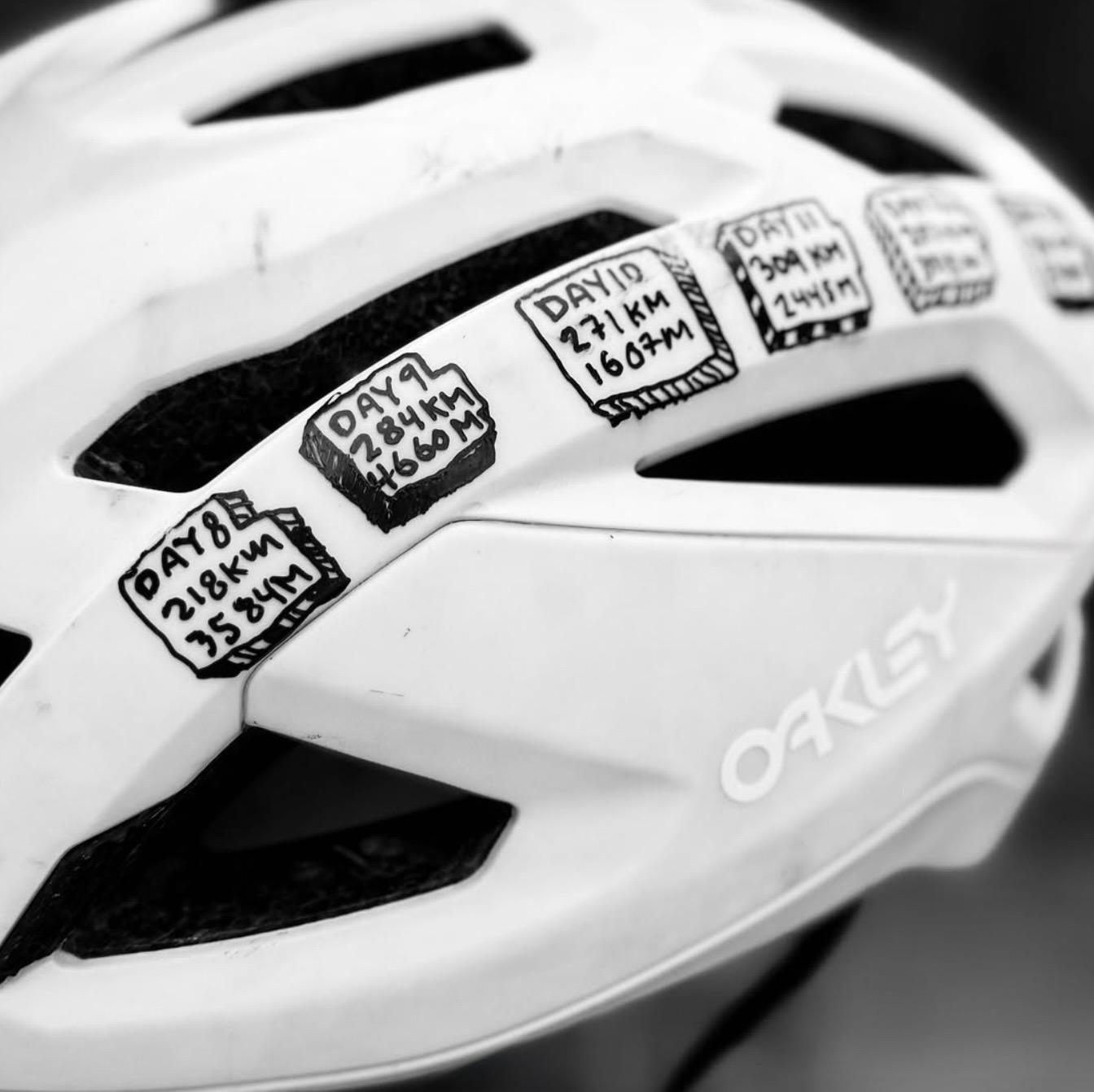
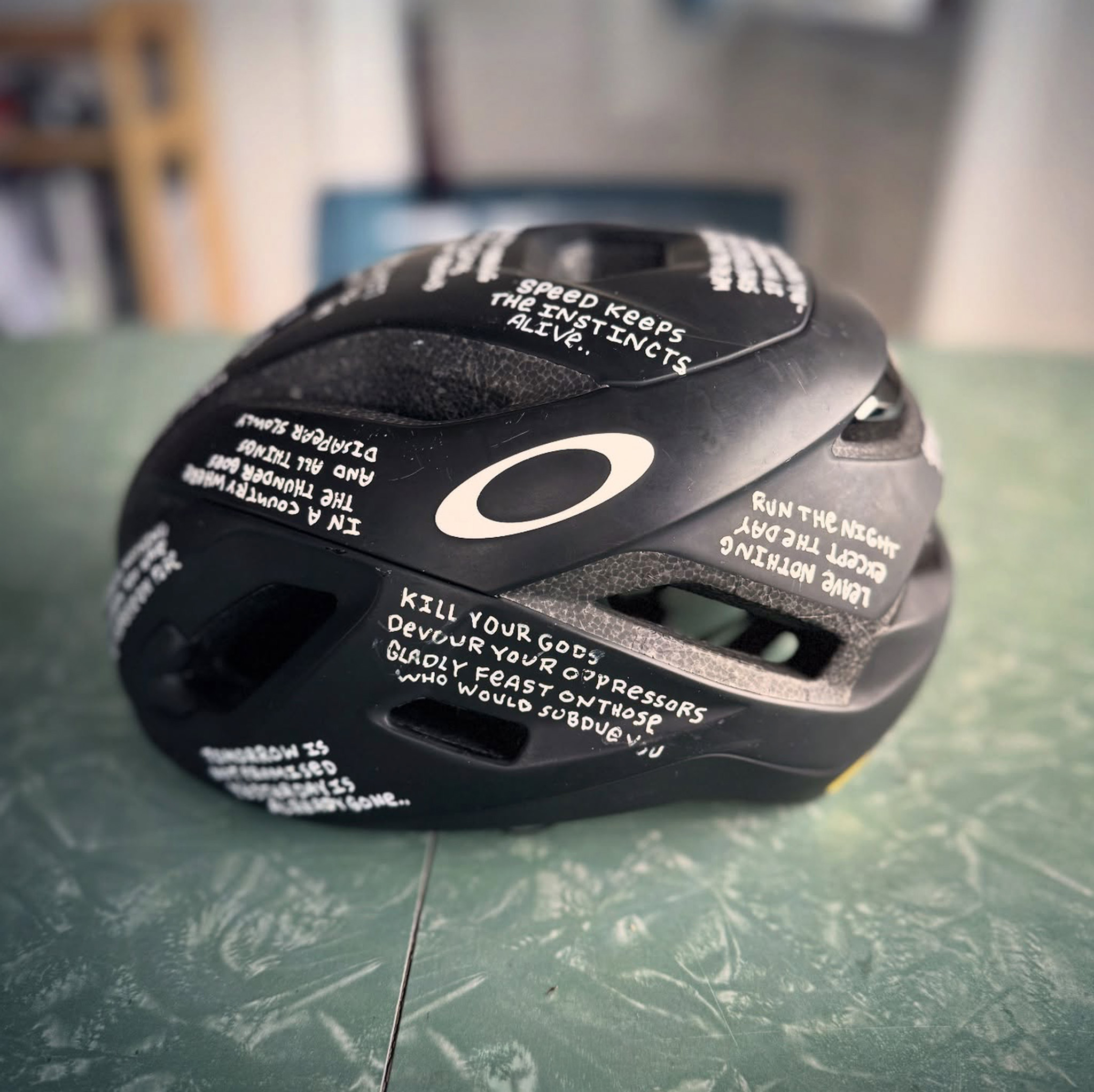
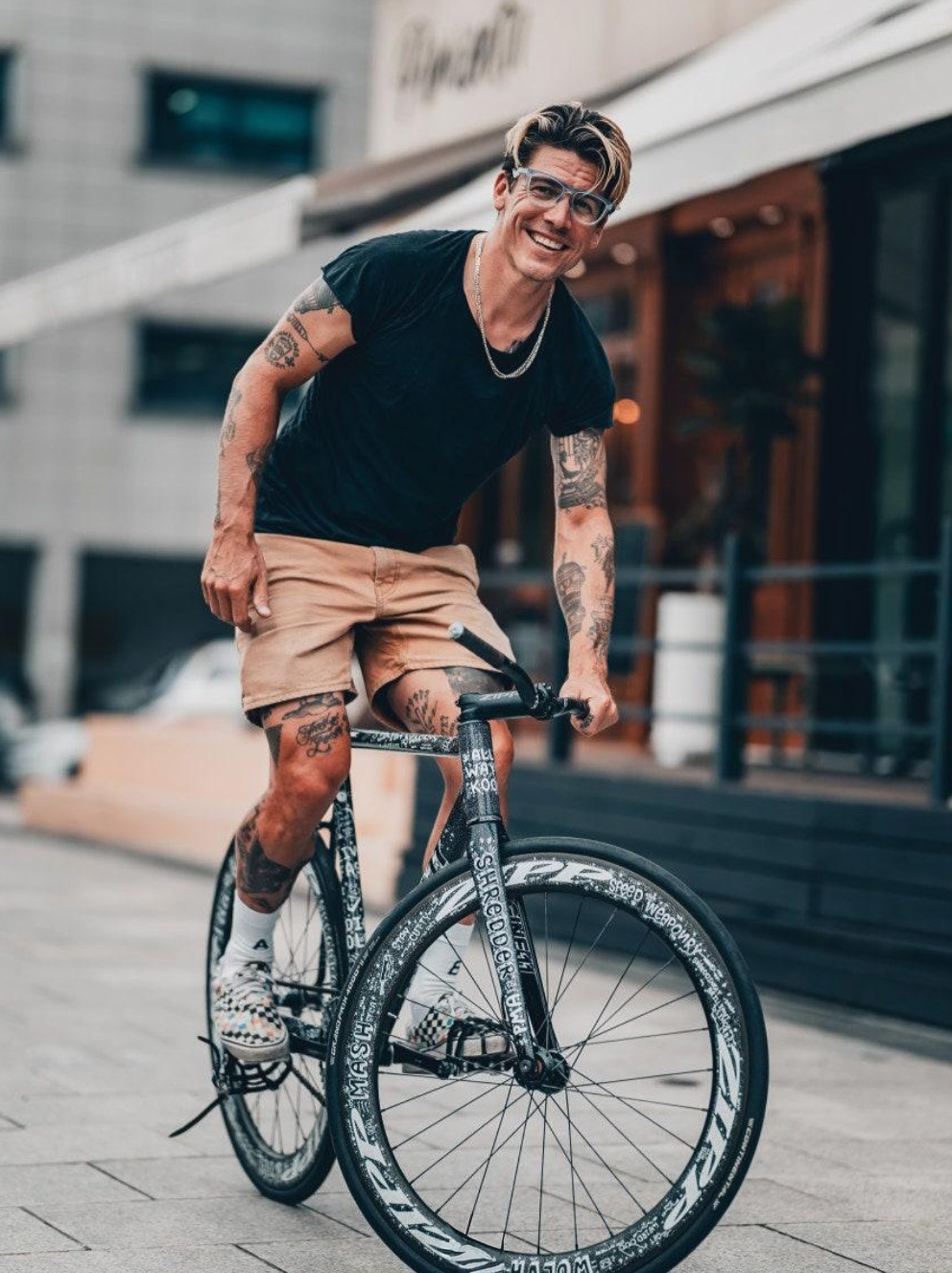
It’s a deep part of messenger culture and when I was working in the city—making drops at Fortune 500 company offices, basement businesses, and everywhere in between—I would hear people talking and clock the signage on the streets. So I decided—rather than lose all these references—that I would write them down. And not wanting to tag on someone’s property led me to start drawing on the things I would get sent by my sponsors. Whether it was a helmet or a pair of shoes; I would personalise it with my doodles. Then when I started to travel, I would return home with notebooks full of thoughts and ideas, images on my iPhone and photographs I’d taken with my film camera. I didn’t have any canvases but what I did have lying around were disc wheels and brake calipers and it’s all just evolved from there. A stream of consciousness that I transfer onto physical objects.

cyclespeak
You mention photographs and a couple of months back you posted a series of images shot on a roll of film that had been mistakenly put through the camera twice. An accident but a very fortuitous one.

Chas
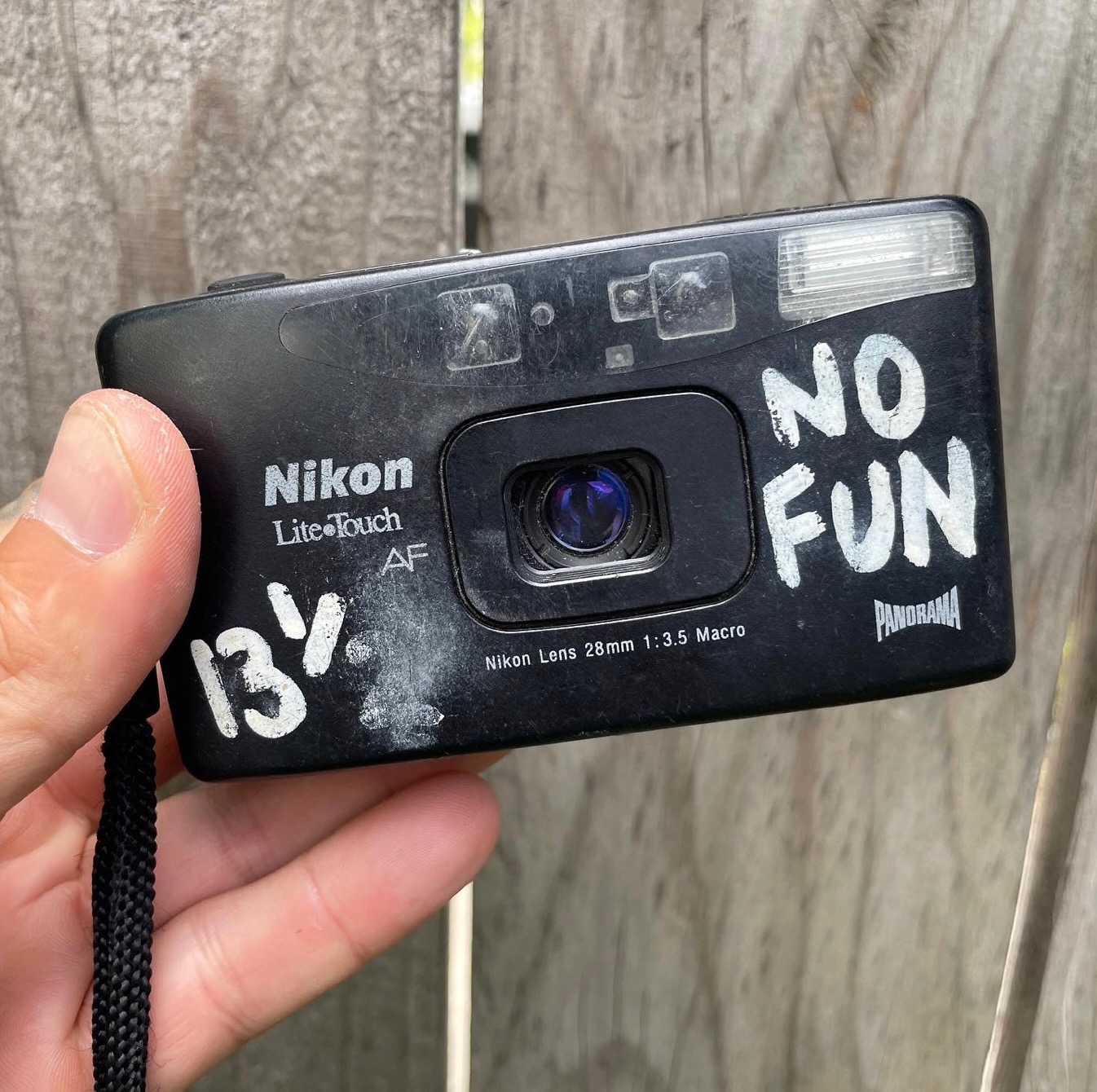
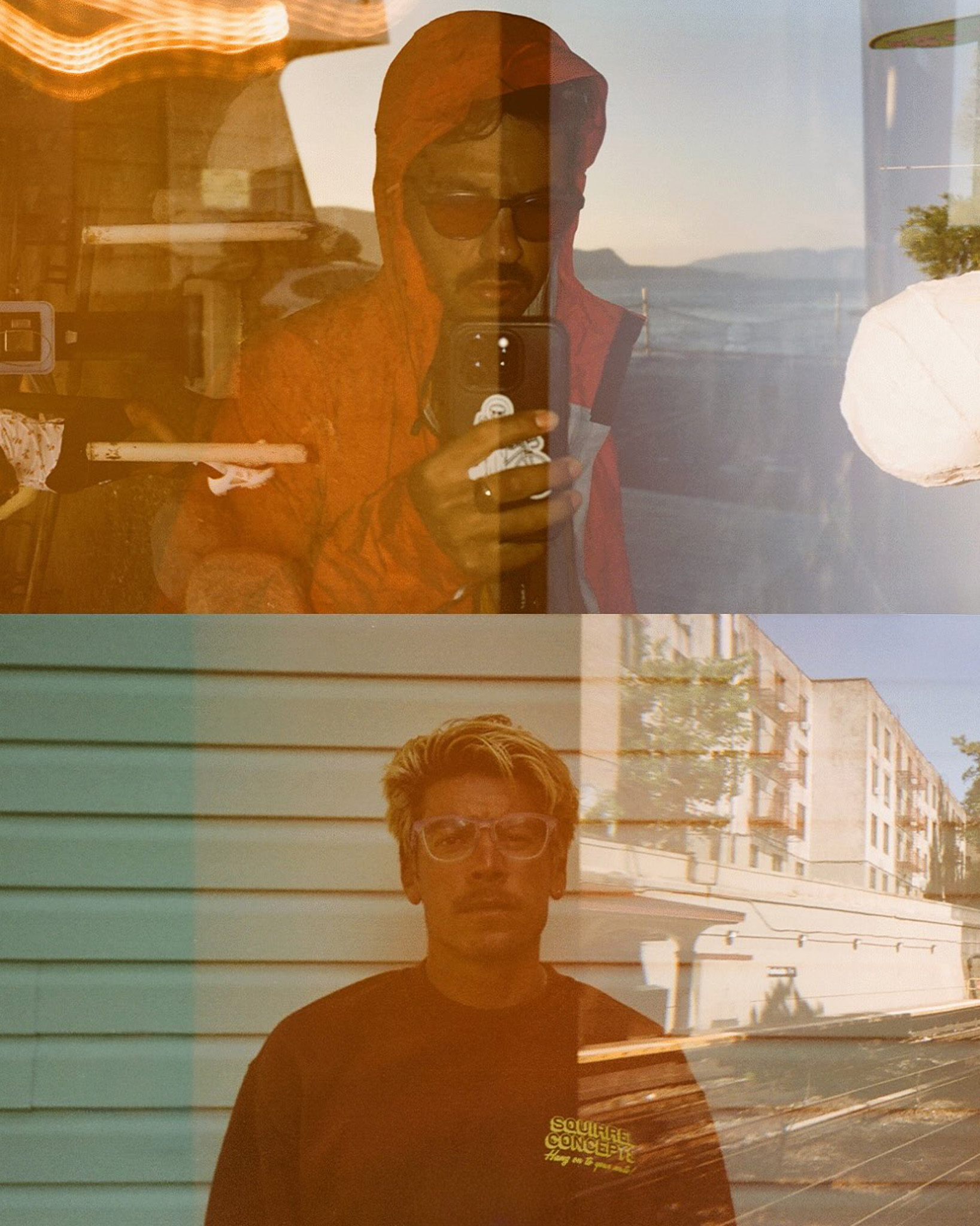
Double exposure shots are something I’m always playing with but those turned out better than the ones I purposefully try for. And I love film cameras in general. You take a shot on your phone or with a digital camera and you can see it immediately, you can edit it on the fly, there’s instant gratification. But I have multiple film cameras on the go at any one moment and some of those have rolls in there for six to nine months. So you have this chronology of things that you’ve done and moments that you’ve probably forgotten. And it’s only when the roll gets developed and the shots are printed that you get reminded of that. I like the idea of documenting life and then seeing whatever you get out of it.


Click on image to enlarge

cyclespeak
You’re comfortable with this analogue process?

Chas
My generation is the very last to truly remember a pre-internet age. I wrote my first papers by hand and I didn’t get a smartphone until I was 25. And you know what, I feel really privileged to be part of the generation that bridges that gap.

cyclespeak
But you wouldn’t want to wind the clock back?

Chas
There are lots of advantages to having our current level of connectivity. But I can’t help missing the travelling I did before I got my first smartphone. That feeling you had when you were lost and had to ask for directions. You had so many interactions with the people in the place you were at. Now you just ask your phone for the top-ten rated restaurants and you follow the blue dots. The first international trips I made to race alley-cats, you got handed a physical map and you memorised the landmarks. Not that it’s better or worse but I just miss analogue travel.

cyclespeak
Zooming in on day-to-day life and living, is there such a thing as a typical day?

Chas
I’m trying to get there [laughs]. These last three years, I feel like I’ve finally achieved a life goal of being an international, globetrotting, professional cyclist. I’ve been fully sponsored by Oakley and it’s been amazing. But all that equates to 180 days out of every year on the road. And as with most things in life—when you dare to live your dream—inevitably it starts to tarnish. It’s hard to be a parent and a partner when you spend so much time away from home. Frequent flyer miles are fun and cool but you reach the point where it starts to feel like work. Which really bums me out because living that life was truly special. So this year, I’m still racing bikes but what was once a typical day—returning from a trip, catching up on laundry, before getting on another plane—will now involve more time at home, more time in my studio, and more of a focus on quality over quantity in the races I do.

cyclespeak
Your Instagram profile leads out with Exploring the world in search of the stoke. What, to you, does this embody and have you found it?

Chas
The stoke is a feeling of freedom and speed. That moment when everything else falls away and you’re one hundred percent focused. And, for me, I find that on the bike. Whether that’s a track bike on city streets, a training ride to a mountain top, or crossing a desert on a hardtail; whatever is happening in front of you is your entire existence. Your body and soul focusing on one thing without distraction. Not that it’s a perpetual state of being—it’s fleeting—but I like to think it’s a never-ending search. And like I’ve already mentioned, I’m big into PMA—positive mental attitude—but that’s not to say that you always have to be happy. Maybe it’s enough to know that things will get better, even when it’s looking really shitty.


Click on image to enlarge

cyclespeak
Looking back over your life to date, is it fair to say you’ve burnt bright in terms of a rich and diverse range of experience?

Chas
It’s one of the things that scares me the most. I’m very momentum driven and if a project is given a green light, I go. And I truly believe that saying yes has allowed me to live this life and have these experiences: I’ll buy the ticket and take the ride. One of the things that gives me a sense of pride about myself is that I will jump into a scary situation and just kind of work things out. But all of that predisposes that things keep happening. Because what’s the word they use about sailing?

[here Chas pauses]

The doldrums. That’s it. When the wind dies down, the waves flatten and you’re just stuck floating. And I guess your question hits particularly hard because I’m about to have ACL surgery—my first big injury in a decade of professional racing—which means I’ll be out for six to eight weeks. Longer than I’ve been down in my entire life. But it is what it is, and I’m excited to face that challenge. I’m not what you’d call a spiritual person—I’m not religious—but I do believe there are forces in life and things happen for a reason. And this injury is now part of my journey so let’s see where it will take me.

All photography with kind permission of Chas Christiansen / notchas.com