Taylor Phinney / And everything in between

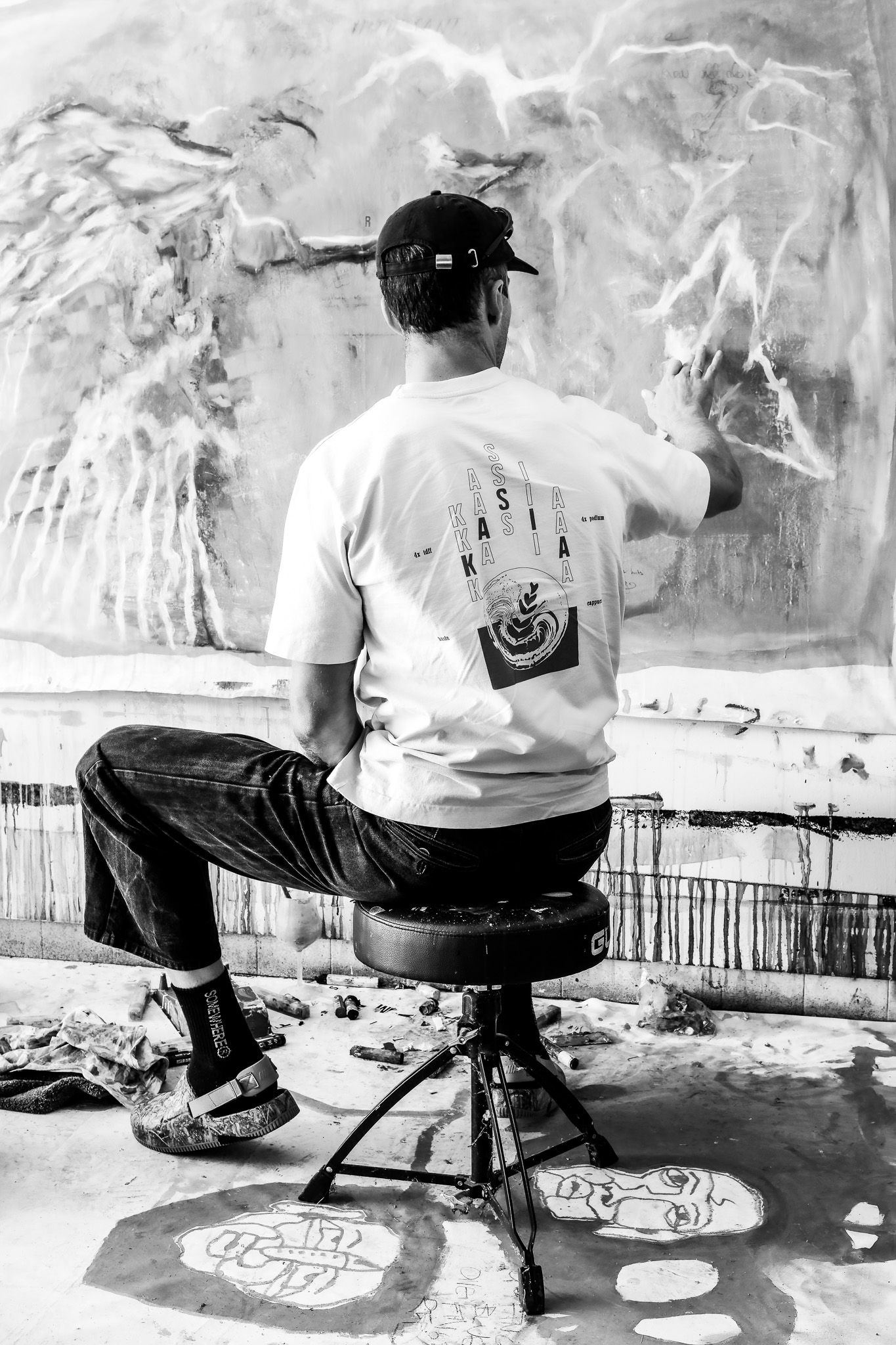
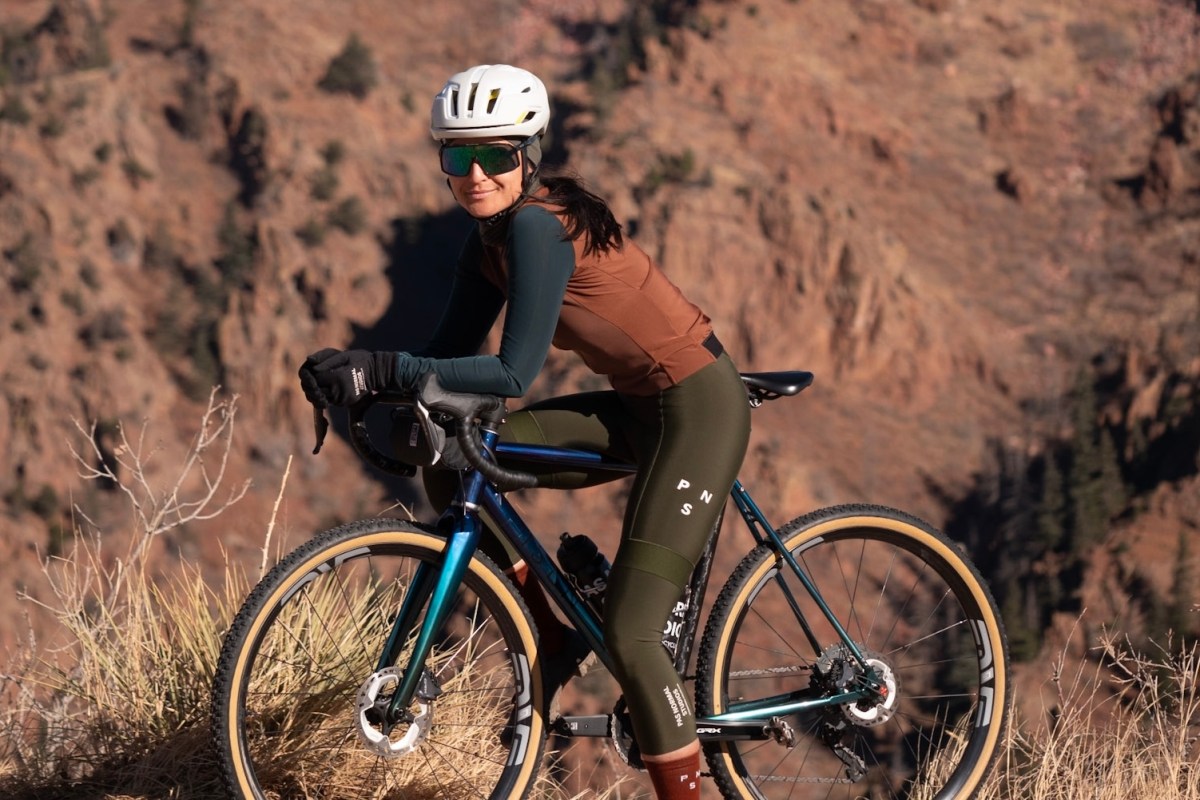
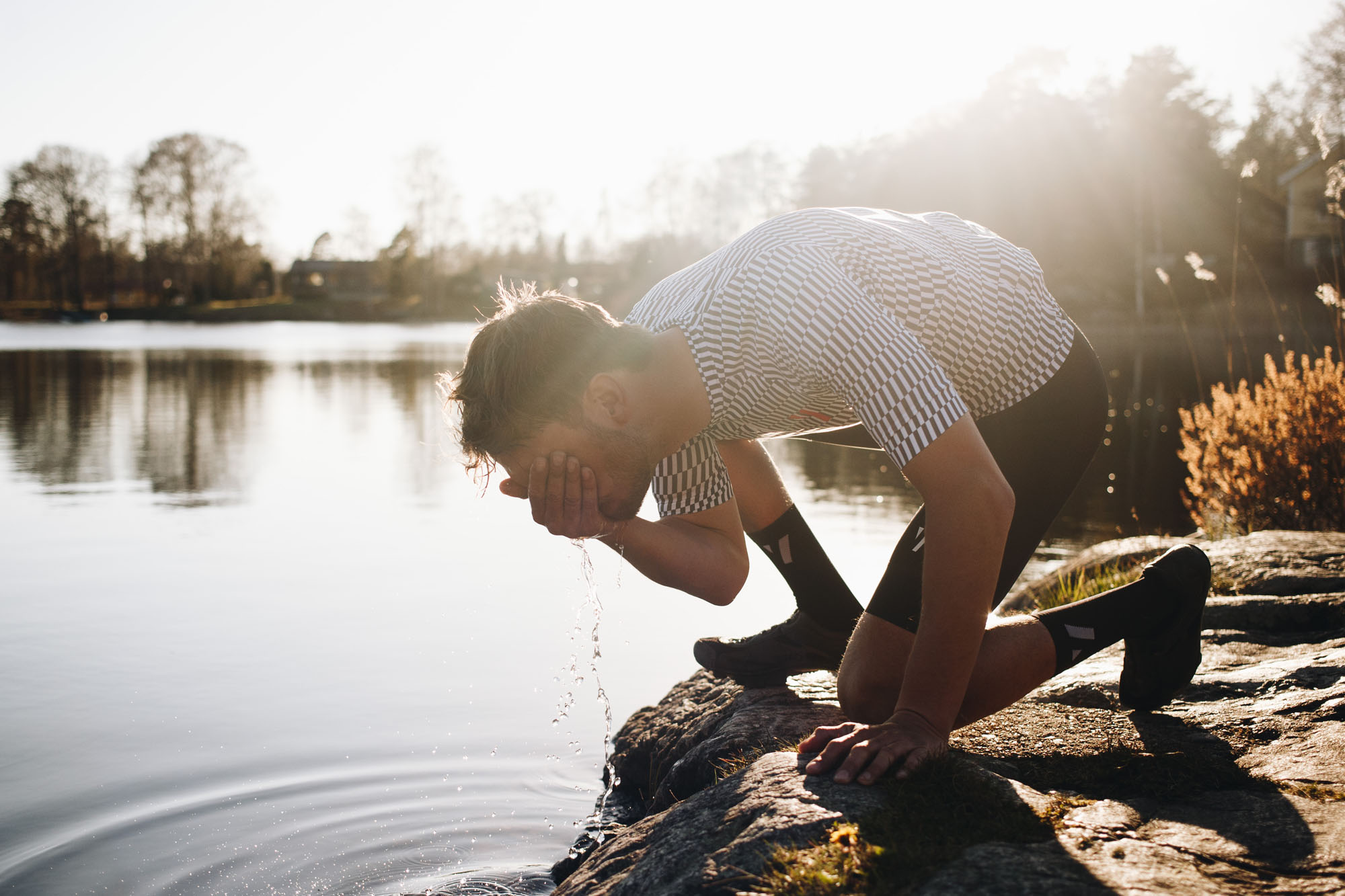
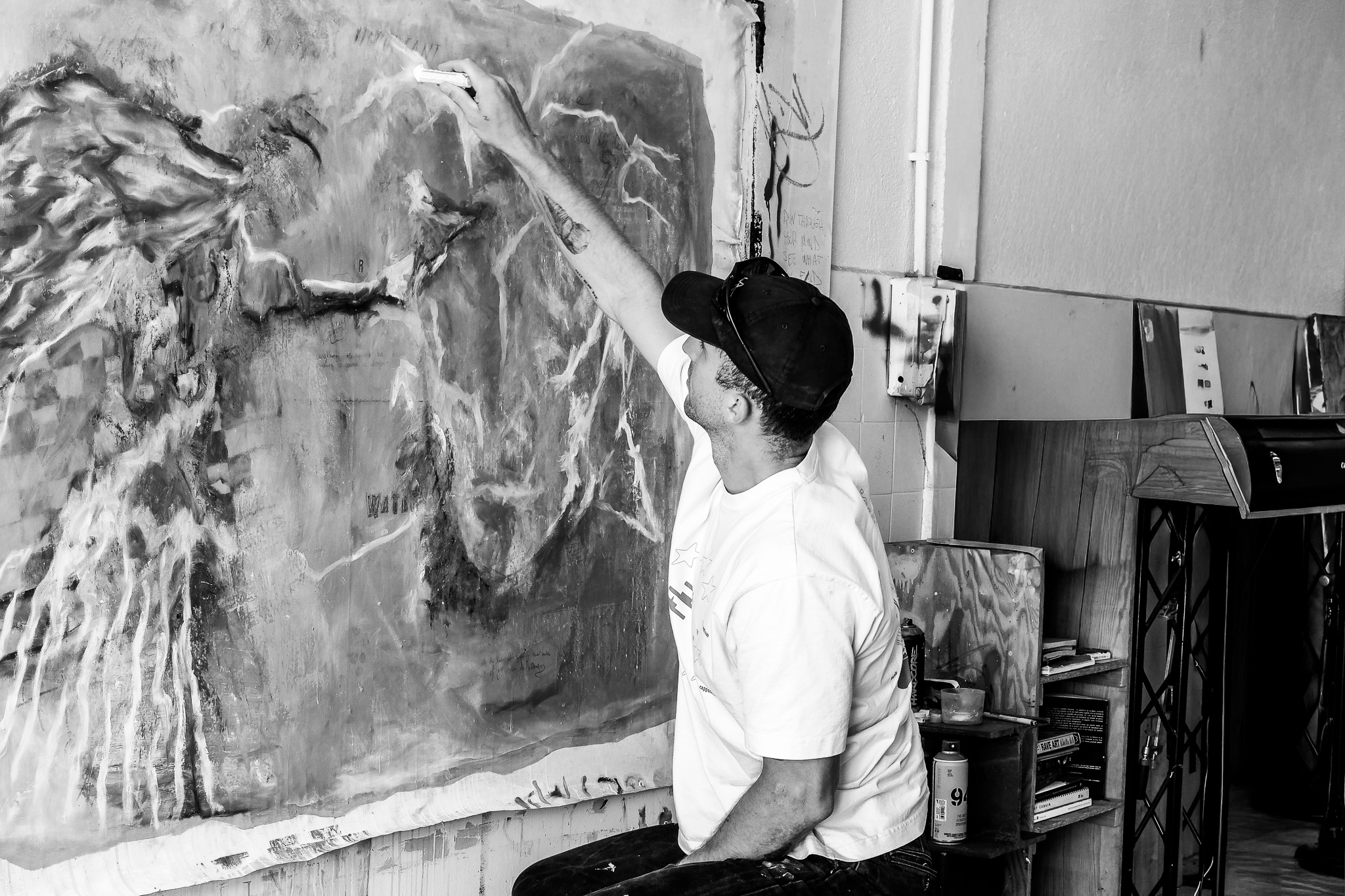
Taylor Phinney is waiting outside his studio that’s nestled in the semi-industrial suburbs of Girona. Immediately welcoming in a calm, quietly contained manner, he’s wearing his latest Sponsor Correct tee: the Kasia Cappuccino shirt that celebrates his wife’s successes at the Tour de France Femmes avec Zwift.

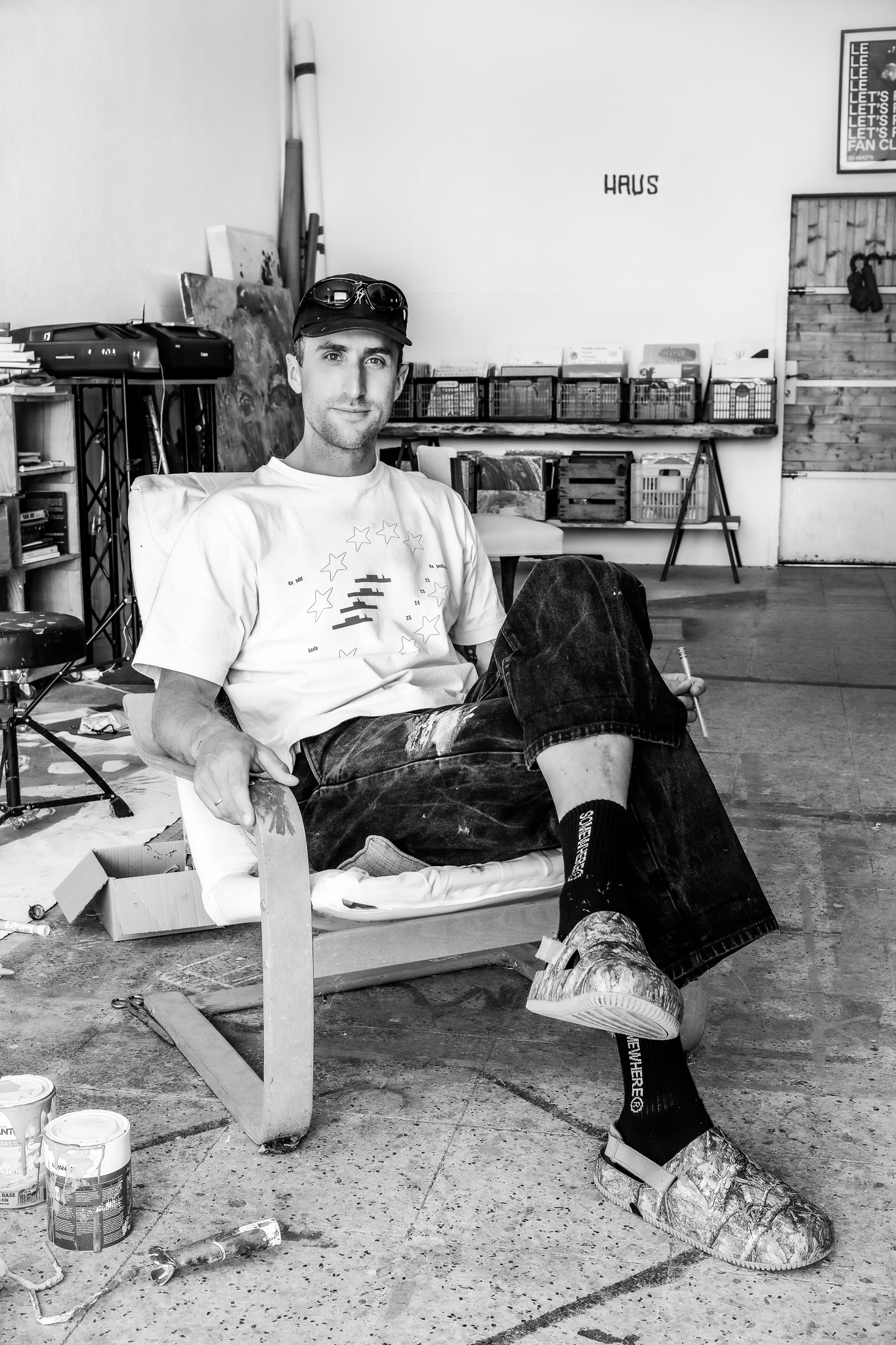
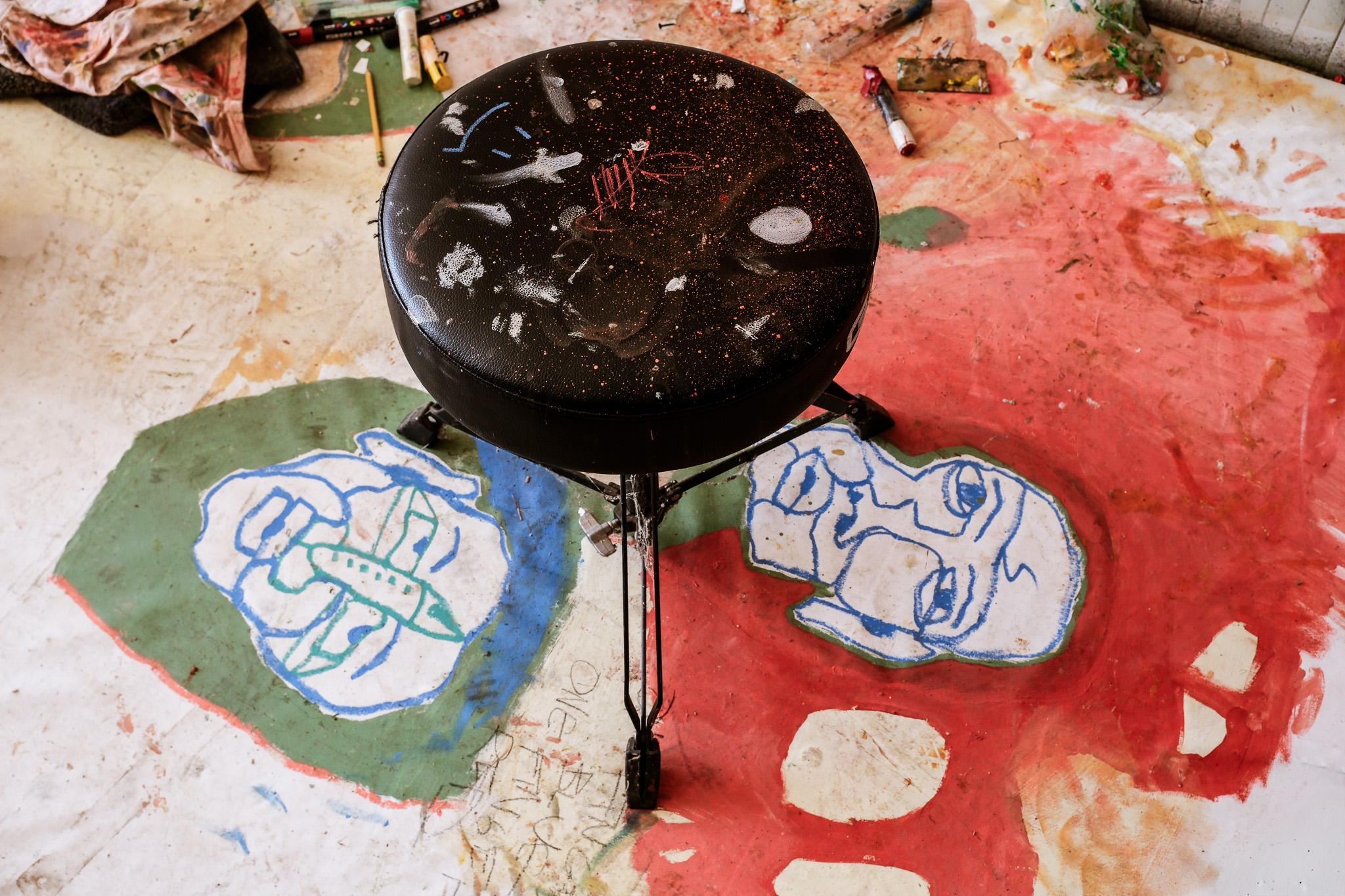
Entering the space he shares with two other artists, on one side serried ranks of canvases are mounted in neat, uniform rows. On the other side—Taylor’s side—the concrete floor is covered by a random assortment of paint and mark-making paraphernalia.

Dragging a couple of chairs over to the wide, sunlit doorway, Taylor apologises for not having any beverages to offer before we sit down and begin to chat. A meandering succession of subjects with Taylor carefully considering each and every response but with a playfulness and candour that draws you in and fixes the attention. A back and forth series of conversational tangents taking in bikes, art, and everything in between.


cyclespeak
I saw the post from last week of you interviewing five-time Tour de France winner Miguel Induráin. You must be pretty fluent in Spanish?

Taylor
Good enough I guess. I miss some of the grammar but I can get across most of what I want to say.

cyclespeak
I’m sure they appreciated you making the effort.

Taylor
I didn’t really have a choice…

cyclespeak
Because he doesn’t speak English?

Taylor
There is that. But what’s funny is they told me they were doing a podcast and I just assumed that they were talking to me. And then, at the last moment, they mentioned it was me talking to Miguel. Just having a chat [laughs].

cyclespeak
From one Tour de France winner to another, you were there when your wife Kasia Niewiadoma won the 2024 Tour de France Femmes avec Zwift with only a handful of seconds to spare.

Taylor
These things are often described as an emotional roller coaster and I was definitely doing some pacing, back and forth, on the mountain. So it was a super euphoric moment for all of us but what I felt most was relief.

cyclespeak
Because Kasia had previously placed so well but never quite got that top step of the podium?

Taylor
She’s always animating a race. And for someone who only seldomly did that, I know how rare it is. And she deserves it because she works super hard. In the same way that all those athletes work super hard. So with her Tour de France win, it was nice to see the chips all fall in her favour.


cyclespeak
As a former World Tour racer yourself, there’s the recognised route of retired professionals going into team management as a directeur sportif. So hypothetically speaking, what kind of DS do you imagine you’d make?

Taylor
I think I’d make a pretty good one. And I say that because I’m a sensitive and empathetic person, which didn’t particularly help me as an athlete but was a big help with the team dynamic. So I find it relatively easy to understand someone else’s perspective and where they’re coming from. And I recognise that I have this ability to bring a group together in an American Football coach sort of way. But, man, sitting in a car, six hours a day, for three weeks?

cyclespeak
Those must be some hard miles.

Taylor
It’s not a particularly healthy lifestyle and I really like to be active and creative and on my own programme. So I’d worry that I’d get back into that bike racer mindset of not really wanting to be there. And I enjoy not having to travel so much and, if I do, it’s pretty much on my own terms.

cyclespeak
So fast forward to the life and times of Taylor Phinney post racing. Can I start by asking whether there’s a routine to each day? A cup of coffee, some breakfast oats, a little workout and then off to the studio. Or would that feel too constraining?

Taylor
Actually, it would be pretty nice if I had more of a routine. But maybe I give in too much to my ADD?

cyclespeak
When you say give in, is that willingly?

Taylor
Probably half and half [smiles]. And a lot of the time I forget what I’m supposed to do. So I have to write it all down.

cyclespeak
So you’re a Post-it person?

Taylor
I have this app on my phone called MinimaList that makes things real easy and I am getting better with time management. But there’s something about the creative process; in that you’re actively trying to get lost. So I guess the trick is to differentiate that from everyday tasks without disappearing down a rabbit hole.

cyclespeak
But those creative tangents can be interesting?

Taylor
They are and I’m fortunate to have the flexibility to follow them. So I guess the only thing that really reminds me of time is my wife.

cyclespeak
And do you welcome that tap on the shoulder?

Taylor
Most of the time, yes [smiles].

cyclespeak
So how do you start your day?

Taylor
We wake up and I make coffee. I used to do meditation in the morning but I found it allowed me to fall into my ADD. As opposed to waking up and just doing something productive.

cyclespeak
Do you consciously decide when to focus on painting, designing for Sponsor Correct, clearing your local trails? Or do you wait until inspiration comes calling?

Taylor
With the trail building, it’s pretty weather dependent. It really has to rain quite a lot for the ground to become malleable. And that’s always a really exciting time for me as it’s probably my happiest place: outside, by myself, sculpting the earth. It’s creative and with this whole other reward process.

cyclespeak
The before and after?

Taylor
That’s part of it. But not only do I get to enjoy it in the days, weeks, months afterwards; you see the whole community returning too. Because the way the trails work is they get overgrown and dirty so people ride somewhere else. But after you work on a section and open it up, the next time you go there you see all these tracks on the ground. And that’s without me saying anything to anybody. This whole word-of-mouth thing that spreads organically.

cyclespeak
From your actions, there are ripples of reaction?

Taylor
Something I strive to be is a people mover: whether that’s through music, organising rides, or trail building. So even if I don’t say anything, I like to see if I can influence the movement of all these different people. But that doesn’t really answer your question about how I prioritise things.

cyclespeak
Which is?

Taylor
The trail building is seasonal. Painting is something I keep more for myself. I do sell some pieces but I’m not actively networking and seeking out galleries in an effort to get my work out there. There’s this whole brand identity side of that which I don’t like so much. And I find that if I start selling more paintings and doing commissions, then I stop thinking about what I want to paint and start thinking about what other people want to see. So, for me, painting is like this creative force that grounds everything else and I do design projects when I’m inspired. Which can often be when I’m travelling and have my computer with me—it’s just so easy to dive in.

cyclespeak
Design work that includes projects like Sponsor Correct?

Taylor
The Sponsor Correct stuff honestly started as a joke. Something I’d wanted to turn into a brand from back when I was racing because we heard it nonstop. Like, make sure you’re sponsor correct because you’re doing this photoshoot or interview. And that always pissed me off because it didn’t leave any room for being original.

cyclespeak
I’ve heard you reference these thoughts before. Kind of a cookie-cutter approach?

Taylor
Which makes sense because all of these brands are paying to have their riders represent them. And I just felt that the sponsor correct thing was so omnipresent within the culture, that anyone involved in bike racing and professional sport would recognise the phrase. A way of conforming and being rebellious at the same time.


cyclespeak
And your music?

Taylor
That’s a vibe. If I’m here in the studio and stuck on something, then I’ll just start playing some music. But that scene is also tied to identity and brand which I’m not searching out too much. And late nights in clubs? It can feel like I’m in some layer of hell at four in the morning. I don’t really party like that—I’m completely sober—and I want to wake up refreshed and ready to ride my bike outside.

cyclespeak
It sounds like you’ve got a lot going on?

Taylor
Sometimes it can feel that way but really, it’s about creating some kind of momentum.

cyclespeak
Without giving too much of yourself away?

Taylor
I’m okay with giving up my energy. It’s more about building this foundation that I can always recognise and get back to.

cyclespeak
So focusing for a moment on your painting, have you ever had any formal training or are you entirely self taught?

Taylor
Self-taught makes it sound like I was reading books [smiles]. But what it actually looked like was revisiting drawings that I’d made as a kid and being reintroduced to painters like early Basquiat. 

cyclespeak
I’ve seen Picasso exhibitions that show work from when he was a student and he’s copying the style of the grandmasters. Which is a natural process as you’re developing your own style?

Taylor
It’s totally natural. Like another of my favourite artists, the painter Wes Lang. He’s from LA and mixes this Native American imagery with a Basquiat type of composition and colour. And I was listening to a podcast where he was saying that he decided on these stylistic references because it was the conversation he wanted to have with that particular artist. And that made me feel more comfortable about my own visual journey. Because, when I first started painting, there were two people I was thinking about and if they would like my work or not. And they were the ghost of Basquiat and this friend of mine that first encouraged me to pick up a brush. So I do believe that it’s not only allowed but also a positive part of the process.

cyclespeak
This dialogue that goes back and forth?

Taylor
Even though it’s in your own head, it still feels like you’re having a conversation.

cyclespeak
In terms of your own visual inspiration, I don’t mean this in a negative way but is that a passive process or do you consciously seek to be inspired?

Taylor
I probably look more actively now. But in the past it tended to follow a familiar pattern of visual diary pages, a lot of stream of consciousness, and improvising colour combinations. Thinking that maybe I shouldn’t do this but doing it anyway because it felt rebellious. Like I would use oil paint sticks and then paint acrylic over the top when the marks were still wet.

cyclespeak
So you were breaking rules?

Taylor
Rules that I never quite understood or mastered [laughs]. And a lot of my stuff kind of happened by accident.

cyclespeak
So does each canvas follow a systematic pattern?

Taylor
I definitely start by drawing or writing on a canvas; I like to have stories underneath the paint that you might not be able to see…

cyclespeak
But you know they’re there?

Taylor
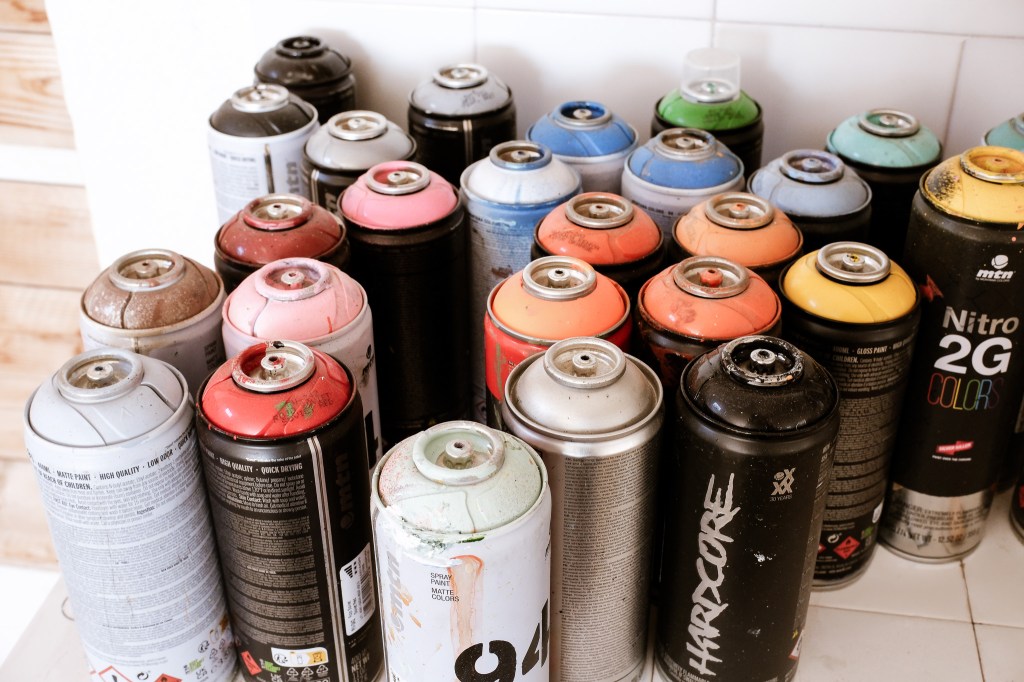
I guess that a blank canvas with one image on top doesn’t tell enough of a story for me. Which is why I like to use spray paint and graffiti markers to add all this texture. And then, when it all gets covered up, my friend David makes fun of me and says another layer [laughs].

cyclespeak
But the layers form the foundation of your work?

Taylor
And oftentimes I’ll strip them back with water or paint thinner—or even just scrubbing at the surface—which allows all this other stuff to come through from before. And if that surprises me, I’ll know that I did the right thing.

cyclespeak
How difficult is it to say enough and acknowledge a painting is finished? Or is there a temptation to keep going back?

Taylor
It’s never easy to know where that line is. Because I look at a lot of in-process pictures of a particular work and I’m like, dude, that would’ve been real sweet if you’d stopped right there. But it’s buried underneath layers of something else. So maybe I need to have 18 paintings up on the wall at any one time and then just bounce back and forth? But I don’t have enough space because they’re usually all quite big. Which is why the bike is a useful tool whenever I have a problem or I’m not sure what the next step will be.

cyclespeak
Is that because the physicality of each pedal stroke frees up the thought process?

Taylor
I’m not quite sure how to explain it but the number of ideas I had mid-race as a professional cyclist that I could never quite recall at the finish…


cyclespeak
Are they always your canvases, even if they’re sold?

Taylor
That’s what I mean about this foundation of feeling comfortable with what I’m creating and not needing to think about someone else’s opinion. Because I’m never going to paint a portrait of your dog as a commission. It’s much better if I do my own thing before seeing whether it adapts in some way.

cyclespeak
You mentioned how playing music can act as a welcome distraction from the creative process. And I was curious regarding the subtleties of reading the room when you’re playing a DJ set.

Taylor
Whether people are moving or not is an obvious sign and you can definitely feel if there’s a vibe. Which is a nice kind of puzzle when you go in this or that direction with your song choices.

cyclespeak
And it’s in real time; unlike painting a canvas where you can put down the brush and step back for a moment?

Taylor
It’s not that I feel rushed but there’s definitely a sense of flow. Which is what I really like about it; this layering of sounds—one after another—which is kind of like my paintings.

cyclespeak
Are you storytelling when you DJ?

Taylor
I’ve been thinking about that a lot recently. And it’s not storytelling as…

cyclespeak
A narrative?

Taylor
It’s more of an abstract way in the sense that you grab peoples’ attention—almost like foreplay—and that’s where you create tension. And then when people are locked in, you don’t immediately give them exactly what they want; this energy is building inside of them and you’re the one that helps them release it.

cyclespeak
That sounds like quite a powerful sensation?

Taylor
I guess that’s why a lot of DJs are perhaps a little egotistical?

cyclespeak
For someone growing up spending their Saturday mornings in record stores, can I ask whether vinyl is still important or is everything now digital?

Taylor
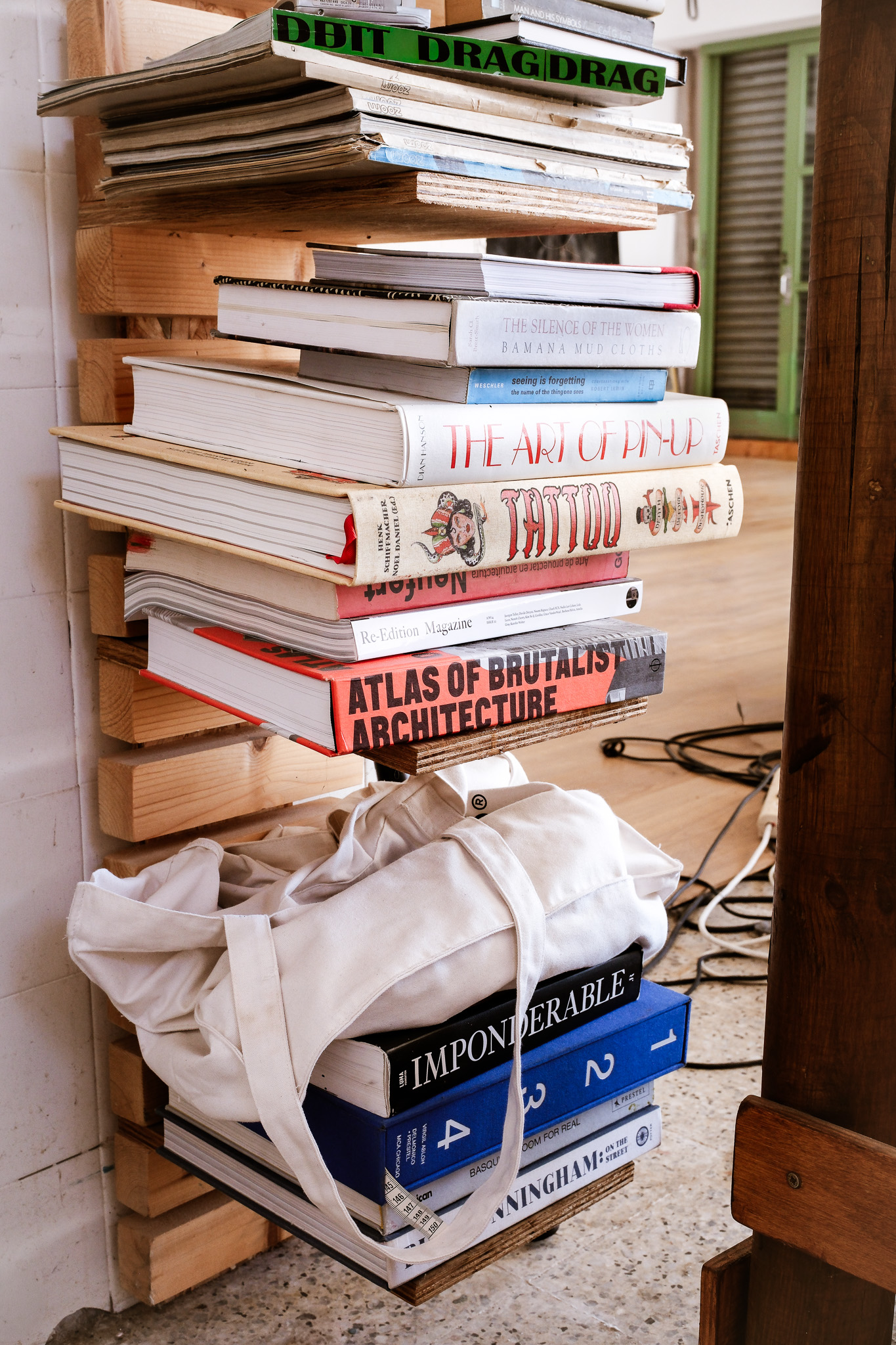
It’s relatively niche but that’s the way it all got started and you now get music labels that are releasing vinyl-only DJ records to be played in a club. There’s only one or two tracks on each side with a minute of kick drum which makes them easier to mix. And it’s a lot nicer to look through a crate of records as opposed to scrolling through a digital playlist.

cyclespeak
The physicality of the process?

Taylor
There’s no need for screens. Just the needle, the wax and the mixer.

cyclespeak
Returning once more to Sponsor Correct, I’m sure they were flattered—at least I hope they were—but did Pas Normal respond in any way when you dropped your Pan Normal shirt?

Taylor
The only feedback I’ve received has been positive. And I’ve been told that a few people at their head office have the shirt.

cyclespeak
They do say that imitation is the sincerest form of flattery.

Taylor
What I find funny is there are people who love PAS and only wear PAS. And there are people who hate PAS and everything associated with the brand. And the reason that Pan Normal works is that both groups, from either extreme, want to buy the shirt.

cyclespeak
So in that Venn diagram, where the two circles intersect, sits Taylor Phinney and Sponsor Correct?

Taylor
Yes [laughs]. And to be honest, you could argue that both of those groups are a little ridiculous.

cyclespeak
Does that viewpoint reflect your take on Pas Normal or because you don’t like extremes?

Taylor
I think there’s something cliquey about most worlds. And if you take cycling brands as an example, much of the high end apparel is made in the same factory. So if you’re an X guy and you’re hating on the Y product, oftentimes you’re wearing the exact same piece of kit. It’s just branded differently and that’s what you’re buying into. Which I find really fascinating.

cyclespeak
The emotional connection with brands that an individual favours?

Taylor
I had this friend who only wore MAAP and, for whatever reason, hated PAS. But he bought every single one of my Pan Normal shirts and then he posted this photoshoot on his Instagram feed—shot in a very PAS style—of him fully decked out in Pas Normal. So that got me thinking that I’m doing a pretty good job in marketing these guys. And that maybe, if you hate on something so much, you kinda want to be part of it but you’ve already declared you don’t like it. So I do question whether the stuff that I make bridges this gap and creates some magical space in between.

cyclespeak
I get the impression that you’re having fun with Sponsor Correct?

Taylor
Having fun and learning at the same time. Because in a similar way that we mentioned having a dialogue with the work of artists we admire, studying how brands communicate their own identity and message through their designs—placement, size, fonts—has really taught me a lot.

cyclespeak
Skills that you used to create your Kasia Cappuccino shirt?

Taylor
David was an industrial designer and he got me started with Illustrator. So yeah, I can now create my own designs but I probably don’t know 80% of what the program can do. Which is why I have my own work arounds to figure things out.

cyclespeak
I listened to a podcast recently where you started listing the bikes you own and then kept remembering another one and another…

Taylor
Yes [smiles]. I’m not particularly good at selling bikes but that being said, I really don’t need any more.

cyclespeak
So it’s now a case of one in, one out?

Taylor
There are some bikes that I’ll never part with, like the Raleigh over there. A 64 cm frame that I picked up in Belgium and built up with 10-spd Dura Ace and longer brake calipers to allow for some bigger tyres.

cyclespeak
So are you a bike tinkerer? In the same way you see pictures of Lachlan Morton’s garage and he’s working on all these weird and wonderful bike builds.

Taylor
That’s definitely me but I find it easier to tinker with older stuff. With the newer stuff, I can’t resist testing the boundaries of what a bike can do…

cyclespeak
Is that test or push?

Taylor
It’s probably both. And goes back to the cycling cliques—do you ride in PAS or MAAP—and the viewpoint that if you’re mountain biking you wear the same type of kit, ride similar bikes and talk about the same stuff. But if you ride gravel or road, then that’s another aesthetic you all share.

cyclespeak
And you?

Taylor
I grew up riding gravel on my road bike before gravel was even a thing. So I’ve always wanted to mash up as many things as possible; fusing different riding styles and confusing those looking on.

cyclespeak
Which is why—and I do mean this very respectfully—you rode Badlands on a spectacularly inappropriate bike?

Taylor
Yes. But I was comfortable.

cyclespeak
I imagine so. Up to the point you nearly ripped your toe off riding in sandals and had to cauterise the wound with your pocket knife.

Taylor
That was because I threw away my Vans [laughs]. I definitely took way too much stuff on that trip. And if I was going back, I’d probably ride what I call my gravel plus bike which is a drop bar mountain bike. And the reason for that is my ten thousand hours are in a drop bar position. Something I wouldn’t have admitted five years ago.

cyclespeak
But you’re now able to embrace?

Taylor
I like to play with things and I also like to play with peoples’ expectations and, in doing so, break some norms. Because everyone is so traditionally rooted in what they think they’re supposed to do within whatever clique speaks to them. So when you show up to a gravel ride and you’re riding on flat pedals wearing Vans, everyone is woah, man.

cyclespeak
And cycling is full to the brim of cliques and unspoken rules.

Taylor
But when you get to the coffee shop and people are walking around like ducks and I’m just like a normal person, which one of us is weird [laughs]?

cyclespeak
I remember when Gus Morton brought out his Outskirts films, it was like a lightbulb moment. That whole tee over bibs vibe.

Taylor
Those guys had a huge influence on me for sure.

cyclespeak
Which was also the case for the EF Gone Racing films that you, yourself, featured in.

Taylor
I’ve heard that from a few people recently. How watching those films totally changed how they rode a bike.

cyclespeak
Generally speaking—with maybe the exception of Unbound where you had countless flats—you all looked like you were having fun. And it wasn’t solely super serious with a focus on results alone.

Taylor
That’s about the size of it [smiles].

cyclespeak
You’ve talked about how the bike offers a means of escape. And you’ve also mentioned how you often get inspired when you’re out riding. So do you ever switch off?

Taylor laughs and thinks for a moment

Taylor
I would love to hear my wife answer that question.

cyclespeak
What do you think she would say?

Taylor
Maybe that I’m in a state of sleep-mode at all times? But no, I’m a creature of inspiration and curiosity. So whenever that strikes, I’m on. Mixed in with periods of feeling a little lost and overextended. Which is usually fixed by spending a couple of days on the couch.

cyclespeak
In this age of social media and from the outside looking in, it might appear that life and living is—not easy—but pretty good.

Taylor
I definitely live a very privileged lifestyle. In the sense that I get to come here and do what I want to do. And it’s fairly easy for me to connect with brands and make things happen. But saying that, I don’t think anybody’s life is like riding a rainbow.

cyclespeak
That’s something that Sami Sauri often mentions. That people think it’s all flowers and unicorns when it’s actually a lot of hard work.

Taylor
I can hear her saying that [laughs].

cyclespeak
I suppose for many people, a vast majority of their life decisions are made for them: a job that might not particularly inspire, mortgage payments to meet, a family to care for and nurture. Whereas on the flip side, always having to determine the next project or collaboration can also bring its own set of challenges?

Taylor
Personally, I prefer that to having a 9-5 to bang up against. But it’s been a learning process that I’m no means close to the end of. How to string a bunch of things together to pay rent and buy my wife presents.

cyclespeak
Buying your wife presents is nice though.

Taylor
It is. Being with Kasia makes me very happy and I get to come to the studio, do my thing here, and the trails are amazing whichever direction you go. And for me, that’s enough.

Taylor Phinney / Sponsor Correct

All photography by Chris Hargreaves
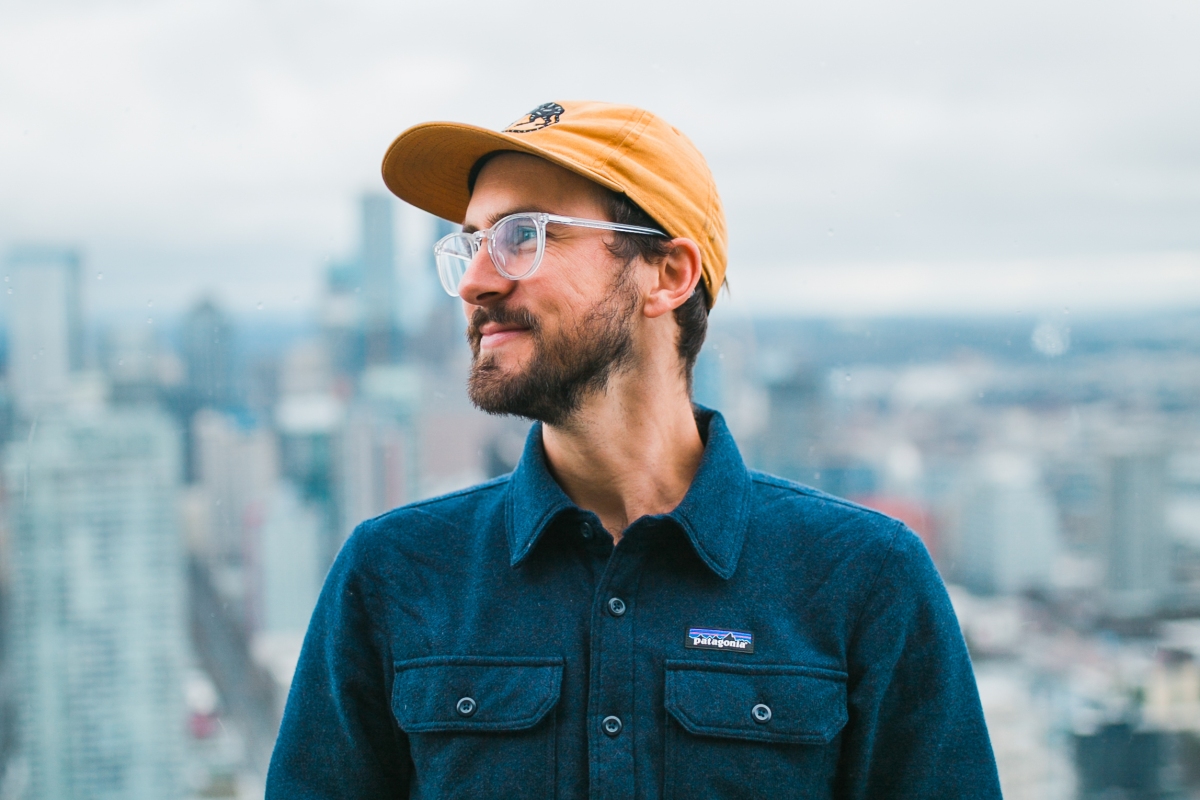
Alex Roszko / Fast, fun and easy

It’s Thanksgiving Day and photographer Alex Roszko is taking our video call on his mobile phone as he strolls through a suburban neighbourhood in Austin, Texas. Jacket zipped up against the December chill, he’s visibly relaxed and happy to let our conversation wander.

Tracing his love of visual storytelling to when he was gifted his first cameraa Polaroid covered in Ninja Turtle stickerswhen the opportunity arose to swap his programming position with an engineering firm for the gravel trails of race events, he decided to make the leap.

A decision to pursue photography as a full-time career that he explores with an unwavering honesty; Alex offering an intriguing take on the challenges of being your own boss, and why it can be the smallest of details that make your heart sing.


Alex
Good morning. Or I guess afternoon for you?

cyclespeak
That’s time zones for you. But we managed to navigate the difference at our first attempt. You’re calling from Austin?

Alex
I am. But I usually only stay for a few weeks at a time. Which probably explains why the most common question I get asked is, “So, how long are you here?”

cyclespeak
Austin is enjoying something of a boom?

Alex
You can see it in the house prices. Tech is coming in. We’re the new San Francisco [laughs].

cyclespeak
The price of progress. And I remember a friend of mine mentioning that a lot of your dirt roads are being paved over?

Alex
You have to get pretty far out of town to find any good gravel.

Click image to enlarge

cyclespeak
Because you’ve just got back from Girona where there are endless trails to ride. And I was smiling at your Instagram story where you mentioned not being able to take your bike bag on the small train to Barcelona which meant an unexpected €200 trip by taxi.

Alex
To be fair, I’d taken this same train a couple of times without any problems. But this time, I just happened on the wrong person and it was a very definite ‘no’.

cyclespeak
I was looking at the ‘About’ section of your website where you mention that your first name is John.

Alex
But I go by my middle name, Alexander. Or Alex. But most people call me Roszko. Which is my last name. Which I can see is all kind of confusing [smiles].

cyclespeak
When I saw the spelling of Roszko, I immediately thought you might have some European heritage?

Alex
I believe my great grandparents came over from Poland in the 20s.

cyclespeak
Well, there you go. And looking back on your family life and childhood, do you remember it as being particularly creative?

Alex
Actually, my dream as a child was to be an artist. I was obsessed with drawing and I must have sketched the Titanic over a hundred times to try and get it perfect. But I’ve always been a visual learner rather than relying on memorising text.

cyclespeak
So what are your first memories of photography?

Alex
I got my first camera when I was seven or eight. So I’ve been looking through a lens for a long, long time.

Click image to enlarge

cyclespeak
Did your visual education continue at high school and college?

Alex
I went to high school in Houston. Initially still wanting to be an artist but that changed when I developed an interest in meteorology and geography. I was really enamoured with the physical world and our weather and how that all combines. But when I enrolled in community college, I discovered meteorology was out of the question because it required four years of physics or math; two subjects I’m just hopeless with. My brain just doesn’t bend in those ways [laughs].

cyclespeak
So what did you study instead?

Alex
I graduated from Texas State University with a degree in physical geography.

cyclespeak
Where did your photography fit in?

Alex
I’d skateboarded for twenty years by this point but got an injury so I picked up my camera to take some pictures of my friends. And that was the moment when photography re-entered my life and I started to scratch this creative itch.

cyclespeak
I’m guessing you didn’t immediately start earning a living as a photographer?

Alex
I remember in 2013 using my credit card to buy my first full-frame camera—which was terrifying—and the deal I made with myself was I had to pay it off with the income I made using the camera. At the time I was working for a local engineering firm so at weekends I would take high school portraits, graduations and engagements before trying my hand at weddings. That lasted for eight years. A 9-5 job during the week and photography on the weekends.

cyclespeak
So what happened to make photography a full-time gig?

Alex
Covid, actually. We were all working from home and my company sent out this email to ask for volunteers who wanted to quit.

cyclespeak
Voluntary severance?

Alex
That’s right. I thought about all the free time I would have and what I could do if I accepted their offer. So I volunteered.

cyclespeak
And said goodbye to the 9-5?

Click image to enlarge

Alex
Actually, no. Long-story-short, they denied my application but this idea was still stirring around inside my head so I reached out to some local bike shops and offered my photographic services on retainer. I’d arranged a meeting with one of these bike shops and told my boss that I was sick and had to finish early. But he told me I couldn’t because we had a meeting at noon that I needed to attend. So I rescheduled with the bike shop, turned up at this meeting, only to be told they were letting me go.

cyclespeak
How did that feel?

Alex
I was kind of happy, excited and also a little scared. But then I just drove down to the bike shop and negotiated my first retainer. So I was technically unemployed for about 30 minutes.

cyclespeak
Looking back at your photographic work since this pivotal moment, it’s been very varied and you’re definitely not pigeonholed with a bike in every shot.

Alex
Each brief is pretty unique. And I wear a lot of hats. I do a lot of product photography but even that allows a degree of creativity when there’s a message behind what I’m portraying. Other times it’s adventure photography where it’s more difficult to control the environment so there’s an element of spray-and-pray. And then there are times when I try a new creative angle.

cyclespeak
Keeping things fresh isn’t always easy?

Alex
It’s very hard and needs constant thought and application. Something I discuss with my videographer friends and their use of movement, edits and music. But a photo is a photo. One final product.

cyclespeak
Sometimes I think it’s the shots off the bike—sitting around a campfire making coffee or sheltering from a rainstorm—that afford you little moments of visual magic.

Alex
I completely agree. I definitely get more joy from the details. When I see someone capturing muddy eyelashes it just looks so cool.

cyclespeak
Your Instagram story from earlier today had a very nice shot of your partner’s wisps of hair escaping from her helmet and droplets of rain on her eyewear.

Alex
Capturing details like that is my personal motivation. You know, the little nuances of a moment like the hair wisp photo. I’m out with my partner—we’re in the mountains with the Fall colours on the trees—but I keep getting pulled in by the way her hair is catching the wind. Until eventually I snap out of it and realise I need a photo [laughs].

Click image to enlarge

cyclespeak
In your approach to a shoot, where does the balance lie between what you’ve previously planned to capture and your instinctual response to a subject and location?

Alex
I plan things pretty meticulously—a lot of scouting and Google Street View—but I do a lot of my shoots on the bike and I’ll always see something I didn’t expect. And those are the moments I typically like the most. The impromptu shots when you feel that spark of inspiration. I’d much rather be pulled in by a location than force the photo. Which is why I build in some spare time on a shoot and I always tell everyone that it’s going to be fast, fun and easy. As if we’re just on a bike ride and hanging out together.

cyclespeak
Are you conscious of using phrases like ‘just one more time’ or ‘can you ride that section again’?

Alex
Managing time and keeping everyone happy and engaged is one of the biggest challenges of any shoot. And it definitely helps that you sell yourself; so they’re onboard with what you’re trying to achieve. If you’re fun to work with and personable and you make people laugh, then you’re much more likely to forge a healthy relationship with a client and get a callback. The images are almost the easy part—that’s what I do, it’s my job—but what I’m also focusing on is my interaction with the subject or the client. That takes a lot of effort but I want it to look and feel effortless.

cyclespeak
The secret sauce?

Alex
A shoot can go great and you come away with some stunning images. But if the client or subjects are having a rotten time, then that almost feels like a failure.

cyclespeak
I’ve enjoyed talking to a wide range of creatives across a number of disciplines and they can be very hard on themselves—always focusing on how they could have done something better. And I was wondering where you sit on that spectrum?

Alex
I re-read my post about Big Sugar and it made me question whether I’m ever positive about my work [laughs]. I’m aware that sometimes my sharing can be a little woe-is-me, but I think it’s important to share both the wins and the losses. And it doesn’t help when my friends and co-workers are constantly churning out incredible work. A feeling encapsulated by probably my favourite quote, ‘comparison is the thief of joy’.

cyclespeak
I love that.

Alex
But I believe that you really do have to be critical of yourself in order to improve. Because if you thought that everything you did was bang on the money…

cyclespeak
You’d stand still?

Alex
Exactly. But, as in all things, there’s a balance to be found. And one thing that I have noticed in my creative community, is how welcoming and supportive they all are. To such a degree that I see them as co-workers rather than my competition. And I might leave an event in a self-critical frame of mind but then get lifted up by the positivity of what feels like a family.

Click image to enlarge

cyclespeak
With all this talk about doing a good job, can I ask if there’s such a thing as the perfect photograph? Does it exist and, if so, whether there’s a recipe to replicate perfection?

Alex
I wish I knew [smiles]. So I’m going to butcher a quote from a good friend of mine, the photographer Caleb Kerr, who suggests that every good photograph needs three things: an interesting subject, something happening that makes that particular moment unique, and good light. Because you can take a hundred great photos of someone smiling, but if you can capture that exact glance, at that exact time…

cyclespeak
A photographer friend of mine, Ian Walton, very often places the point of interest just outside of the frame…

Alex
Nice!

cyclespeak
So it encourages the viewer to seek the narrative.

Alex
I completely agree.

cyclespeak
Your own imagery is beautifully lit and full of captured motion. And you’ve mentioned that you like to shoot while on the bike. But are there times when it’s better to be slightly removed?

Alex
Sometimes when I’m close to the action, I do get lost in it. So I just have to take a step back and remind myself that I’m the photographer with a job to do. And that can be as simple as being dropped off at a distance to get that tracking shot of the riders crossing the landscape.

cyclespeak
Are you the type of person that can leave for an assignment at the drop of a hat?

Alex
It can vary. Sometimes I can be ready to go in 10 minutes. Sometimes it might take half a day. And I am pretty scatterbrained so I like to have everything I need physically arranged in front of me.

Click image to enlarge

cyclespeak
I’m guessing it’s also important to keep yourself fuelled on a long workday? Does a coffee help and, if so, what’s your order?

Alex
Now that I’m back from Spain, I’m a flat white kind of guy.

cyclespeak
Does a Texan flat white differ from the Spanish equivalent?

Alex
Inwardly I’m smiling when you order a flat white in Austin and they ask you, “What size?” And when it comes to food, I do have this pretty notorious streak for under-fuelling on race days.

cyclespeak
In the same way that Dominique Powers has her partner Ken handing her Snickers, you need someone to take charge of your fuelling.

Alex
If we’re working the same event, Dominique feeds me actually. She’ll produce a hummus sandwich or an extra Uncrustables.

cyclespeak
I’m guessing it’s a tool of your trade but what are your views on Instagram?

Alex
Just last night I thought, this is a soul-sucking waste of time. And then, other times, I view it as such an amazing networking tool. So maybe, as my Dad is fond of saying, everything in moderation. And because I manage social media for a few brands, it’s part of my job and I kind of need to know what’s going on.

cyclespeak
Inspiration comes from a rich variety of sources. Where do you look to fill up your creative reserves?

Alex
All kinds of places. I have friends that only use an iPhone and get amazing results that make me stop and think. And my colleagues blow my mind when we’re at the same event and they come away with a completely different image set.

cyclespeak
Is this a state of mind? Being open to visual stimuli?

Alex
I think of work all the time….

[Alex pauses]

…or am I just looking for inspiration? Because returning to this concept of the perfect photograph, it needs to strike me visually—give me goosebumps—but also include an emotional element. What is that person thinking and how does it make me feel? Which is pretty amazing for a flat format that you view on a screen or pin to the wall.

Click image to enlarge

cyclespeak
From the outside looking in, people might assume that it’s an enviable career but are there challenges of earning a living as a professional photographer?

Alex
It’s funny you ask because I’ve just posted an image on my Stories that asks what people think you do as a professional photographer. And it shows a pie chart with the smallest segment labelled as ‘taking photos’ and the largest as ‘having fun’.

cyclespeak
That sounds like the perfect job [laughs].

Alex
But there’s a second pie chart which shows what I actually do.

cyclespeak
Which is?

Alex
There’s the same-sized segment for taking photos but the rest is divided up into marketing, social media, budgeting, emails, planning, portfolio consolidation. Basically everything that consumes the vast majority of my time.

cyclespeak
That’s a lot of work.

Alex
I’m very fortunate to love what I do but at times it can be stressful and I’ve never worked harder in my life. And only recently when I was in Spain on holiday with my partner, she commented that I looked rather down. So I explained that I’d been up since four in the morning worrying about what I was going to do next year and whether this career was sustainable.

cyclespeak
I imagine you aren’t alone with those thoughts. And because you work for yourself, everything is down to you.

Alex
Which reminds me of another silly quote, ‘I didn’t want to work a 9-5 job so now I work 24/7.’

cyclespeak
Obviously travel is a necessary aspect of your profession. So I was wondering about your concept of home? Is it a place, people, belongings or something else?

Alex
When I’m away, it’s people. That’s what I miss the most. And I’ve had some changes in my living arrangements this year so I’m staying with a friend right now whilst I transition into my next phase.

cyclespeak
What might that look like?

Alex
It could be a van or even multiple locations; part-time here and there. So home for me is a little abstract at the moment.

Click image to enlarge

cyclespeak
As a photographer, your sight is crucial to the imagery you create. How do you tap into your other senses?

Alex
My music taste is pretty eclectic, but the last time I flew back from Spain, I spent the entire journey—upwards of 20 hours—listening to Brian Eno. Very musical and pure ambience. And I find that to be incredibly meditative as it helps me to stay calm and centre my thoughts.

cyclespeak
I like the image of you flying across the Atlantic together with Brian Eno.

Alex
And I’ve played drums for many years so whatever I’m listening to, I’ll concentrate on the rhythm and technique.

cyclespeak
What does a typical day in your life look like when you’re not carrying a camera? How do you unwind from the pressures of a busy work life?

Alex
I ride nearly every day. I wake up at seven and hopefully I’m out on the bike by eight. And I also like to plan fun things; it’s always nice to have something to look forward to. Maybe the next trip, tickets for a show, or checking out a few vans for sale as I’m in the market.

cyclespeak
Have you got a #vanlife wish list?

Alex
Basically a sprinter van. Room for a bed, storage for bikes. Water and solar. Composting toilet.

cyclespeak
Is the plan to convert it yourself?

Alex
Based on my work schedule, that’s unlikely. So I’ll probably go for one that ticks most of my boxes, try living with it for a while and then make any necessary modifications.

cyclespeak
You’re living the dream [smiles].

Alex
That’s an interesting phrase because I hear it a lot. And I never quite know how to respond.

cyclespeak
How so?

Alex
Don’t get me wrong, my life is rich and varied and I feel very fortunate to be earning a living this way. But there are aspects I still find a little scary. So I’m wary of people comparing a romanticised version of my life with theirs and feeling they come up short. Because I was there, working the 9-5, for a very long time, dreaming of becoming a photographer. And now that’s become a reality, I’m a little happier but there are also things that stress me out.

Click image to enlarge

cyclespeak
Is it fair to say that happiness as a state of being doesn’t really exist? That life has a way of balancing things out? And we live in a world where marketing and social media platforms drive sales through making you feel less of a person without this or that? So maybe, rather than shooting for happiness—or living the dream—it might be better to aim for contentment?

Alex
Only very recently, I was thinking something very similar when I was having a bad day in Spain. There I was, on holiday with my partner, riding my bike, eating great food, not worrying about money or health issues. Absolutely no reason that justified me feeling unhappy. But I was. And then the next day—when it was cold and nasty—I was in the best mood ever. So what’s going on? And that got me thinking about our perception of happiness. You definitely can’t buy it and it can be tricky to hang onto.

cyclespeak
I guess there’s always more. Always something bigger or better. And maybe we all occasionally struggle with knowing when enough is enough.

Alex
I guess so [smiles].

cyclespeak
So once again circling back to your photography, in an emotional sense can you describe how it feels to hold your camera and raise it to your eye?

Alex
It can be frantic. Get the shot, get the shot. The subject is moving, things are changing. Go, go, go.

cyclespeak
I guess that’s especially the case for an event or race situation?

Alex
But if you’re talking about pure emotion, when I’m holding a camera I definitely feel empowered and confident. And, in a sense, invisible. Which I guess is an odd thing to say when you consider I’m taking pictures. 

cyclespeak
In the sense that you’re divorced from what’s going on?

Alex
Absolutely. And maybe because it’s human nature for people to want to look natural. So they’ll play it cool. Which was exactly what happened yesterday when I was taking a shot from the inside of a coffee shop of some riders in the parking lot. Nobody took a blind bit of notice—or at least that’s the impression they gave—so I was invisible.

Click image to enlarge

cyclespeak
Do you think a lot about the future? Where you’ll be and what you’ll be doing?

Alex
I know we’ve talked about me getting a van and, long-term, I do think about a home and where it will be. But for now, I’m just trying to take advantage of my time and health by travelling and pushing my limits both physically and creatively. I’ve been very aware and thankful for my health over the past few years.

cyclespeak
One aspect of our lives that we sometimes take for granted?

Alex
Definitely. Everything is fleeting. And maybe that’s why I enjoyed photographing those hair wisps so much. Because, for me, they perfectly represent another one of my favourite quotes; ‘nuance is the spice of life’. I’m not sure where I first heard it but it’s been ringing around in my head a lot lately and it’s so true.

cyclespeak
The little details—so easy to overlook—that help define a situation or experience and its importance.

Alex
Because nuance is the best part of most things. It’s the part you can’t describe or easily explain.

cyclespeak
The things on the edge or outside of the frame?

Alex
There you go. Beautiful [laughs].

All photography by Alex Roszko / roszkophoto.com

Crank! Communication / That last 10%

Founder of Crank Communication, Bregan Koenigseker, is recounting the time he was crossing what appeared to be a shallow creek only to discover the water came up above his waist. On face value an amusing anecdote – including the observation that another rider more familiar with the locale simply deviated to a handily placed bridge – but one that ended sadly when months later his steel frame cracked after this rust-inducing soaking.

Setting aside the loss of a cherished bike, what this story does illustrate is a passion for cycling that transcends purely professional responsibilities. And with such a driven individual heading up the Crank Communication team, the company is enjoying a period of sustained growth as new clients join an already established roster of brands. But what exactly does an international cycling content and PR agency do? And why do brands place a value on these services in an increasingly competitive market place?

Offering an insider’s perspective on industry processes, Bregan conversationally explores what Crank brings to the table. And why, ultimately, a love of cycling continues to fuel his creative journey.

cyclespeak
Could you set the scene by describing the origins of Crank Communication?

Bregan
I’m based in Berlin – I’ve lived in the city for over 20 years – but my weekends are now spent renovating an old farmhouse. After university I started working as a bike messenger and the company I was working for asked if I knew the people at Chrome because I had one of their bags. I had no idea who owned Chrome but said I did, ordered 50 of their bags and then subsequently made a deal with Chrome to start distributing across Europe.

cyclespeak
And that proved a good decision?

Bregan
Fast forward two years and I’d designed my own online shop, was sponsoring events and had built up a small dealer network. Alongside all this I was organising messenger races and Brooks England came onboard as a sponsor for the European Cycle Messenger Championships at Tempelhof Airport in Berlin. The event proved a success – we had over a thousand racers – and this led to Brooks asking if I’d like to start working full-time for them in a general sales and marketing capacity.

cyclespeak
That’s a pretty pivotal two year period.

Bregan
It was a miracle. Working at Brooks I got to plan social media strategies, handle their worldwide PR and was travelling everywhere and meeting everyone. On the advice of my mentor at Brooks, I then decided to start my own agency and so Crank came into being with Brooks as a very valued client.

cyclespeak
So what is Crank? And the reason I ask is that I was wondering whether there are any misconceptions about what you actually do?

Bregan
The support we offer can be very creative if we’re asked to work on a campaign. Other times it’s about helping a brand to understand how to market and sell a particular product. So maybe the misconception is that we just have this list of contacts and we charge brands to make a few phone calls—when what we’re really offering is a creative set of solutions that can be delivered in collaboration with in-house teams at the brand.


cyclespeak
So, in effect, a shared journey?

Bregan
Often brands come to us with really good ideas and we help in getting that last 10%. And that’s why I believe we have such long- standing relationships because we don’t just reel off a standard solution. Instead, we actually think about what our brands are trying to achieve.

cyclespeak
Do you have a favourite project that illustrates the typical creative process you follow?

Bregan
Recently we worked with Ass Savers from the very start of their Win Wing campaign. And what I like so much about this project is that it allowed us to showcase so many of our different talents. We helped develop the product name, taglines and slogans before working on the product story with a multi-channel approach. And rather than a traditional PR launch where the product is unveiled to great fanfare over the course of one or two days, we intentionally extended the launch over months so that it was buzzing the whole time.

cyclespeak
With obvious success?

Bregan
We had feedback from Ass Savers that not only did this particular product receive a real boost in awareness but general sales across the company’s online shop also saw a significant increase. Of course, we had a great product to work with and when you see a project like that coming towards you, you want to immediately jump on board.


cyclespeak
What changes have you witnessed in the creative tools, mechanisms and platforms that you use to communicate a brand’s message or vision?

Bregan
I started Crank in 2014 before social media was so ubiquitous. Back then you approached a magazine through your PR contacts or you took out an advertisement. But now we have so many options…

cyclespeak
Is that a good thing or a challenge?

Bregan
It can be a little of both [smiles]. So what you need is the relevant experience to choose the right path forward. 

cyclespeak
Can you see any differences in how Crank achieves this pre and post pandemic? Because the period in between saw enormous growth in cycling with people wanting to purchase bikes and components.

Bregan
Which increased competition between brands and resulted in our business growing in tandem with this expansion in the industry. But one difference I have noticed is that there’s a lot less enthusiasm about travel which has resulted in a huge increase in local events across Europe.

cyclespeak
For me, the lockdown restrictions encouraged me to start exploring routes from my own front door. And that still heavily influences how I ride.

Bregan
It’s very difficult for international events to attract sponsorship right now. When before, we wouldn’t even blink at the thought of flying a bunch of journalists in for a bike show. But times change and you’re right when you say there’s more focus on local rides and community. And that’s something our brands also understand.

cyclespeak
Do you ever turn down clients?

Bregan
Yes. Often.


cyclespeak
Can I ask why?

Bregan
Sometimes we’re approached by brands not really ready to use our services. And you don’t want to start a project that will end in sadness for everyone.

cyclespeak
Your business is ultimately driven by consumers buying products. And I wondered how you squared the environmental impact of a world with more stuff?

Bregan
Having worked with Brooks England on their PR for 14 years, it’s a theme that often comes up. And if you make good products, then people tend to respect that investment and look after what they’ve chosen to purchase. But there’s also the understanding that kit and components can lead a hard life and will need to be replaced at some point. So there is this balance between need and want but it’s usually the case that if you buy cheap, you buy twice.

cyclespeak
I’m guessing influencers have a valuable role in building an audience? And I was wondering how you match them up with the needs of a brand?

Bregan
The most amazing influencers are real people and not one-trick-ponies that just post the same picture again and again. We want to work with people that are consistently interesting and have the ability to take you on a journey with them. We’ve had the privilege of spending time with some super high profile influencers and do you want to know their secret? They are actually awesome people.

cyclespeak
Can I ask what strategies inform how you recruit and develop Crank Communication as a business?

Bregan
We’re very play-it-by-ear [laughs]. It starts out with people asking you to do things that you don’t have time for but want to do anyway. So then you look for people that can help and that’s how I’ve pretty much found everyone that’s worked for us.

cyclespeak
I gather a lot of your team work remotely?

Bregan
When I was offered the job at Brooks England, they wanted me to be based in Italy. But I didn’t want to move there—not because I don’t like Italy but because I have a family and didn’t want to uproot everyone. So we started to use all these remote working tools that we now take for granted but that was way back in 2009.

cyclespeak
And then the pandemic swept across the globe and it’s now something we’re all doing.


Bregan
It’s certainly a different way of working but totally possible with the technologies that are available. Sometimes it makes sense to sit down in person with someone but often it’s much easier to work things out over a video call.

cyclespeak
So is there such a thing as a typical working day?

Bregan
It’s not a job for someone who doesn’t want to work hard [smiles]. You have to keep a lot of balls in the air.

cyclespeak
So what keeps you motivated?

Bregan
I love it when we really nail slogans and communications. For me, probably the most satisfying aspect of the job. And it’s good to be part of the bike industry and be respected for the part we play. The media and brands understand our function and we, in turn, are proud to be a useful part of a great industry.

cyclespeak
How do bikes and your own riding fit in and inform your work with Crank?

Bregan
We actually don’t get to ride as much as people think. They assume we spend every day out on our bikes!

cyclespeak
No?

Bregan
Everyone else is cycling and we’re working [laughs].

cyclespeak
But riding is still at the heart of your business?

Bregan
Everyone cycles at our agency and we talk about cycling all the time. Something that I always hope can be a feature of Crank because it really helps us connect authentically with our clients. So it’s like I’m fond of saying—we speak bike [smiles].

Bregan Koenigseker

Images with kind permission of Crank! Communication

Lauren Wiper / A Tale of Two Cities

Raised in Oregon, Lauren Wiper transferred to her company’s London office where she immersed herself in the city’s cycling scene. A subsequent move back to the US saw her build another cycling community amongst the tree-lined boulevards of East LA. A transatlantic tale of two cycling cities that she recounts in finely observed detail.


Lauren is taking our call from her kitchen table. Having recently returned from Girona where she rode the Traka, her partner John is nursing a case of Covid so their East LA apartment is temporarily zoned to allow for his quarantine. Brimming with good health herself and nicely tanned, Lauren smiles readily and is quick to laugh as she considers the idiosyncratic nature of both cycling and cyclists.

A youthful 32, Lauren grew up in Oregon before attending college in Colorado where she majored in Political Science and Spanish—a decision influenced by the time she spent studying abroad.

“I lived in the Spanish city of Santander, circumnavigated the world by boat and spent six months in Argentina. And then following graduation I took a job in the telecommunications industry. But as I’d finished my course in three rather than the usual four years, I entered the workforce aged 20. As the legal drinking age is 21, not something I would advise.”

Based post-college in Denver, Lauren had plenty of opportunities for outdoor activities—a nod to her self-described hyper athletic childhood when she enjoyed soccer, swimming and skiing.


“I rode a bike growing up in Oregon but never really saw it as a distinct sporting pursuit. And my first clear memory is of crashing. Growing up on a farm, our driveway was a good kilometre in length with the house perched up on a hill. I was riding this old school 90s mountain bike and decided to just send it before careering straight into one of our fields and giving myself a little scar to remember the occasion. Later, when my Dad was managing a ski resort, I would use the runs in summer for downhill mountain biking. Not particularly well, I should add, but those experiences still come in handy when I ride events like the Traka.” 

“But what I do remember was the bike as a means to explore—a way of pushing myself physically. The speed of cycling definitely works for me. Hiking is a little slow but riding a bike hits that sweet spot where you’re making progress but not so fast that you miss things.”

A road cycling Colorado co-worker did at least encourage Lauren to buy a bike—a Surly that she used for commuting and a few bike packing trips. But joining the Rapha Cycling Club was more about the coffee perk than any desire to engage with the cycling community.

“I was happy to just putz around but that all changed when I moved to London.”

With an opening to oversee her company’s European graduate sales programme, Lauren decided to take the plunge and accept the new position. But moving to a new city meant leaving her established friends behind. So each morning she would call in at Rapha Spitalfields to pick up a coffee on her walk to work. Gradually getting to know the store staff, their gentle teasing about not riding encouraged Lauren to ship over her Surly and join the weekly Rapha rides.

As she reminisces, I ask her to describe the London cycling scene as she remembers it—Lauren suggesting the terms classic and heritage immediately spring to mind.

“People know about the sport and that’s reflected in this sense of belonging. And there’s a lot more opinions than I get from cyclists in LA. Everyone gets really excited over the Classics and the Grand Tours and then there’s Regent’s Park laps which are obviously an institution. Do you go on a Tuesday when people are really hammering it or on a Friday when it’s a little more casual. Do you go early, do you go late? Do you want to be seen? For better or worse, Regent’s is where it’s easiest to see all the different groups and cliques.”

Reflecting on this established cycling culture, Lauren feels that riding in London is to a certain extent rule driven—how there’s an expectation that you’ll point out potholes and be comfortable singling out if needed. Aspects of group riding, I suggest, that can be a little daunting for the beginner?

“I’m eternally haunted by this picture of me where I’m wearing short socks. It was taken in Wales on one of my first big rides and I thought I looked pretty good at the time. But years on, I look at that picture and realise that I knew nothing. Which I suppose goes back to that rule thing. The same way that people now comment on my bar bag which, by the way, is staying [laughs].” 


“But I still view London as the centre of my cycling world so it’s kind of difficult to separate that out. And while it’s very rooted in tradition, there’s also a sense that it’s continually evolving. Sitting somewhere between the classic European cycling traditions and the States where it’s still very youthful and scrappy.”

With John returning to the States to start a new job, Lauren decided to follow and handed in her notice. Initially spending three months travelling around Europe, she boarded a flight to LA before taking up a new position with the live auctions site Whatnot.

“Imagine eBay and Twitch running into each other. I work in luxury handbags for them.”

Once again needing a new ride community, Lauren rolled up for Panda’s Ponies—a hilly loop through Griffith Park that meets at 6:30am every Wednesday morning and a recognised fixture of the LA cycling scene.

“The first time I did this ride there were close to 70 other riders. But compared to London, ride numbers here can be huge in comparison. And where British cycling is rooted in tradition, LA has a counterculture, cool-kid vibe. It’s still quite a niche activity but the gravel scene is helping to encourage more participants. And this all means that it’s very open and welcoming—a come one, come all, come with whatever kit you have.”

At this mention of kit, I ask if the move to LA is also subtly referenced in her ambassador role with Pas Normal Studios? Whether their colour palette works well set against a West Coast landscape?

“Even though the LA scene is kind of nuanced and counterculture, people have a clear sense of style—both on and off the bike. And for me, that means choosing colours that look absolutely awesome against the desert vibes of where I ride. Add in the Pas Normal chamois – class leading in my opinion – and you’ve got both aesthetics and comfort pretty much covered.”

As for Lauren’s observations on the bikes people ride, she suggests that in London it ranges from ultra-custom steel or titanium to the newest of new, sub-UCI carbon weight-weenie.

“In LA, people don’t seem to care as much. I went on a chilled coffee ride last weekend and saw a Ritchey Outback with 650B wheels alongside the latest S-Works Aethos. So maybe there’s more focus on showing your own personality than letting your kit do the talking for you. You could roll up with a pizza rack and no one would blink.”


“London definitely has the capacity to be as laid back as LA but it’s more predetermined. The groups that I knew in London tended to stop for coffee at the end of a ride. In LA, it’s not unusual to have an hour’s coffee stop before we even start riding. Which can sometimes leave me feeling a little angsty when I want to get going and beat the heat.”

Riding in such a car-centric city as LA, Lauren very rarely commutes to work by bike. And when she does, it can feel like she’s the only cyclist on the road, mixing it up with the morning traffic.

“In London, there are so many other cyclists that you feel this sense of kinship. And even though it rains more in London, there’s this critical mass of bikes. LA just doesn’t have a public transit culture so most people drive their cars to get around. People will ride their bikes on the weekend but they don’t use them as a means of transport. But when the weekend does come around, there’s such varied terrain within a reasonable range of the city. You can ride road or gravel, flat or hills. So the access to good riding in LA is pretty underrated.”

A little apprehensive of asking which city’s ride scene Lauren prefers, I suggest she doesn’t need to answer for fear of upsetting either or both of her cycling communities.

“That’s really hard so I’m going to cheat on the answer. I’ve made some dear, dear friends in LA – I love them to pieces – but LA doesn’t really have an equivalent of Regent’s Park and there’s also something special about the people that ride bikes in London. How they simultaneously have this sense of tradition whilst also being open to new ideas. But LA definitely has better riding.”

With this subject diplomatically squared away, I finish our conversation by asking Lauren why she herself rides. A question that initially causes her to pause as she mentally gathers the various strands of her thinking.

“I ask myself that all the time. Especially when I’m bonking and 200km from anywhere. I guess that riding in general serves that space that I don’t want to fill by continuing to climb the corporate ladder. I love that I have a vibrant, multifaceted lifestyle and that’s reflected in all the varied and eclectic facets of cycling. There’s the fashion and the friendships. The heritage and history. It’s got you cheering on pros that are way better than you. So the why behind it for me, is that it’s a deeply personal pursuit that’s framed within this strong sense of community. They know what it feels like to be on the trainer in the middle of winter when it’s shitty outside. And that’s super cool.”

Lauren

Pas Normal Studios

Feature image by John Wasserman. Other images credited individually.

Amity Rockwell / Other things too

“How can I put this? I love bikes and I love what I do. But I also love a lot of other things too.”

Bursting onto the gravel scene with her 2019 win at Unbound, Amity Rockwell quit her barista job and turned professional. And now, as she prepares for another season of racing, Amity reflects on her journey so far: from first running to then riding, how she strives to balance a life lived under public scrutiny, and her take on gravel’s ongoing search for identity. A freewheeling conversation that takes in everything from Amity’s own coffee order to the very reasons she rides.

cyclespeak
Hi Amity. Looks like you’re calling from home?

Amity 
That’s right. I’m in Lake Tahoe right now. Up in the mountains so we have plenty of snow. I live at 6,500 ft and most of the peaks are pushing 8,000 ft around here.

cyclespeak
I saw a post by Pete Stetina who lives near you and he was checking for bears before he let his dogs out.

Amity
There’s a few of us gravel racers that live up here. It’s like a Californian altitude retreat and we’re quite a crew. And we do have bears but they’re not dangerous. No one gets attacked—they just want your food. You’re actually excited when you spot one.

cyclespeak
It’s morning for you so I guess you start the day with a coffee?

Amity
I’ve already had my coffee and now moved onto tea. It’s so cold up here that I need a warm beverage at all times. But I am a big coffee person—that was my job before bikes became my sole professional focus.

cyclespeak
So how do you make your coffee at home?

Amity
I just make myself a pour-over. Nice and simple.

cyclespeak
And if you were ordering at a café?

Amity
Drip.

cyclespeak
Not an espresso based drink?

Amity
Just a mug of whatever batch brew they’re serving. That’s the best way to judge a place. If the drip’s not good then forget it. It’s the core of any coffee operation.

cyclespeak
That’s a good tip. And while we’re talking about your recommendations, what’s your take on ride snacks?

Amity
I usually carry sandwiches made with the bread that I bake. So a nice peanut butter and marmalade.

cyclespeak
Interesting. Marmalade rather than jelly?

Amity
I make a lot of marmalade [laughs].

cyclespeak
Smooth or rough cut?

Amity
Rough. And it’s probably very non-traditional but I’ve given some to my British friends and they approved.

cyclespeak
Your name, Amity, sounds a little unfamiliar to my English ear. Is it typically North American?

Amity
I’ve never actually met another Amity [laughs]. My Mom is a total hippy and I think she just wanted me to have an original name. And she came across it because of her friend’s dog.

cyclespeak
So you’re named after your Mum’s friend’s dog?

Amity
I guess so. In a weird way. And it means friendship and goodwill which is kind of nice. But that’s also why it’s used ironically in a lot of horror movies and it’s also the town in Jaws.

cyclespeak
That’s right. It is.

[Amity laughing]


cyclespeak
I was intrigued by how much care you took arranging the sliced pieces of avocado in the Old Pueblo film for Wahoo. Does that reflect your personality?

Amity 
I’m sure it does. And I wasn’t doing it consciously. I’ve done it like that for as long as I can remember—way before I posted about it on Instagram. And when I did put up a video, it got way more views than any of my cycling related content [laughs].

cyclespeak
You mentioned your love of baking and we know you slice avocado very proficiently. Any other hidden talents?

Amity
Oh, gosh.

[pause while Amity is thinking]

I do tend to irritate a good deal of my friends because, everything I do, I’m usually very good at. And I don’t mean to sound full of myself. I just don’t have any time or energy to do things poorly. So if I get into something, I have zero chill about it. I won’t accept not doing it to the highest possible level that I can manage. But I’ve always been somewhat of a perfectionist [laughs].

cyclespeak
And how do you apply this perfectionism?

Amity
In college I did a lot of printmaking and I still draw a lot. People write in a journal but I tend to draw things to help sort my brain out. And I fully can see myself returning to more artistic pursuits once I’m done with bicycles.

cyclespeak
Speaking about bikes, how are your mechanic skills?

Amity
I’m decent. Maybe a little better than most professional racers because I didn’t have a particularly easy way into the sport. When I dropped out of college I got into coffee where I was making $12 something an hour. Not the kind of money you need to access the competitive end of the bike world. So my way around that was volunteering at a community bike workshop in Berkeley. And by putting in the hours there, helping people fix their bikes, I was able to acquire the skills I needed to work on my own bikes. Which is a big expense if you can’t do it yourself. And I could also buy tubes at wholesale prices [laughs].

cyclespeak
Useful skills to have.

Amity
If you’re riding 200 miles, there’s more chance that something will go wrong and having some idea of how to fix things helps you to not panic. I had a relatively clean race when I won Unbound but the year I came back and got second, I had a lot of issues but managed to keep moving. My shifting totally failed at mile 120 but I was able to fix it.

cyclespeak
It was your win at the 2019 Unbound that meant you could quit your barista job and turn professional. Is there anything you miss from those days?

Amity
Oh, absolutely. I miss having a set number of hours a day that I’m at work and then you’re done and you come home. You’re at peace and you can do whatever you want. There’s nothing to think about until you show up for work the next day. More and more – as I manage my own stuff and push my racing career – that’s what I dream about. The luxury of only doing something for a set number of hours per day and then having leisure time. But that’s always going to be the struggle when you turn a hobby into your job.

cyclespeak
Pete Stetina – who we’ve already mentioned – told me how he regularly puts in 50 hour weeks managing all his training, logistics and social media commitments. Does this sound familiar?

Amity
I don’t want to say that I’m not dedicated but I keep all the extra stuff to a minimum. I don’t have my own podcast and I don’t have some super organised approach to social media. So there’s not a huge amount of side projects alongside my racing. Stuff comes up, naturally, but I see those World Tour guys being so applied [laughs].

cyclespeak
I guess we all have varying degrees of focus?

Amity
How can I put this? I love bikes and I love what I do. But I also love a lot of other things too. Yes, I train and ride a lot but I try not to let that totally consume me.

cyclespeak
Is it fair to say you have a different relationship with the bike since turning professional?

Amity
100%. In some ways, it now feels like a job. Before it was my career, I made an explicit point of never riding if I truly didn’t want to. Because I knew it would result in me seeing riding in a negative light. And choosing to not ride would mean I’d want to ride twice as bad the next day and probably go twice as far.


cyclespeak
That makes sense.

Amity
I came to cycling after burning out pretty badly as a runner. My attitude then was you go out no matter what. It wasn’t even my job but that was the mentality I had at that time. But that meant I had to quit running completely which is why I now ride a bike.

cyclespeak
And listen to your body?

Amity
I do. But there’s also times when you don’t want to go out and then after a few minutes you’re loving it. And I have this superstition that it’s those days when I get to see the craziest sunset or PR a climb.

cyclespeak
Sometimes it can be a case of just getting out of the door?

Amity
It is! That’s the most infuriating thing about cycling—that it takes so long to kit up. You need to apply your sunscreen, lube your chain, pump up your tyres, make sure everything is charged. And if it’s cold there’s base layers, jackets and overshoes. Whereas with running, you just need a few moments of intention and you’re out there. With cycling, you have 30 minutes to come up with every excuse why you shouldn’t ride [laughs].

cyclespeak
There’s maybe the odd occasion but it’s rare that I regret a ride.

Amity
Living up here in Lake Tahoe, there are fewer barriers to getting outside. Literally across the road from me is one of the best climbs in California. I don’t need to put the bike in the car or slog through miles of suburbs. When I was living in San Francisco, you’ve got to carry your bike down however many steps and there’s way more traffic. Which is why riding with friends is so important. If you’ve made plans the day before, you don’t let them down.

cyclespeak
Looking back at that Unbound win, the start is quite frenetic with everyone jostling for position. Is it possible to prepare yourself specifically for this particular event? And what part does good fortune play in determining your result?

Amity
I don’t want to come off like a complete asshole but Unbound is not the hardest race that I’ve done. For me personally, I come from the Bay area where long hard rides are a thing and the dirt is pretty gnarly. I didn’t realise until after the fact but I’d done harder races before I rode my first Unbound.

cyclespeak
But it’s talked of with such reverence?

Amity
It’s insane and I do think that winning it was down to a combination of everything going well. Mentally, physically, mechanically, tactically. So, yes, it is a hard race to do well at but I also believe that it’s an achievable goal for most cyclists if they manage to fuel their ride.

cyclespeak
What got you to the start line?

Amity
It was Yuri Hauswald  – who lived not far from me – winning in 2015 that sent ripples through my neighbourhood when he took the top spot. That first made me think that if I worked really hard, then maybe in five years or so I could try racing the event. Meanwhile I’m going to these Grasshoppers which are a local gravel series. And there was one – I’m not even sure if it exists anymore – that was 80 or 90 miles of pavement with 9,000 ft of climbing followed by 20 miles of single track best suited to a full-suspension mountain bike. But you’re on a gravel bike which isn’t really suitable for either section and it’s 100°F in the shade. And that’s what I think about when anyone asks what’s the hardest event I’ve ever raced. There are lots of things about Unbound that make it unique but it’s nice to have that Grasshopper in my back pocket. And it took nearly three years of doing fast, hectic race starts for me to be really comfortable in those situations. But once you deal with the nerves, it’s kind of a gift in a way. Because the first two hours go by and you’ve done almost 50 miles and you’ve had a bunch of help and barely pedalled.

cyclespeak
I believe there are some changes for this year’s Unbound?

Amity
It’s going to be a lot different because they’re separating the elite field from everyone else. And I honestly don’t have a strong opinion either way. A few years ago gravel was so small that it was really important for women to be a part of the main field. And it’s kind of cool that riders like me can just come out of relatively nowhere and do well. So perhaps there’s an argument that there are people just outside of the elite field who could legitimately win.

cyclespeak
And a counter viewpoint?

Amity
On the flip side, possibly there are questions of safety. The more there is on the table, the dumber some people will behave—myself included [laughs]. So maybe it kind of encourages this sense of recklessness. But that’s what’s nice about having a bunch of different race organisers. Everybody can make their own decisions on what kind of race they want to run. Some things are going to stick and some aren’t—there’s not one answer to how you should run a gravel race. I’ve been doing Crusher in the Tushar for years and they’ve always separated the men and women’s starts. But it’s worked because you very quickly reach this two hour climb which sorts things out. But Kansas? It’s a total rush to start with this huge field all wanting the same position. Personally I love that—it’s part of racing. Nobody enters a crit and complains about elbows. It is what it is.

cyclespeak
Riding 200 miles on gravel must give you lots of time to think. Or are you totally focused on your placing, nutrition, listening out for leaking sealant?

Amity
Oh God no. I’m all over the place. Usually I’m playing music in my head—the same three song lines on repeat. You can’t focus for 12 hours and I think the ability to let your brain do whatever it wants is a key aspect of being a successful endurance athlete. Generally, we’re pretty good at entertaining ourselves for hours on end [laughs].

cyclespeak
I guess sponsor partnerships are a vital element of racing professionally and you very recently announced a new relationship with Pas Normal Studios. Have you managed to dry out after that weekend of riding over in the San Francisco Bay area?

Amity
Only just [laughs].

cyclespeak
It looked really wet.

Amity
So wet that it was kind of funny. After a certain point, everything is so bad that you have to take a step back and look at it from a different perspective. And all it takes is two other people saying let’s do this and you’re out there.

cyclespeak
Do you ever train indoors?

Amity
It works great for some people but I’m not mentally strong enough for Zwift. The main reason I ride a bike is to spend time outside. So if the weather is particularly awful and I really don’t want to ride, then I’ll find something else to do. And I tend to do well at races in really terrible conditions which is probably because I will ride my bike in pretty much anything. Even up here when there’s 10 ft of snow either side of the road, if it’s over 40°F and not too icy then I’ll ride. Anything beats staying indoors and getting even more screen time than I already do.


cyclespeak
Your Instagram feed beautifully documents the strong friendships you’ve forged with other riders and industry professionals. You’re wearing Dominique Power’s sweater in her Camelbak shots of you—much to her sister’s amusement. Are these relationships incredibly important?

Amity
I guess that’s the short answer to why I’m doing what I’m doing. Like I said, previous to bikes I was a runner and that’s a very solitary pursuit. But I was fine with being a loner—I’ve always had the kind of personality that doesn’t need to be constantly socialising.

cyclespeak
But now that you ride bikes?

Amity
Cycling has been this crazy way to enjoy really strong female friendships that I never experienced growing up or at college. Super important but in an ironic way we’re all such good friends because we’re the type of people not to have a lot of close friends. Biking is this weird kind of enabler for all of us.

cyclespeak
So would you say the bike helps balance your life?

Amity
I think there was probably a time when that was the case but it can also work in the opposite direction.

cyclespeak
Interesting.

Amity
I do meet a lot of professional cyclists that let their life revolve around the bike. Which, in turn, means they’re incredibly good at what they do. But I don’t think I’d be successful as a traditional pro. Despite being pretty strong, I would never have made it in the road scene. I don’t have that single mindedness and I never will. So it’s such a blessing that we now have this weird discipline called gravel where you can still be very, very good without being 100% focused all the time.

cyclespeak
You’re known for standing up for beliefs and causes you feel are important. And you also reference on your Substack newsletter how difficult 2022 was. So I was wondering whether your public platform proves a challenge, a privilege or a mix of sometimes conflicting thoughts and emotions?

Amity
I suppose it’s fair to question why you should bother having such a public existence if you’re not going to use it for some purpose. And I do think there’s an obligation once you reach a certain level in the sport to shape it how you believe it should look moving forward. But do I enjoy it? I really don’t know.

[pause as Amity gathers her thoughts]

Amity
Attention is great. I love when I meet someone out on the trails and they know who I am. That’s always going to feel good. But I’m also envious of my friends who can be whoever they want to be on Instagram or decide not to post anything at all for six months. And when something happens, there’s no expectation that they should say anything about it.

cyclespeak
But you need to maintain a social media presence?

Amity
And I honestly don’t think it comes naturally to me. The one thing I have figured out is that it’s best not to think about it too much [laughs]. And I have a few rules such as not posting anything if I’m not 100% sure about what I’m saying. And I’ll also stick to my guns about certain issues which I think resonates with some people.

cyclespeak
I think they respect the fact that when you say something, it is you saying it.

Amity
That’s got me in hot water before.

[cyclespeak laughs]

Amity
There was some discourse – maybe about two years ago – about making all these rules in gravel. And I got so mad that I sat down and just cranked out this piece about the spirit of gravel. I have connections at VeloNews – mostly my friend Betsy Welch – and she immediately published it. Shortly after I had this major sponsor reach out to say they loved how I was out there, talking about stuff, but could I just give them a heads-up next time [laughs].

cyclespeak
We live and learn.

Amity
That’s the funny thing with sponsorship. I’m unapologetically myself – quite scrappy and totally self-sufficient – but then you get bigger brands coming in and wanting to support you but also wanting to have some amount of ownership over your brand and what you say and do.

cyclespeak
That sounds like it takes some navigating?

Amity
Trust is needed from both parties and that’s something I don’t always find easy. I can be quite stubborn and I do like to say what’s on my mind. So some relationships work and some don’t but for the most part it’s been good.

cyclespeak
I guess life isn’t all plain sailing [smiles].

Amity
It wasn’t any different in coffee. I’m sure all my employers back then found me occasionally difficult [laughs].


cyclespeak
Speaking of difficulties, I listen to a lot of different podcasts that reference the growing pains of the North American gravel scene.

Amity
It’s like adolescence with gravel trying to figure out its core sense of identity.

cyclespeak
You must have noticed some changes over the past few years?

Amity
In 2016 I was racing road because back then, you couldn’t make a living in gravel. I’d show up to try and accumulate some points but they’d say the race didn’t qualify because the women’s field was so small. So gravel was this revelation because I wasn’t pigeonholed. We showed up, riding whatever bike we had and we all raced together. And the contrast between those two extremes was so insane to me. It’s done more for women’s equality in cycling than anything else I can think of.

cyclespeak
Sharing the same roll out for example?

Amity
What gravel has done is give us this space to outwardly demonstrate how strongly women can race. Which perhaps is why you see more equality in sponsorship, prize money and coverage when compared to road racing.

cyclespeak
What does your season look like in terms of racing? Will we see a return to Unbound?

Amity
I love Unbound and see that as an absolute key aspect of my success there. A lot of people don’t seem to enjoy it and maybe it’s something they feel they have to do? It’s not for everybody and that’s absolutely fine. Personally, I feel it’s a fantastic event. The energy is insane and the course is a perfect distance for me. Enough time for everything to fall apart and be put back together again. And succeeding in something difficult and challenging is what keeps me out on the bike all year.

cyclespeak
What else is planned?

Amity
I’ve got a 24 hour cross-country race. And I’m thinking how cool it would be to set a FKT* but you can imagine how much can happen in 24 hours [laughs]. Maybe I can only ride for 13 hours because that’s the longest I’ve ever ridden. And I’m also finally getting out to Kenya for the Migration Race. Never been to Africa, never raced in those conditions. Literally no clue what that’s going to be like [laughs].

*Fastest Known Time

cyclespeak
Sounds super exciting.

Amity
It’s half events that I know and love. And the other half? Who knows what will happen. But I took that chance at Kansas and it led me here.

cyclespeak
Putting aside racing, what would a pretty perfect day look like?

Amity
I always say I prefer training to racing. So a perfect day would start with a good cup of coffee followed by a long, mountain bike ride. And then coming home and getting to do something creative. I really enjoy cooking and baking so something with food would be satisfying on a personal level.

cyclespeak
That sounds like a nice, peaceful day.

Amity
I sometimes make the straightforward seem a little complicated. But generally? My life is full of pretty simple things.

Amity Rockwell

Feature image with kind permission of Dominique Powers

Mattia de Marchi / A dollar in the pocket

In gravel, we all line up together.”

After taking an early race lead, a final non-stop stint of riding saw Mattia de Marchi less than 100 km from the finish line of Badlands 2021. The virtual field of dot watchers globally urging him on to victory then noticed his tracker had stalled—as if Mattia had pulled up and stopped on the side of the road. What later became apparent was a crash in the town of Murtas saw Mattia dusting himself down and continuing without realising he’d lost his tracker. But rather than any sense of despair when it did finally sink in that his progress wasn’t being recorded, the Italian gravel racer calmly shared his location with the race organisers over WhatsApp before pushing on for the win.

“Even after riding for close to 750 km and without any sleep for the final 48 hours, I don’t remember any moments of panic. But I think our heads have a crazy strength and can do things that we can’t even imagine.”

With this combination of mental and physical resilience carrying the day, it helps frame Mattia’s mention of always keeping a dollar in his pocket. A reference to leaving enough in the tank that, whatever the eventuality, he can marshall reserves even when sleep deprived and at the limits of his endurance.

“There’s a difference in events of about 48 hours where the tendency is to start very strong – almost like a Gran Fondo – and then find a pace that allows you to advance. In multi-day races you look for regularity and minimising your stops. You can gain or lose hours each day depending on your strategy for eating and sleeping. But it’s a delicate balance and you don’t always get it right.”


Growing up near the Italian city of Venice, bikes were always a family passion and Mattia fondly remembers visiting the Udine region to the north where he would ride with his cousins. As an energetic 9 year old, the racing handlebars and coloured helmets were what first delighted but it wasn’t long before he recognised the competitor within.

I don’t like to lose and I’m prepared to dig deep if I find someone stronger than me in my way. But I was definitely not born with extraordinary gifts. I’ve worked hard and made sacrifices to be who I am now. And I’m not just talking about being strong on the bike.”

This mental strength was needed when Mattia turned professional but didn’t quite make it to the World Tour—a stage win at the Tour of China proving a highlight and demonstrating an innate talent that has continued to reap rewards since a switch to gravel at the 2020 Atlas Mountain Race.

“That first gravel event proved quite a contrast after racing professionally on the road. There, you have mechanics in the car shadowing the peloton but when I broke my handlebars and cut my thumb in the North African mountains, I had to deal with these issues on my own. Even now, I always carry a tube of superglue when I’m racing to help fix things and seal up any open wounds.”


With experience teaching the tactical advantage that paying attention to details offers – in a race as gnarly as Unbound, a cut tyre wall can lead to a significant delay or even a DNF – Mattia would still argue that it takes luck as well as skill to secure a win. And that mental resilience is just as important as the ability to plug a tyre.

“It all stems from the head. If you really want something, you have to go for it. Listening to your body and training makes a significant difference. But you have to be hungry!”

The thought of racing against Lachlan Morton at Badlands certainly appealed to Mattia—the Education First rider, a source of inspiration with his Alternative Calendar of gravel, mountain biking and ultra-endurance events. Morton ultimately chose not to defend his Badlands win from the previous year but the pair did line up at the 2022 Traka and what ensued proved to be an entertaining mix of determination and doggedness. After taking an early lead, the pair battled it out until Morton’s seatpost broke. Fixing it (after a fashion) with a combination of duct tape and prayers, the Australian chased but not before Mattia took his second Traka win in successive years.

“I’ve spent three weeks in Africa with Lachlan. Racing our gravel bikes but also the transfers in between by jeep and bus. And Lachlan is as you see him—genuine, true, and most of all you can tell he has fun riding his bike.”


This sense of camaraderie between competitors is often mooted as a significant difference between the professional world of road racing and the privateer model of the gravel calendar. And looking back at his own road career, Mattia well remembers how his teammates all sat wearing headphones on team bus transfers – himself included – and that sharing a few beers was reserved for the final evening before flights the following morning. Some might argue the antithesis of the simple pleasures that riding a bike affords and one possible point of inspiration that led Mattia and friends to found the Enough Cycling Collective.

“The idea was born from what fundamentally makes us happy—riding a bicycle and sharing this joy with people from all walks of life. It’s our vision to help them grow through cycling in all its different and wide forms. And if you look at gravel, it isn’t just dirt. Gravel is something that every person can experience in a way they like it best. There’s fewer of the boundaries that still persist in the world of road cycling. In gravel, we all line up together.”

This mention of riding together leads to Mattia admitting – with a smile – that he wasn’t brave enough to enter this year’s Silk Road Mountain Race singularly—preferring instead to ride as a pair. Even so, the brutal nature of such an extreme parcours took its toll and Mattia was forced to withdraw. A difficult decision made harder by the thought of leaving his friend to continue on alone.

I often talk about listening to your body but before the Silk Road Race I didn’t. I hate not accomplishing something and I tried to move forward with my head but sometimes it’s not enough. But you learn a lot from these experiences and in the following weeks I took some time for myself and especially for my body. I’m fortunate enough to travel the world and do events that many people can only dream about. But still, it is not as easy as some may think. You take this year’s wet Unbound—it was a fucking battle. But over the years I’ve tried to work on not being affected with weather conditions. If it rains, it rains on everyone!”


Closing out the season in his first national jersey at the UCI Gravel Championships close to where he grew up, Mattia was pictured pre-race making pizza and chatting informally with his supporters—a lighthearted interlude that reflects his innate capacity to seek enjoyment in life’s simple pleasures.

I’m constantly travelling from race to race and feel very fortunate that I can discover these new cultures. But I’m also very attached to my home and always like to come back. Maybe I focus a little too much on the bike, so spending time with family is very important. Life is not always straightforward and it’s important to find a balance. And like I say, keep a dollar in your pocket because you never know what might happen next [smiles].”

Mattia de Marchi

Photography by Sami Sauri (including feature image) and Chiara Redaschi

See individual images for photo credits

Image

Jochen Hoops / Mallorca

After months of winter riding in his native Hamburg, creative producer Jochen Hoops headed south to ride the quiet back roads and climbs of Mallorca. Having documented this migratory escape with his camera, here Jochen muses on the seasonality of cycling; the discipline of dark winter days, the emotional release of springtime and the reasons he chooses to ride whatever the weather.


Am I a year-round cyclist? I don’t think it’s laziness but it’s not easy to ride in the depths of winter. You’re less likely to have company and cycling alone in bad weather has its challenges.

In winter months Hamburg is cold, wet and windy. And the landscape is not very pleasant to the eye—the light is flat and the sky a uniform grey. Maybe that isn’t important to some people but for me it is.

But still, I have to get out – for my physical and mental wellbeing – and usually I end up enjoying the ride. You just need the discipline to step out of the door.

February

I was fortunate to enjoy two trips to Mallorca—the first resulting from an off-the-cuff remark and a spontaneous decision. A friend from Paris mentioned that he was heading out to Mallorca for a week and had arranged to stay at this little, boutique hotel. Saying how nice that sounded and adding that I also needed to get away, my friend kindly suggested that I join him on the trip.

The hotel only had four guest rooms so it was very intimate and good riding was easy to find in any direction. It was still only February but we’d left a wintery Hamburg to discover signs of spring on the island. Passing through tiny villages – the clink of coffee cups and our freewheels resonating along the narrow streets – by the second day the rhythm of riding had transported me far away from any everyday concerns.

In winter you somehow feel stiff and you need the warmth of more southerly climes for your legs to push the pedals a little easier. So we were intent on catching the sun’s restorative rays, eating good lunches and discovering the island by bike. Simple pleasures.


May

A training camp comprised my second trip. Arranged every year by the same group of friends, I’d met some of them at a charity ride out of Paris and they’d asked me if I wanted to join them. A little different from my February visit to the island – more focus on effort – but we also found time for fun and laughter.

And it’s these differences – the contrasts between both trips – that make cycling so interesting. The meandering rides with time to stop and stare and the fast paced charges that leave your chest heaving and legs empty. A joy in movement that, irrespective of the season, means the motivation to ride doesn’t really change. Wherever or whenever I’m out on the bike, I clip in and move forward and immediately it just feels right.


All images with kind permission of Jochen Hoops

(artist management / production at Bransch)

Krysten Koehn / Portage Cycling

When artist and adventurer Krysten Koehn slammed into the ground on a Hamburg bike path, the immediate consequences of a badly broken hand stretched to postponing a planned bike packing trip through Slovenia. With a move back to Amsterdam in time for the start of a new teaching position already arranged, Krysten decided to return home to Colorado and recover with the help and support of her family. But once reacquainted with the mountain landscapes of her youth, she quickly arrived at the realisation that this emotional reconnection with her homeland was questioning her sense of place.

‘Maybe it takes a stark contrast to unlock your understanding because it soon dawned on me how I’d underestimated the incredible beauty of Colorado. I’d spent so long living in a wet and windy Amsterdam – which at the time I loved – that I’d forgotten what it was like to have the sun shine over 300 days a year and the mountains right on your doorstep.’

With the decision to stay made, Krysten started to search for a temporary teaching job and almost immediately found a suitable position. A brief visit to Europe saw personal belongings packed ready for shipping and her bike boxed for the return flight—Krysten now recrossing the Atlantic as a returning resident rather than temporary visitor.


A few months on from this homecoming and we’re catching up over a video call. It’s just after 5:00am in Colorado but despite the early hour Krysten looks happy and content as she punctuates gaps in our conversation with a spoonful of oatmeal. I comment on the brightly coloured design of her closed curtains and immediately a smile lights up her face.

‘My belongings were sent from the Netherlands to London and 5 months later they’re still sitting in a warehouse waiting to be put into a container. The curtains were given to me by a friend who was moving and she kindly donated a bunch of stuff I could use in my new apartment. She found them in a thrift shop and now it’s my turn to use them.’

Although unsurprisingly frustrated at the shortcomings of transatlantic shipping, having her gravel bike to hand means weekends are now filled with rides as Krysten rediscovers a physical relationship with a landscape that prompts flashes of memory from her childhood.


‘I can remember being on the trail with the sun shining through the branches of pine trees—walking next to a stream with tall grasses parting as my legs pushed forward. And then, as I grew older, those experiences carried more weight and became more salient. My sense of being was formed by this landscape and when I left for Europe, I had this visceral longing for the mountains—like they were a magnet for future experiences. A compass for my life with the mountains at true north.’

Delighting in this process of rediscovery, Krysten nevertheless describes herself as a puzzle piece that once fitted neatly into a bigger picture but now has edges a little roughened from the passage of time.

‘Returning home, there was this sense of reverse culture shock. Even in the wilder parts of Europe, you’re never that far from some form of civilisation. And that’s just not the case in Colorado. Nature is so, so big and it’s taken a while to get my head round this lack of constraints. To ride out and the only thing that references the presence of other people being the tyre tracks left on the gravel trail you’re following.’

This boundless freedom that Krysten documents so beautifully in her Instagram posts and stories has now prompted a new chapter in her cycling journey. Taken aback by the overwhelmingly positive reactions to her social media snippets, Krysten has distilled her love of these landscapes and passion for community into Portage Cycling—a company offering custom cycling adventures that benefit from her unique insights into the best riding experiences Colorado has to offer.

‘I came to the conclusion that I want to be working towards something rather than simply standing still. So why not be really intentional about how I live my life and spend my time. And what really brings me joy – where the air comes from – is creating things, experiencing nature, riding my bicycle and making meaningful connections with people. Combining these four pillars is where Portage was born.’

With the dream of one day opening a cycling guesthouse that focuses all the elements of Portage into a physical space, Krysten is busy launching her new venture as a point of departure for this ultimate goal. A process that required her to name the initial concept and cause for another broad smile.

‘I deliberated for months—scrolling through endless lists of cycling terms to spark ideas. And then I landed on the name Portage. French in origin and meaning to carry but also a colloquial term for carrying your bike. And because gravel riding in Colorado can be pretty gnarly, on occasion you do find yourself hike-a-biking. But, to me, that means you’re truly on an adventure.’


Not limited to a literal translation, another connotation applies to Krysten’s desire to carry people through an experience so all that remains is for guests to relax and truly enjoy the riding.

‘I want the trips I organise to be highly customisable. Maybe you want to eat sandwiches on the trail before heading back to Boulder for dinner at a Michelin starred restaurant. Maybe you only have a weekend and want some sample routes to follow. However you want to ride, whatever you want to experience, I can accommodate that.’

With the process starting over a conversation that enables Krysten to drill down what her guests really want from the experience, with oatmeal now finished and a cup of coffee to hand, I ask her to describe a typical Portage day.

‘It would involve all of the things that you want and none of the things you don’t—highly specific to your individual ideas. A day that starts with a cup or two of really good locally-roasted coffee. And then picture a bowl of homemade granola or a giant plate of Eggs Benedict with bacon and homemade biscuit. We’d then head out on a ride together and discover magical views over endless mountains with red-dirt roads stretching off to the horizon. Lunchtime would see us stopping at a little general store before the ride continuing into the afternoon. Arriving back at base, after showering we’d enjoy a lovely farm-to-table dinner that’s made with locally-sourced, in-season ingredients.’

With a boundless energy and joie de vivre – undiminished even by the pre-dawn challenges of our transatlantic call – as a practising artist, Krysten’s desire to make artworks is inseparable from how she consciously chooses to live her life—a bike ride drawing imaginary lines on the landscape and the act of building Portage from the ground up, both outlets for her irrepressibly creative spirit.

‘To me, bringing an idea into existence and creating something from nothing is an artistic act. And my intention is to show people this awe inspiring land in the hope that, faced with its beauty, they have the same ache in their hearts that I do.’


Krysten Koehn / Portage Cycling

Feature image by Dennis Kugizaki / Ride images by Donalrey Nieva / Colorado images by Krysten

Steff Gutovska / A Look Back

It’s early evening and Steff Gutovska is relaxing on an apartment block balcony in Altea. Dressed casually with her long hair framing her face, in the morning she’s due to return home to Norway after an extended period working on a number of creative projects. Mentioning how I’d previously spent a few days on this stretch of Spanish coastline and was surprised at how accepting the local motorists were when the training rides returned to the hotel along the autoroute, Steff explains how together with her partner Christian she enjoys spending winter nights in Norway watching British road rage videos. This throwaway comment just one indication of a wry take on life in general and cycling in particular—a considered and amusing perspective that encompasses her views on social media, emerging trends in cycle culture and how riding in the rain can help mend a broken heart.


I’m Ukranian by birth but after a year on a civil engineering course I left to study abroad when I was 19. Instead of basing my decision on really intense research, I went for the university with the nicest looking website. That happened to be in the Netherlands and it wasn’t even a university. It was a Hogeschool – which is more vocational – where I enrolled on their international media and communications programme. So, basically, three years of pouring one glass of water into another.

As these things happen, I fell in love but the guy didn’t. Deciding to ease my pain with consumerism and looking around for something to buy, I had no idea about riding bikes but I did recognise that fixed gear was very popular so I bought an old road bike. It was a 53cm frame—which for someone my size is impossible to ride – and it was autumn – so obviously it was raining. But the raindrops hitting my face mixed with the tears that were rolling down my cheeks and I felt so beautifully bad for myself. Somehow cycling just fitted with this delicious sense of loss and I found I enjoyed riding a little faster than I would on a heavy commuter. Six months later I moved to Madrid, took the bike with me and then, a little while later, I once again met a guy.

He had a café and they wanted photographs of customers with bikes. Deciding that could be me, I kept calling in and locking my bike very slowly until he finally noticed me. We started talking about the fixie scene – I mean, why would anyone ride a bike without any brakes – and two months later I was riding a bike without brakes. But then you hurt your knees and you try wearing lycra and riding a road bike and discovering gears are actually fun. And the boyfriend? The usual happened and I was sad and riding through the rain.

When Erasmus ended I’d already decided that I was never going back, so my parents kindly drove to the Netherlands to pick up my stuff and brought it to me. I now had to enrol in a Spanish university and chose the Business Administration faculty. But studying taxes and finances – in Spanish! – really wasn’t working so I applied to film school, got in on a full scholarship and then called my parents. Drama, drama, drama…

Instagram

In terms of how I try and portray myself, I feel there’s really only one way to go. If you pretend to be super cool, people are going to be ugghhh. But if you stay humble, they can relate to that because sometimes you’re up and sometimes you’re down. Yes, I might have this expensive bike and be living in Norway but I also have super shitty days.

I recently posted a story about a bike packing trip through Georgia. I understand that we were six people in fucking lycra riding through the mountains in the middle of Eastern Europe but there was this guy trolling me on Instagram saying it looked like a Paris fashion show. On the other hand, you see certain well-known cyclists riding bikes costing $12,000 and acting like they’re not bothered with their look and just happy to ride in a t-shirt.

There’s a view that pretty much everything on social media is curated in one way or another. So let’s take me as an example. If I’m riding in a beautiful place and I make a beautiful photograph which I then post, is it still authentic or curated?

I feel there’s a lot of tension in the Instagram community at the moment. As if the whole cycling industry and how they use social media is this big bubble that’s about to burst. But even though everybody judges everybody, it’s only human to be liked and to be loved. Right?

I admit that I will post a picture of myself standing in front of a certain colour wall because I prefer to see 2000 likes instead of the 500 I get if I post a picture of my parents. And I have to be completely fair and acknowledge that most of the people that follow me are middle-aged men in lycra. And when they scroll on their phone – sitting in the morning eating their breakfast or having their coffee before going to work – an image of me against a simple white background will pop out more and stand a better chance of getting a like.

So I’m very aware of what drives engagement. And that’s sad but it’s also true. I mean, I don’t cry if a post doesn’t do very well in terms of a response but I have created this little world around my persona. And I’m constantly struggling with whether I should post this or that because I love it or because I want to get some likes. Maybe we should consider why the vast majority of Instagram users make a post?

It can sometimes be a case of, fuck, I haven’t posted anything for ten days and I feel obliged to do it. But on the whole, it’s still fun and a good tool to meet new people and make connections.

A few years ago I was riding with friends down the coast road south of Barcelona. Very beautiful with views over the Mediterranean but so many cars. It was pretty late as we’d been held up, it was getting dark and we didn’t have lights. All the drivers were really pissed off — beeping and overtaking far too close to us. But then, all of a sudden, no one was passing. I could still hear car horns but the cars had stopped overtaking. We decided that someone must be protecting us and then a couple of kilometres later a car passed with someone waving as they drove by. Later that evening after I’d had a shower, I got a message from this random guy who follows me on Instagram saying that he’d seen us on the road and decided to hold back the traffic. And I felt like crying. Such a nice thing to do.


I was already making videos and doing photography and the film school teacher suggested – this will come over as sooo pretentious – that I would be better waiting and entering the second year. Having a couple of months to waste, I was helping out a lot of people with photography which kind of led to little paid jobs and those, in turn, led to some more. I was then approached by a start-up that needed an intern and, by the time my course was due to begin, I was offered a full time position. So it was a case of, hmmm, fuck study.

They were basically trying to be like LinkedIn but with aspects of Tinder. My role was to travel around and make profiles of strange and weird IT companies so they looked attractive to the IT people wanting to relocate to them. But after a while this got boring so I moved to Barcelona to finish my education and did another three years of another bullshit course involving communication and PR.

But one particular highlight from this period was meeting Christian. We were following each other on Instagram and he messaged to ask if I could recommend a ‘cycling friendly hostel in Barcelona’. Reading between the lines, he was checking to see if he and his friend could crash at mine after riding from Salzburg to Barcelona. I said that it wouldn’t be a problem but miscalculated the days—realising that I would be in Slovenia on a Pas Normal trip. So I asked him if he felt like joining – which he did –  and he liked it so much that when we’d finished, we travelled together for another ten days. The rest, as they say, is history—with me trying to win over his cold Scandinavian bachelor heart.

Meanwhile I was taking on the odd photoshoot and when my friend and current professional partner suggested we start working together creating lifestyle content for platforms like Shutterstock, I thought, let’s try it, why not. It took off and I’ve been doing that ever since. This new direction also coincided with a downward curve in my cycling career. I still love riding but I constantly struggle with how easy it is to lose fitness. You have a few weeks off the bike and it’s back to fucking zero. That makes you feel like shit which demotivates you even more. And it’s so hard to get back to the point where you go for a ride and think, hey, I kinda feel good.

But when I do go for a ride, I honestly feel I perform better the worse the conditions. I would never choose to leave the house to go riding if it’s raining – who would in all honesty? – but whenever we’re bike packing and it’s really shitty, I’m not going to complain. I will complain if it’s sunny and everyone is pushing and I’m dying. But if the weather is bad, I shut the fuck up, embrace it and go.

Trends and tribes

Compared to some other mainstream sports, I think there’s way more pretentiousness in cycling. Even at an entry level, you need so many accessories. A bike, shoes, helmet – the list goes on – which can be a great starting point for conversations and makes it very easy to meet new people because you can always talk about bikes and kit. But on the other hand, it can encourage some individuals to act a little smug. And to be totally honest, we’ve all been there. A few years ago I was all ‘look at me’ in my Rapha or Pas Normal kit.

In terms of what’s next, I think we’re definitely going down the bike packing direction. You see lots of well-known cyclists posting pictures of themselves riding gravel and camping out under the stars—in much the same way that van life so quickly became a thing and now you can’t park anywhere because everybody is pissed at people living in a van and pooping in a park.

Maybe it’s the only way of cycling at the moment that people feel OK about? The simple pleasures of travelling by bike and feeling humble. Not washing for days on end and letting that go. I’m dirty, I smell, it’s fine.

Before, it was all about serious roadies in their lycra or relaxed mountain bikers. But even mountain biking has become really, really expensive. The bikes cost a fortune and that chilled, mud-on-my-face look is very monetised at the moment. Which probably explains why I’m a little tired of the cycling bubble. Over the years I’ve been doing photoshoots for different brands and, especially in Europe, it can get a little samey. Skinny boys and skinny blonde girls riding in the mountains. I kind of want to do it more like the American way; all shapes and sizes and colours. But not all of the European based companies are prepared to challenge their customer base. So if a cycling project is interesting, I’m happy to get involved but otherwise, I just stick to my production stuff.


With the nature of my work involving a lot of travel, I’ve been based in Spain for a few months but I’m leaving tomorrow for Norway. Faced with the difficulty of travelling back and forth during the pandemic, it just made financial sense to stay for a decent length of time rather than keep paying out for the 24 hour Covid tests. And try getting anything in Spain in 24 hours!

I know my partner Christian won’t be happy when I say this but home, for me, is still the Ukraine. Probably because I have a very strong bond with my family and used to visit every few months. Moving to Norway was my choice but I don’t have a degree in IT that would allow me to earn enough to make living in Norway more bearable. Let’s be honest, summer is amazing but otherwise the weather isn’t that great. And the supermarkets! Only two types of cheese. So it was more a conscious decision to move to where Christian works in a nice bike shop. And it doesn’t really matter where I’m flying out from. Barcelona or Oslo—it’s potato, patato. And then Covid happened and it doesn’t really matter what airport I’m not flying out from.

So, for now, I’m just happy to adjust to living in Norway. Especially as whenever you meet someone new, you hope it’s forever and I really want it to be so with Christian. We’d been dating for a while and decided we just wanted to be together. I have a Polish residence card which allows me to live in Europe and that was working perfectly fine in Spain. But then Covid happened before I’d moved to Norway and I already had tickets to go to the Ukraine so I went home and spent a couple of months in lockdown. During that time Norway announced they were closing the borders to anyone who wasn’t Norwegian until the end of August. So I was crying my heart out and Christian – as any first world, completely naïve person would try and do – was going to call the Embassy and figure it all out. But I’m Ukrainian and we’re third world and nobody gives a fuck!

In the end, I drove into Poland with my parents after lockdown was eased. We had to quarantine for two weeks with the Polish police checking on us each day. We were counted – one, two, three – and had to send selfies of us all together at different times of the day.

Next, I grabbed a ferry to cross over to Sweden because they’d declared that Covid didn’t exist and from there I got a train north to where Christian’s mum lives. He’d sent me a bike which I assembled and then changed into cycling clothes before another train even further north, 80km of gravel, a 2km walk through the forest and into Norway.

When restrictions began to ease in the summer, we bought a van and left Norway so that when we returned I would have an official entry stamp on my passport. And then it was like, fuck it, let’s get married! So now I’m legally a spouse and should be able to re-enter. I suppose we’ll find out tomorrow* [smiles].

*Steff managed to safely enter Norway and was reunited with Christian. She’s since discovered waffles with brown cheese.

Images with kind permission of Steff Gutovska, Katia Lavrova and Christian Ekdahl

Stories About Georgia